Constant Acceleration Equations
To derive the constant acceleration equations, we will need the following free fall equations.
In this lesson, you will learn
- the five constant acceleration equations
- how to derive equations 3, 4 and 5 from equations 1 and 2
- how to choose the right equation by finding the missing quantity
From Free Fall to Any Constant Acceleration: Equations 1 and 2
Remember that g is the acceleration of gravity, and it is a constant acceleration. It is not only gravity that can give a constant acceleration. A car can also drive with a constant acceleration. We can generalize the two equations above by replacing g with a.
An object has a constant acceleration when its velocity changes by the same amount every second.
a in this case is any constant acceleration.
v is the final velocity, v0 is the initial velocity, a is the acceleration, t is the time, and d is the distance (displacement).
A car starts at 5 m/s and accelerates at 2 m/s2 for 6 seconds. What is its final velocity?
Show answer
17 m/s. Equation 1: v = 5 + 2 × 6 = 17.
Derivation of More Constant Acceleration Equations: Equation 3
We can use the equations above to get 3 more constant acceleration equations. To derive the constant acceleration equations, concepts of factoring, simplifying exponents, and fractions will be used.
Solve for t in equation 1
v = v0 + a × t
v − v0 = a × t
t = v − v0a
Rewrite equation 2
d = 2v0 × t + at22
2d = 2v0 × t + at2 (equation a)
Replace t in equation a
2d = 2v0 × v − v0a + a × (v − v0)2a2
2d = 2v0(v − v0)a + (v − v0)2a
2d = v − v0a × (2v0 + v − v0)
2d = v − v0a × (v + v0)
2d = v2 − v02a
v2 − v02 = 2ad
v2 = v02 + 2ad (equation 3)
In the third line, we factored out v − v0a, and in the fifth line, we used (v − v0)(v + v0) = v2 − v02.
Forgetting that the brackets matter. t = (v − v0) ÷ a, not v − v0 ÷ a. The whole difference v − v0 is divided by a.
Equation 4: Distance Without the Acceleration
Solve for a in equation 1
v = v0 + a × t
v − v0 = a × t
a = v − v0t
Equation 2 can also be rewritten as
Replace a in equation 2
d = v0t + v − v0t × t22
d = v0t + (v − v0)t2
d = 2v0t + vt − v0t2
d = v0t + vt2
d = (v0 + v)t2 (equation 4)
A bike speeds up from 4 m/s to 10 m/s in 6 seconds. How far does it travel?
Show answer
42 m. Equation 4: d = (4 + 10) × 6 ÷ 2 = 84 ÷ 2 = 42.
Equation 5: Distance Without the Initial Velocity
Finally, solve for v0 in equation 1 and replace v0 in equation 2.
v0 = v − at
d = (v − at) × t + a × t22
d = vt − at2 + a × t22
d = vt + −2at2 + at22
d = vt − a × t22 (equation 5)
The Five Constant Acceleration Equations and When to Use Them
We then have five important constant acceleration equations.
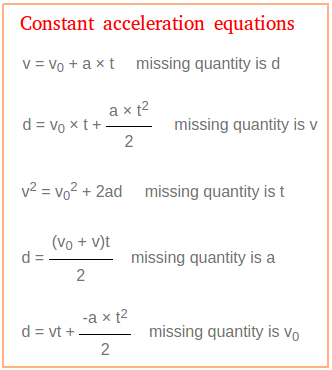
To choose an equation, find the quantity that the problem does not give you and does not ask for. Use the equation where that quantity is missing.
- Given: v0 = 10 m/s, a = 2 m/s2, d = 75 m. Asked: v. The time t is not given and not asked, so use equation 3.
- v2 = 102 + 2 × 2 × 75 = 100 + 300 = 400.
- v = √400 = 20.
The final velocity is 20 m/s.
A ball rolls from rest with an acceleration of 3 m/s2 for 4 seconds. Which equation gives the distance directly, and what is it?
Show answer
Equation 2: 24 m. v is not given or asked. d = 0 × 4 + 3 × 42 ÷ 2 = 48 ÷ 2 = 24.
Any questions about how I derived the constant acceleration equations? Send me an email.
Summary
- Equation 1: v = v0 + at (no d).
- Equation 2: d = v0t + at2/2 (no v).
- Equation 3: v2 = v02 + 2ad (no t).
- Equation 4: d = (v0 + v)t/2 (no a).
- Equation 5: d = vt − at2/2 (no v0).
- Pick the equation that leaves out the quantity you are not given and not asked for.