Acceleration Word Problems
Before you look at these acceleration word problems, you need to make sure you have mastered the topic about velocity.
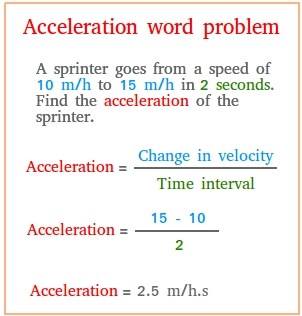
In this lesson, you will learn
- how to find acceleration with the formula: change in velocity divided by time interval
- how to read a unit such as mph/s (miles per hour-second)
- the difference between constant velocity and constant acceleration
- how to compare two accelerations
Problem 1: Find the Acceleration of a Motorcycle
What is the acceleration of a motorcycle moving on a straight path when the speed goes from 0 to 70 miles per hour in 5 seconds?
The motorcycle goes from 0 to 70 mph, so the change in speed is
70 − 0 = 70
It took the motorcycle 5 seconds to reach this velocity, so the time interval is 5 seconds.
Plug these numbers into the formula.
Acceleration =705
Acceleration = 14 mph/s
Do you remember how to read the answer?
We read 14 mph/s as 14 miles per hour-second.
In other words, each second, the speed increases by 14 miles per hour.
- Change in velocity: 18 − 6 = 12 mph.
- Time interval: 4 seconds.
- Acceleration: 124 = 3 mph/s.
The acceleration is 3 mph/s: each second, the speed increases by 3 miles per hour.
Dividing the final speed by the time. Always subtract the starting speed first. For the cyclist, 18 ÷ 4 = 4.5 is wrong; the change in speed is 18 − 6 = 12, so the answer is 3 mph/s.
A car goes from 0 to 60 miles per hour in 6 seconds. What is its acceleration?
Show answer
10 mph/s. The change in velocity is 60 − 0 = 60, and 60 ÷ 6 = 10. Each second, the speed increases by 10 miles per hour.
Problem 2: Constant Velocity or Constant Acceleration?
What is the acceleration of a Honda Accord with a constant velocity of 50 km/h for 20 seconds? Does the car have a constant acceleration?
If the Honda has a constant velocity, this means that the speed is constant and the car is going on a straight path.
Because the speed is constant, the car is not accelerating.
The driver probably put the car on cruise control with a speed of 50 km/h for 20 seconds.
So a = 0.
There is a world of difference between constant acceleration and constant velocity.
Constant acceleration means that the speed is changing. However, it is changing by the same amount each second.
For example, from 10 km/h to 20 km/h in one second, then from 20 km/h to 30 km/h in the next second, etc.
The change in speed is always 10 km/h, so this is a constant acceleration.
Constant velocity on the other hand means that the speed is not changing!
Since the speed is not changing at all, the car is not speeding up or slowing down: its acceleration stays at 0.
A train moves at a steady 80 km/h on a straight track for 2 minutes. What is its acceleration?
Show answer
0. The velocity is constant, so the speed does not change and the train is not accelerating.
Problem 3: Who Speeds Up Faster?
You can speed up from 0 to 25 feet/s in 25 seconds and your brother can speed up from 0 to 6 feet/s in 6 seconds.
Who speeds up faster?
Each second, your speed can increase by 1 foot/second.
If it is hard to see, you can always use the acceleration formula.
Your acceleration
Your acceleration = 25 feet/s25 s
Your acceleration = 1 foot/s2
Your brother's acceleration
Your brother's acceleration = 6 feet/s6 s
Your brother's acceleration = 1 foot/s2
Therefore, neither you nor your brother speeds up faster.
A higher top speed does not mean a bigger acceleration. You reach 25 feet/s and your brother only 6 feet/s, but you both gain 1 foot/s each second. Acceleration compares how fast the speed changes.
Bike A goes from 0 to 12 feet/s in 4 seconds. Bike B goes from 0 to 15 feet/s in 3 seconds. Which bike speeds up faster?
Show answer
Bike B. Bike A: 12 ÷ 4 = 3 feet/s2. Bike B: 15 ÷ 3 = 5 feet/s2, which is bigger.
Problem 4: Your Turn!
I will not solve this acceleration word problem for you.
Two cars are racing on the highway with the same constant acceleration of 10 miles per hour-second. They do this for 12 seconds.
Do you think the cars set their cruise control?
What was the instantaneous speed of the cars at the 5-second mark?
What is the highest instantaneous speed of the cars?
Summary
- Acceleration = change in velocity ÷ time interval. Subtract the starting speed from the final speed first.
- An acceleration of 14 mph/s (14 miles per hour-second) means the speed increases by 14 miles per hour each second.
- Constant velocity means the speed does not change, so the acceleration is 0.
- Constant acceleration means the speed changes by the same amount each second.
- To compare who speeds up faster, compare the accelerations, not the top speeds.
Practice: Solve 5 Acceleration Word Problems
Now solve some problems yourself. Problems 1 and 2 walk you through every step. Problem 3 has fewer steps. In problems 4 and 5, you follow the key steps and find every answer yourself. You can skip a problem at any time, and each time you play you get new problems.
Practice Complete!