Definition of Acceleration
The definition of acceleration is a little more complex than that of the speed or the velocity. Maybe if you clearly see the difference between the two, it will help you to avoid common pitfalls. So what is the difference between speed and acceleration?
In this lesson, you will learn
- the difference between speed and acceleration
- the formula: acceleration = change in speed ÷ time interval
- how to read units like "miles per hour per second"
- why turning a corner at a constant speed is also acceleration
What Is Speed?
The speed is how fast you can get somewhere.
The word somewhere tells you that some distance is involved.
The word fast tells you that time is involved.
For example, let's say that a store is 8 miles away and your Toyota Camry can make it to the store in 10 minutes.
Below are different ways to express the rate or the speed at which the car can cover this distance:
- 8 miles per 10 minutes
- 16 miles per 20 minutes
- 24 miles per 30 minutes
- 48 miles per hour
You can also write 48 miles / 1 hour. And this is where the definition of speed came from.
What Is Acceleration? How Fast the Speed Changes
Now, if you want to know how fast the speed can change to take you to the store, you are talking about acceleration.
Acceleration is how fast the speed changes.
Here is a situation where you will care about the acceleration of your car.
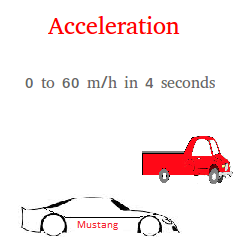
Suppose on your way to the store, there is one last traffic light. You stop at that traffic light, and a Ford Mustang Shelby stops next to you and wants to race you.
You are no match if you are driving a pickup truck that can do 0 to 60 miles per hour in 12 seconds, because the Mustang can do the same in 4 seconds.
See below a description of the acceleration, or how fast the speed of the Mustang and the speed of the truck are changing.
| Time | Speed |
|---|---|
| 1 s | 15 mph |
| 2 s | 30 mph |
| 3 s | 45 mph |
| 4 s | 60 mph |
| Time | Speed |
|---|---|
| 1 s | 5 mph |
| 2 s | 10 mph |
| 3 s | 15 mph |
| 4 s | 20 mph |
| 5 s | 25 mph |
| 6 s | 30 mph |
| 7 s | 35 mph |
| 8 s | 40 mph |
| 9 s | 45 mph |
| 10 s | 50 mph |
| 11 s | 55 mph |
| 12 s | 60 mph |
Every second, the speed of the Mustang increases or changes by 15 miles per hour.
Every second, the speed of the truck increases or changes by 5 miles per hour.
A motorcycle goes from 0 to 60 miles per hour in 6 seconds at a steady rate. By how much does its speed increase each second?
Show answer
10 miles per hour each second. 60 ÷ 6 = 10.
The Formula for Acceleration
You can see that the Mustang increases its speed faster than the truck. We say that it has a greater acceleration, and we can write:
The 15 mph per second is read as "15 miles per hour per second". And this is where the definition of acceleration came from.
For the Mustang
The change in speed is 30 − 15 = 15, or 45 − 30 = 15.
The time interval is 2 − 1 = 1, or 3 − 2 = 1, and so on.
a = 15 mph1 s = 15 mph per second
When advertisers say that a car can go from 0 to 60 in 8 s, they are talking about the car's acceleration, not the speed.
Mixing up speed and acceleration. A car moving at a steady 60 miles per hour has a high speed but no acceleration, because its speed is not changing.
- Change in speed: 8 − 2 = 6 m/s.
- Time interval: 3 s.
- a = 6 m/s3 s = 2 m/s2.
The acceleration is 2 m/s2: the speed increases by 2 m/s every second.
Slowing down is acceleration too. When a car brakes from 30 m/s to 0 in 5 s, its speed changes by 6 m/s every second, in the direction opposite to its motion.
Expanding Our Definition of Acceleration: A Change of Direction
It is not just a change in speed that causes acceleration.
Acceleration can also be caused by changing the direction of motion.
If the road curves, you will feel that your body is trying to move toward the outside of the curve.
You are experiencing acceleration even if your speed is constant.
That is why the definition of acceleration is best described as the change in velocity divided by time.
Acceleration, just like velocity, is directional. A change in either the speed, the direction, or both will cause acceleration.
A car drives around a circular track at a steady 50 km/h. Is it accelerating?
Show answer
Yes. Its speed is constant, but its direction keeps changing, so its velocity changes.
Summary
- Speed is how fast you get somewhere: speed = distance ÷ time.
- Acceleration is how fast the speed changes: a = change in speed ÷ time interval.
- "0 to 60 mph in 4 seconds" describes acceleration, not speed.
- Slowing down is also acceleration.
- Changing direction is acceleration too, even at a constant speed, because the velocity changes.
Test Yourself: 10-Question Quiz
Now check what you learned. Every answer is explained, and each time you play you get new questions.