Cool Math Tricks to Solve Math Problems Quickly
30 Cool Math Tricks
These cool math tricks help you solve basic math problems in your head, with speed and great accuracy. No calculator needed! Each trick comes with worked examples, a short explanation of why it works, and a problem to try yourself.
1Multiply by 9 using your fingers
Even if you know your multiplication table, this trick comes in handy when you have a sudden brain freeze. It works for 9 × 1 through 9 × 10.
Hold up both hands, palms facing you. Starting with your left little finger, number your fingers from 1 to 10, as shown below.
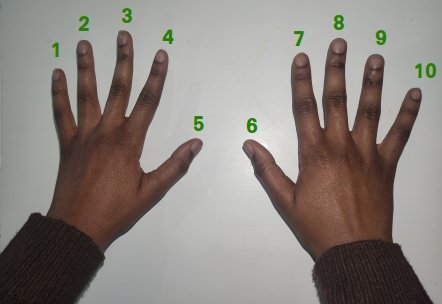
Example 1: 9 × 5
Fold down your fifth finger.
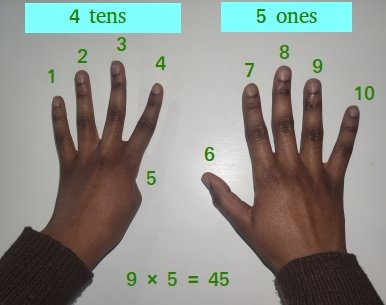
There are 4 fingers to the left of the folded finger and 5 fingers to the right. So 9 × 5 = 45.
Example 2: 9 × 6
Fold down your sixth finger.
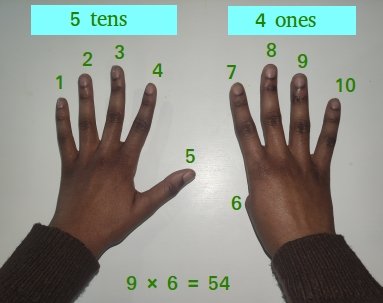
There are 5 fingers to the left of the folded finger and 4 fingers to the right. So 9 × 6 = 54.
Why it works: folding finger n leaves n − 1 fingers on the left and 10 − n on the right. And 9 × n is exactly (n − 1) tens plus (10 − n) ones. For n = 6: 5 tens + 4 ones = 54.
Try it: 9 × 7 (tap for the answer)
Fold down finger 7. There are 6 fingers on the left and 3 on the right, so 9 × 7 = 63.
2Add two-digit numbers from left to right
On paper, most of us add from right to left, and that's fine. But to add two-digit numbers fast in your head, it's easier to work from left to right: add the tens first, then the ones.
Example 3: 56 + 23
Step 1: Rewrite 23 as 20 + 3.
Step 2: Add the tens: 56 + 20 = 76.
Step 3: Add the ones: 76 + 3 = 79.
Example 4: 64 + 35
Step 1: Rewrite 35 as 30 + 5.
Step 2: 64 + 30 = 94
Step 3: 94 + 5 = 99
Why it works: adding tens only changes the tens digit, which is easy to do in your head. Then you only have one small number left to add.
Try it: 47 + 38 (tap for the answer)
47 + 30 = 77, then 77 + 8 = 85.
3Multiply any number by 10, 100, 1,000…
- × 10: write one zero at the end.
- × 100: write two zeros at the end.
- × 1,000: write three zeros at the end.
Example 5: 65 × 10 = 650
Example 6: 14,778 × 1,000 = 14,778,000
Decimals: adding zeros doesn't work for decimals (3.5 × 10 is not 3.50). Instead, move the decimal point one place to the right for each zero: 3.5 × 10 = 35, and 3.5 × 100 = 350.
Why it works: multiplying by 10 makes every digit worth 10 times more, so each digit shifts one place to the left. The new zero fills the empty ones place.
Try it: 230 × 100 (tap for the answer)
Write two zeros at the end: 23,000.
4Square a two-digit number fast
This trick squares a two-digit number much faster than the usual multiplication. The goal is to change the two numbers being multiplied so that one of them ends in zero.
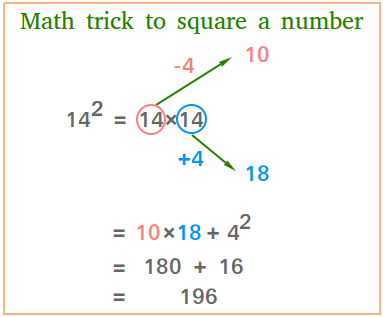
To square 14, subtract 4 from one 14 to get 10, and add 4 to the other to get 18. Multiply 10 × 18 = 180, then add 4² = 16. So 14² = 196.
Why do we add 4²? Multiply out 10 × 18:
10 × 18 = (14 − 4)(14 + 4)
= 14 × 14 + 14 × 4 − 4 × 14 − 4 × 4
= 14² − 4²
So 10 × 18 is 4² less than 14². Adding 4² back gives exactly 14²:
14² = 10 × 18 + 4²
Example 7: 17²
17² = (17 − 7)(17 + 7) + 7²
= 10 × 24 + 49
= 240 + 49 = 289
Try it: 23² (tap for the answer)
Use c = 3: 20 × 26 + 3² = 520 + 9 = 529.
5Multiply 6 by an even number
When you multiply 6 by 2, 4, 6 or 8, the answer follows a pattern:
Example 8: 6 × 8 → ones digit 8, tens digit 4 → 48
6 × 6 → ones digit 6, tens digit 3 → 36
Why it works: 6 × n = 5 × n + n. For an even n, 5 × n is a whole number of tens (n ÷ 2 tens), and the extra n gives the ones digit.
Try it: 6 × 4 (tap for the answer)
Ones digit 4, tens digit 2: 24.
6Multiply any number by 9
Example 9: 18 × 9
Step 1: 18 × 10 = 180
Step 2: 180 − 18 = 162
Why it works: 9 is one less than 10.
18 × 9 = 18 × (10 − 1) = 18 × 10 − 18 = 180 − 18
We use it because multiplying by 10 is easy.
Try it: 37 × 9 (tap for the answer)
370 − 37 = 333.
7Subtract quickly
Suppose you're subtracting 28 from 65. Vertical subtraction works, but when you need an answer fast, there's no time for borrowing and regrouping.
65 − 28: subtract 30 to get 35. You took away 2 too many, so add 2: 37.
Example 10: 461 − 297
461 − 300 = 161
161 + 3 = 164
Done in a snap, with no borrowing at all.
Try it: 83 − 49 (tap for the answer)
83 − 50 = 33, then 33 + 1 = 34.
8Square a two-digit number ending in 1
41²: subtract 1 to get 40.
40² + 40 + 40 + 1 = 1,600 + 80 + 1 = 1,681
Example 11: 61²
61² = 60² + 60 + 60 + 1 = 3,600 + 120 + 1 = 3,721
Why it works: (a + 1)² = a² + 2a + 1. When a ends in zero, a² and 2a are both easy to find in your head.
Try it: 71² (tap for the answer)
70² + 140 + 1 = 4,900 + 140 + 1 = 5,041.
9Quickly test if a number is divisible by 2 to 10
Need to know whether something can be shared evenly between 2, 3, 4… or 10 people? Skip the long division and use the divisibility rules:
| By | A number is divisible if… |
|---|---|
| 2 | its last digit is even (0, 2, 4, 6 or 8) |
| 3 | the sum of its digits is divisible by 3 |
| 4 | its last two digits form a number divisible by 4 |
| 5 | its last digit is 0 or 5 |
| 6 | it is divisible by both 2 and 3 |
| 7 | doubling the last digit and subtracting it from the rest of the number gives a multiple of 7 |
| 8 | its last three digits form a number divisible by 8 |
| 9 | the sum of its digits is divisible by 9 |
| 10 | its last digit is 0 |
Example 12
Can you share $4,557 evenly between you and your two sisters?
That's 3 people, so check divisibility by 3.
4 + 5 + 5 + 7 = 21, and 21 is divisible by 3.
So the answer is yes.
Try it: Is 1,236 divisible by 6? (tap for the answer)
It's even, so it's divisible by 2. Its digits add up to 1 + 2 + 3 + 6 = 12, which is divisible by 3. Divisible by both 2 and 3 means yes (1,236 ÷ 6 = 206).
10Divide without long division
Example 13: 4,557 ÷ 3
3 × 1,500 = 4,500, so take 4,500 first.
That leaves 4,557 − 4,500 = 57.
3 × 19 = 57
4,557 ÷ 3 = 1,500 + 19 = 1,519
So each person in Example 12 gets $1,519.
Try it: 2,568 ÷ 4 (tap for the answer)
4 × 600 = 2,400, leaving 168. And 4 × 42 = 168. So 2,568 ÷ 4 = 600 + 42 = 642.
22 more cool math tricks
Each trick below has its own lesson with examples.
- Multiplying by powers of ten
- Multiplication by 11
- Squaring numbers ending with five
- Finger multiplication
- Number trick with 1089
- Compensation
- Square root trick when the number ends with 25
- Multiply 999 by 5 in 2 seconds or less
- Divide 999 by 5 in 2 seconds or less
- Multiply a repdigit number by a single-digit number
- Multiply 3-digit numbers having a zero in the tens place
- Solve a system of two linear equations in 15 seconds
- Multiply a two-digit number by 101 in one second
- Square a 3-digit number when the middle digit is zero
- Find 5 percent of any number in 4 seconds
- Divide any 3-digit number by 99
- Sum of consecutive odd numbers
- Sum of consecutive even numbers
- Square numbers from 50 to 59
- Divide any number by 5 in 2 seconds or less
- Math mind reader
- How to solve some basic math puzzles