Algebra Proofs
Many algebra proofs use proof by mathematical induction. To show the power of mathematical induction, we will prove an algebra equation and a geometry formula with it.
New to induction? Study proof by mathematical induction carefully first. Otherwise, you may struggle with the proofs below.
In this lesson, you will learn
- The three steps of a proof by mathematical induction
- How to prove that 1 + 2 + 4 + … + 2n − 1 = 2n − 1
- How to prove that the angles of an n-gon add up to (n − 2) × 180°
- Why checking a few values of n is not a proof
The Three Steps of Proof by Induction
Both proofs below follow these steps.
- The first case: show that the statement is true for the first value of n.
- The assumption: suppose the statement is true for n = k.
- The next case: use step 2 to prove that it is also true for n = k + 1.
Checking that a statement works for a few values of n, such as n = 1, 2 and 4, is not a proof. Step 3 is what makes it true for every n.
In step 2, what do you suppose?
Show answer
That the statement is true for n = k. This is called the hypothesis, and you use it in step 3.
Proof 1: An Algebra Equation
Prove by mathematical induction that
Step 1: Show that the equation is true for n = 1
n = 1 means taking only the first term, 1.
Left side: 1
Right side: 21 − 1 = 2 − 1 = 1
Both sides equal 1, so the equation is true for n = 1.
Just for fun, let’s check n = 2 and n = 4 too:
n = 2: 1 + 2 = 3 and 22 − 1 = 4 − 1 = 3
n = 4: 1 + 2 + 4 + 8 = 15 and 24 − 1 = 16 − 1 = 15
Step 2: Suppose the equation is true for n = k
Just replace n with k. This is called the hypothesis:
1 + 2 + 4 + 8 + … + 2k − 1 = 2k − 1
Step 3: Prove that it is true for n = k + 1
First, write down what it means for the equation to be true for n = k + 1. Replace k with k + 1:
1 + 2 + 4 + 8 + … + 2k + 1 − 1 = 2k + 1 − 1
1 + 2 + 4 + 8 + … + 2k = 2k + 1 − 1
Writing down what it means is not the same as proving it. It only shows you what you need to prove.
Now start with the hypothesis from step 2 and ask yourself: “What does the next term look like?” The last term is 2k − 1, so the next term is 2k.
Add 2k to both sides of the hypothesis:
1 + 2 + 4 + 8 + … + 2k − 1 + 2k = 2k − 1 + 2k
The trick is to see that 2k + 2k = 2 × 2k = 21 × 2k = 2k + 1. So the right side becomes:
2k − 1 + 2k = 2 × 2k − 1 = 2k + 1 − 1
This is exactly what we needed to prove, so 1 + 2 + 4 + … + 2n − 1 = 2n − 1 for every n ≥ 1.
Use the formula to find 1 + 2 + 4 + 8 + … + 512.
Show answer
1,023. The last term is 512 = 29, so n − 1 = 9 and n = 10. The sum is 210 − 1 = 1,024 − 1 = 1,023.
Proof 2: A Geometry Formula
Show by mathematical induction that
Two observations before the proof
Observation 1: an n-gon is a closed figure with n sides. For example, an n-gon with 3 sides is a triangle, and an n-gon with 4 sides is a quadrilateral.
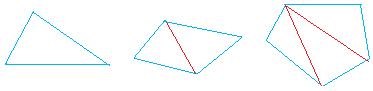
Observation 2: look closely at the figure above. Every time you add a side, you also add one more triangle.
Step 1: Show that the formula is true for n = 3
n cannot be smaller than 3, because you cannot make a closed figure with only one or two sides.
When n = 3, the figure is a triangle, and the angles of a triangle add up to 180°:
(3 − 2) × 180° = 1 × 180° = 180°
When n = 4, you add one more triangle, so you have two triangles, and their angles add up to 360°:
(4 − 2) × 180° = 2 × 180° = 360°
So the formula is true for n = 3 and n = 4.
Step 2: Suppose the formula is true for n = k
Just replace n with k. This is the hypothesis:
The sum of the angles in a k-gon = (k − 2) × 180°
Step 3: Prove that it is true for n = k + 1
Write down what it means for the formula to be true for n = k + 1. Replace k with k + 1:
The sum of the angles in a (k + 1)-gon = (k + 1 − 2) × 180°
The sum of the angles in a (k + 1)-gon = (k − 1) × 180°
Start with the hypothesis and ask yourself: “What does the next figure look like?” The next figure has k + 1 sides.
Recall that adding one side also adds one triangle, and the angles of a triangle add up to 180°:
(k + 1)-gon = k-gon + one more triangle
angles of a (k + 1)-gon = angles of a k-gon + 180°
So add 180° to both sides of the hypothesis:
The sum of the angles in a (k + 1)-gon = (k − 2) × 180° + 180°
= 180°k − 2 × 180° + 180°
= 180°k − 1 × 180°
= (k − 1) × 180°
This is exactly what we needed to prove, so the sum of the angles in an n-gon is (n − 2) × 180° for every n ≥ 3.
- A hexagon has 6 sides, so n = 6.
- Use the formula: (6 − 2) × 180° = 4 × 180°.
- 4 × 180° = 720°. This matches the figure idea: a hexagon splits into 4 triangles, and 4 × 180° = 720°.
The angles of a hexagon add up to 720°.
What is the sum of the angles in an octagon (8 sides)?
Show answer
1,080°. (8 − 2) × 180° = 6 × 180° = 1,080°.
Summary
- A proof by induction has three steps: the first case, the assumption for n = k, and the proof for n = k + 1.
- Checking a few values of n is not a proof; step 3 makes the statement true for every n.
- Writing down what n = k + 1 means only shows what you need to prove.
- To prove 1 + 2 + 4 + … + 2n − 1 = 2n − 1, add the next term 2k to both sides and use 2k + 2k = 2k + 1.
- To prove that the angles of an n-gon add up to (n − 2) × 180°, use the fact that each new side adds one triangle, or 180°.
More Proofs and Logic
Keep exploring reasoning and proof.
Proof by Mathematical Induction
The method used in both proofs on this page, explained step by step.
Examples of Inductive Reasoning
See how we make general conclusions from patterns.
Law of Detachment
Learn this basic rule of logical reasoning.
Proof That the Square Root of 5 Is Irrational
Prove that √5 cannot be written as a fraction.
No Rational Number Has a Square of 2
Prove that no fraction squared equals 2.
Rational + Irrational Is Irrational
Prove that the sum of a rational number and an irrational number is irrational.
Proof of the Pythagorean Theorem
See why a2 + b2 = c2 in every right triangle.
Proof of the Quadratic Formula
Derive the quadratic formula step by step.