Law of Detachment
Below see the law of detachment and some concrete examples to illustrate the law.
In this lesson, you will learn
- what a conditional statement is, and how to write it as p → q
- what the law of detachment says, and how to use it to reach a conclusion
- why the conditional must be true, and why knowing the conclusion is not enough
A Real-Life Example of the Law of Detachment
No one needs to be a rocket scientist to know that if the battery of a car is dead, then the car will not start. This is knowledge that most of us have.
Now suppose a mechanic comes to your house, checks the battery in your car and tells you that the battery is dead. What conclusion will you make? You will make the conclusion that your car will not start.
The statement "If the battery of a car is dead, then the car will not start" is a conditional statement.
Let p = the battery of a car is dead.
Let q = the car will not start.
We can write the conditional above as p → q
p → q is read "if p, then q."
In a conditional "if p, then q," the part after "if" (p) is the hypothesis, and the part after "then" (q) is the conclusion.
In the conditional "If it snows, then school is closed," which part is the hypothesis?
Show answer
It snows. The hypothesis is the part after "if." "School is closed" is the conclusion.
The Law of Detachment
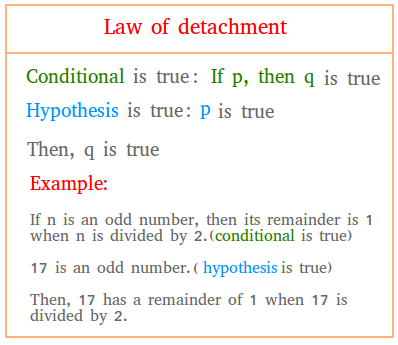
If a conditional is true and its hypothesis is true, then its conclusion is true.
In symbolic form, if p → q is a true statement and p is true, then q is true.
Let us apply this to our example above.
p → q is a true statement since we all know that if the battery of a car is dead, the car will not start. Moreover, the mechanic checked your car and found that the battery is dead. This means that p is true.
Therefore, you can conclude that q is true.
You need two true facts before you can "detach" the conclusion: the conditional p → q, and the hypothesis p.
Important Warning: The Conditional Must Be True
It is important to make sure that the conditional is true before using the law of detachment. Otherwise, you could end up making the wrong conclusion. Here is an example.
If a car needs brake pads, then the car will not start.
A mechanic discovers that the car needs brake pads.
Conclusion: the car will not start.
This conclusion is wrong, because the conditional is false: worn brake pads do not stop a car from starting.
Therefore, always make sure that the conditional is true.
Knowing that the conclusion q is true does not tell you that p is true. "If a car's battery is dead, then the car will not start" is true, but if a car will not start, the battery might be fine and the tank might be empty. The law of detachment only works from p to q.
"If a number is divisible by 4, then it is even." You know that 10 is even. Can you conclude that 10 is divisible by 4?
Show answer
No. 10 being even is the conclusion, not the hypothesis, so the law of detachment does not apply. In fact, 10 is not divisible by 4.
Examples of the Law of Detachment in Geometry and Algebra
- Check the conditional: the angles of every triangle add up to 180 degrees, so it is true.
- Check the hypothesis: we are told that figure ABC is a triangle, so p is true.
- Both are true, so the law of detachment lets you state the conclusion for figure ABC.
Then, the sum of the angles in figure ABC is equal to 180 degrees.
2) If n is an even number, then it is divisible by 2.
4834 is an even number.
Then, 4834 is divisible by 2.
3) If the sum of two angles is equal to 90 degrees, then the angles are complementary.
Angle x is equal to 30 degrees and angle y is equal to 60 degrees.
Then, angle x and angle y are complementary.
4) If x and y are odd numbers, then x + y is an even number.
5 and 7 are odd numbers.
Then, 12 is an even number.
If two angles are vertical angles, then they are congruent. Angles 1 and 2 are vertical angles. What can you conclude?
Show answer
Angles 1 and 2 are congruent. The conditional is true and its hypothesis is true, so the conclusion is true.
Summary
- A conditional statement has the form "if p, then q," written p → q. The part p is the hypothesis and q is the conclusion.
- Law of detachment: if p → q is true and p is true, then q is true.
- Always check that the conditional is true first. A false conditional can lead to a wrong conclusion.
- Knowing that q is true does not let you conclude that p is true.
This figure gives a summary of the law of detachment.
Test Yourself: 10-Question Quiz
Now check what you learned. Every answer is explained, and each time you play you get new questions.
Quiz Complete!
Keep learning