Velocity: Definition and Real-Life Examples
Velocity is not exactly the same as speed. Keep reading to see the difference between the two.
In this lesson, you will learn
- the difference between speed and velocity
- what constant velocity means
- why an object moving in a circle never has a constant velocity
What Is the Difference Between Speed and Velocity?
The speed is just how fast a car is moving, without taking into consideration its direction. If you are looking at the speedometer and you see 50 mph, this is just the speed of the car that you are driving.
You must have both speed and direction in order to have velocity.
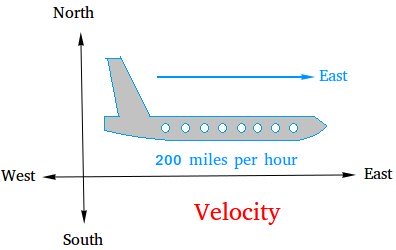
- If an airplane travels 200 miles per hour, we are talking about its speed.
- If an airplane travels 200 miles per hour to the east, we are talking about its velocity.
A train moves at 80 km/h toward the north. What is its speed, and what is its velocity?
Show answer
Speed: 80 km/h. Velocity: 80 km/h north. The velocity includes the direction.
Definition of Constant Velocity
A velocity is constant if the following two conditions are met:
- The speed is constant.
- The direction is constant.
Constant speed means that the object is moving at the same speed, or does not go faster or slower.
Constant direction means that the path is a straight line, traveled one way.
It may make sense to you why the object should not move faster or slower in order to have constant speed.
It might not make sense why the path should be a straight line.
Simply put, if the path is not a straight line, the direction will change.
For example, because the path is not completely straight, the green dot below changes direction 2 times.

The first time the direction changes is on the blue line, and the second time is on the black line.
A car drives on a straight road at a steady 60 mph, always heading north. Does it have a constant velocity?
Show answer
Yes. Its speed and its direction both stay the same.
Why Circular Motion Never Has a Constant Velocity
The same thing will happen if the path is a circle. The direction will change constantly.
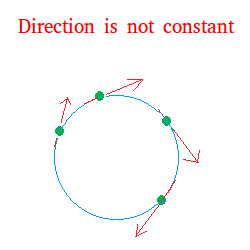
You can see from the figure above that the green dot is moving in a different direction at every point of the circle.
Any object moving on a circular path will never have a constant velocity, because the direction of the object changes every instant. However, the object may have constant speed.
Notice that from the definition of velocity, you can see that a velocity is changing whenever the speed, the direction, or both are changing.
Again, even if an object moves at constant speed around a curved path, it does not move at constant velocity.
Thinking that a constant speed means a constant velocity. A runner going around a track at a steady 5 m/s has a constant speed, but her velocity keeps changing because her direction keeps changing.
- Compare the speeds: both are 60 mph, so the speeds are the same.
- Compare the directions: east and west are different.
- Velocity needs both the same speed and the same direction.
No. They have the same speed but different velocities.
A Real-Life Example: Speedometer, Cruise Control and Compass
When you are looking at your speedometer and you see 65 miles per hour, and your car is on cruise control, you are seeing constant speed.
You are not seeing velocity, since the speedometer does not know your direction.
Some cars are equipped with a compass. If you combine your speedometer with the reading on the compass, you can tell that you have constant velocity when you are on cruise control and heading straight in the same direction.
Speedometer = speed. Speedometer + compass = velocity.
Summary
- Speed is how fast an object moves. Velocity is speed together with direction.
- A velocity is constant only if both the speed and the direction stay the same: a straight path at a steady speed.
- The velocity changes when the speed changes, the direction changes, or both.
- An object moving in a circle can have a constant speed, but never a constant velocity.
Test Yourself: 10-Question Quiz
Now check what you learned. Every answer is explained, and each time you play you get new questions.