Free Fall Equations
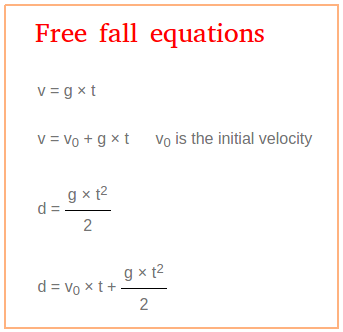
The free fall equations are shown below for free falling objects. In order for you to understand how we found these equations, it is important to understand speed, acceleration, free fall, and acceleration due to gravity.
You may need to carefully review the lessons about speed and acceleration.
In this lesson, you will learn
- what free fall is, and why air resistance matters
- how to find the acceleration due to gravity, g
- the equations for how fast a falling object moves: v = g × t and v = v0 + g × t
- the equations for how far it falls: d = g × t2/2 and d = v0 × t + g × t2/2
What Is Free Fall?
Whenever an object is dropped in the air from a certain height, this object is falling. The object is not experiencing free fall just yet. Why do we say so?
If you drop a feather and a piece of rock from the second floor of a house or building, the rock will have a greater acceleration and get to the ground faster.
This happens because of air resistance. However, if you put the feather and the rock in a tube and remove the air with a vacuum pump, the feather and the rock will have the same acceleration.
Objects experience free fall when there is no air resistance or when air resistance is negligible.
Now, it makes sense why we say free fall equations. It is because they are found when objects are affected only by gravity, and air resistance is negligible.
Thinking that heavier objects always fall faster. In free fall, with no air resistance, a feather and a rock have the same acceleration and land at the same time.
A feather and a coin are dropped at the same time inside a tube with all the air pumped out. Which one lands first?
Show answer
They land at the same time. With no air resistance, both are in free fall and have the same acceleration.
Finding the Acceleration Due to Gravity
Now, let us try to find the acceleration due to gravity only.
If you could drop a rock from the top of a very tall tower and equip the rock with a speedometer that can record the instantaneous speed during each second, you would end up with the following data:
| Elapsed time (s) | Instantaneous speed (m/s) |
|---|---|
| 0 | 0 |
| 1 | 10 |
| 2 | 20 |
| 3 | 30 |
| 4 | 40 |
| 5 | 50 |
| 6 | 60 |
| t | 10t |
Remember that the formula to find the acceleration is
Acceleration between 3 s and 4 s
acceleration = 40 − 304 − 3 = 10 m/s1 s
The acceleration is 10 m/s2.
10 m/s2 is read "10 meters per second squared".
Where did the exponent of 2 come from? A little bit of math may help.

If you did not understand the math above, visit the lesson about dividing fractions.
Since the acceleration is due to gravity, we use g and write g = 10 m/s2. Keep in mind, though, that g is not exactly the same everywhere on Earth.
More accurately, g = 9.8 m/s2. In this lesson, we round it to 10 m/s2 to keep the numbers simple.
A falling ball's speed goes from 20 m/s to 50 m/s in 3 seconds. What is its acceleration?
Show answer
10 m/s2. (50 − 20) ÷ 3 = 30 ÷ 3 = 10.
Free Fall Equations: How Fast?
From the data, we see that 20 m/s = 10 m/s2 × 2 s, or 50 m/s = 10 m/s2 × 5 s.
In general:
If the object is thrown straight down with an initial velocity, the equation is the following, where v0 is the initial velocity:
When an object is thrown upward, or straight up, with an initial velocity, the object is still subject to gravity. Moreover, the speed will decrease until it reaches 0.
Therefore, the speed will decrease by 10 m/s each second: v = v0 − g × t on the way up.
When the highest point is reached and the speed is 0, the object will start going down, and its speed will increase by 10 m/s each second.
- On the way up, the speed decreases by 10 m/s each second: 30, then 20, then 10, then 0 m/s.
- With the formula: v = 30 − 10 × t. At the top, v = 0, so 10 × t = 30 and t = 3.
The ball reaches its highest point after 3 seconds.
A stone is dropped from a cliff. How fast is it falling after 4 seconds? (Use g = 10 m/s2.)
Show answer
40 m/s. v = g × t = 10 × 4 = 40.
We have found two free fall equations so far dealing with how fast. What about how far the object moves?
Free Fall Equations: How Far?
Recall that average speed = total distancetotal time, so
How do we find the average speed? Using our data, what is the average speed from 0 to 10 m/s?
For any object moving in a straight path with constant acceleration, we find the average speed the same way we find the average of two numbers. So, the average speed between 0 and 10 m/s is
Average speed = 0 + 10 m/s2 = 5 m/s
In general, average speed = initial speed + final speed2
To get the speed at any instant, we can use v = g × t. Thus, the same formula can be used to get the final speed.
average speed = 0 + g × t2 = g × t2
Multiply the average speed by the total time, or t:
Distance = g × t × t2
If there is an initial velocity (the object is thrown straight down):
Multiplying g by t instead of t2. After 3 seconds, a dropped object has fallen 10 × 32 ÷ 2 = 45 m, not 10 × 3 ÷ 2 = 15 m.
- The rock is dropped, so v0 = 0 and d = g × t22.
- Square the time: 32 = 9.
- d = 10 × 9 ÷ 2 = 45.
The bridge is about 45 m above the water.
How far does a dropped ball fall in 2 seconds? (Use g = 10 m/s2.)
Show answer
20 m. d = 10 × 22 ÷ 2 = 10 × 4 ÷ 2 = 20.
Summary
- Free fall means only gravity acts on an object: there is no air resistance, or it is negligible.
- The acceleration due to gravity is g ≈ 9.8 m/s2, often rounded to 10 m/s2.
- How fast: v = g × t, or v = v0 + g × t if the object is thrown straight down.
- Thrown straight up, the speed decreases by g each second until it reaches 0 at the highest point.
- How far: d = g × t2/2, or d = v0 × t + g × t2/2.
Test Yourself: 10-Question Quiz
Now check what you learned. Every answer is explained, and each time you play you get new questions.