Introduction to Fractions
In this lesson, you will learn
- What a fraction is, and what the numerator and the denominator tell you
- How to find equivalent fractions and write a fraction in simplest form
- How fractions show addition, ratios and division
- How benchmark fractions and everyday problems use fractions
What Are Fractions?
Fractions are used to indicate the number of parts of a whole. Suppose you go to Domino's pizza and order a medium pizza. If your pizza has 8 slices and you did not eat the whole pizza, this means that parts of the whole pizza will be left in the pizza box.
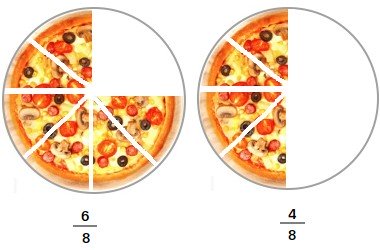
The pizza on the left shows six-eighths (68) and the pizza on the right shows four-eighths (48).
68 and 48 are called fractions.
The top number is the numerator of the fraction and it tells us how many slices are left.
The bottom number is the denominator of the fraction and it tells us how many equal slices there are in total.
Similarly, suppose a rectangle has 4 equal parts and we shade 1 part of the rectangle. The fraction is 14.
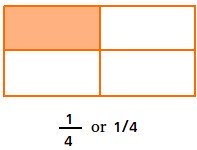
Notice that a forward slash (/) or a horizontal line may be used to separate the numerator from the denominator. Because the horizontal line is more appealing, we prefer to use it instead of a forward slash.
A bar is cut into 5 equal parts and 2 parts are shaded. What fraction of the bar is shaded?
Show answer
25. The bar has 5 equal parts, so the denominator is 5. 2 parts are shaded, so the numerator is 2.
Interactive Fraction Explorer: Build Your Own Fraction
Click on any fraction or create your own to see how it looks as a part of the whole!
Tap a slice to shade up to it.
Make an equivalent fraction
Equivalent Fractions
Now, take a look at the figure below. You can clearly see that six-eighths (68) of a whole pizza is the same as three-fourths (34) of a whole pizza.
68 and 34 are equivalent fractions. Although 68 and 34 have different numerators and different denominators, they are equal.
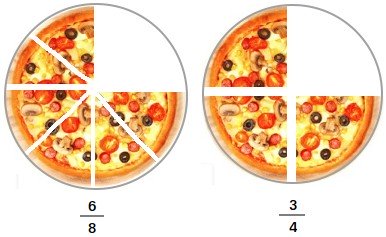
In fact, 68 = 34 = 0.75
More examples of equivalent fractions
Are 23 and 46 equivalent fractions?
Show answer
Yes. Multiply the numerator and the denominator of 23 by 2: 2 × 2 = 4 and 3 × 2 = 6.
Higher Terms and Lower Terms of Fractions
Notice that to get from 12 to 48, all we need to do is to multiply both the numerator and the denominator of 12 by the same number, 4.
In the same way, to get from 13 to 515, we can multiply both the numerator and the denominator of 13 by 5.
48 and 515 are called higher terms of 12 and 13 respectively.
Be careful! 48 is not bigger than 12 and 515 is not bigger than 13.
48 is a higher term of 12 only because it has a bigger numerator and a bigger denominator. However, we saw before that 12 and 48 are equivalent fractions since 12 = 48 = 0.5
Notice too that you can go from a higher term to a lower term. For instance, to bring 515 to a lower term, all you need to do is to divide both numerator and denominator by 5. You will get 13.
Simplifying a fraction is the process of going from higher terms to lower terms. To get the simplest form of a fraction, divide the numerator and the denominator by the greatest common factor (GCF) or the largest number that divides into both numerator and denominator evenly.
For instance, to bring 1040 to its simplest form, divide both 10 and 40 by 10. You will get 14.
12 and 13 are the lowest terms of 48 and 515 respectively.
- List the factors of 12: 1, 2, 3, 4, 6, 12.
- List the factors of 18: 1, 2, 3, 6, 9, 18.
- The greatest common factor is 6.
- Divide both numbers by 6: 12 ÷ 6 = 2 and 18 ÷ 6 = 3.
1218 = 23 in simplest form.
Write 812 in simplest form.
Show answer
23. The greatest common factor of 8 and 12 is 4, and 8 ÷ 4 = 2 and 12 ÷ 4 = 3.
Adding Fractions
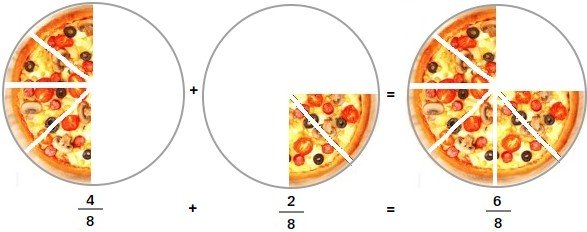
When the fractions have a common denominator (same denominator), add the numerators and keep the same denominator.
Notice that 12 = 48 and 14 = 28. Therefore, 12 + 14 = 48 + 28 = 68.
If the denominators are not the same, you will need to look for the least common multiple (LCM) of the denominators. See adding fractions for more explanations.
Adding the denominators too. 48 + 28 is not 616. The slices are still eighths, so the denominator stays 8.
Add: 27 + 37
Show answer
57. The denominators are the same, so add the numerators: 2 + 3 = 5, and keep the denominator 7.
Using Fractions to Show Ratios
You can use a fraction to show a ratio. In a ratio, the numerator shows the part of a group you are considering and the denominator shows the rest of the group or the whole group.
Suppose a class has 6 boys and 10 girls. What is the ratio of boys to girls? In this example, the numerator is the number of boys and the denominator is the rest of the group or the number of girls.
What is the ratio of girls to the total number of students? In this case, the numerator is the number of girls and the denominator is the whole group or the total number of students.
In the same class of 6 boys and 10 girls, what is the ratio of boys to the total number of students?
Show answer
616. The numerator is the number of boys, 6, and the denominator is the whole group: 6 + 10 = 16 students.
Using Fractions to Show Division
A fraction can also be used to represent division.
You can then write the fraction as a decimal. For example, 45 = 4 ÷ 5 = 80100 = 0.8
Write 15 as a division and as a decimal.
Show answer
1 ÷ 5 = 0.2. 15 = 20100 = 0.2
Benchmark Fractions
Benchmark fractions are fractions that are used a lot in basic math and they are also helpful in picturing other fractions.
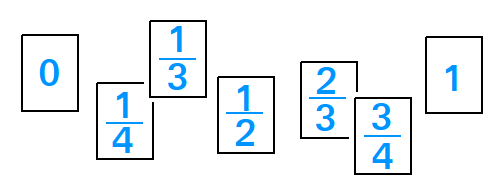
With benchmark fractions, you can do the following:
- Quickly compare and order fractions. For example, 23 is bigger than 14.
- Round fractions and mixed numbers. For example, 34 rounds up to 1 since it is closer to 1 than to 0.
- Estimate sums and differences of fractions and mixed numbers. For example, 34 + 13 is bigger than 1 since 13 is bigger than 14.
Is 23 + 12 bigger or smaller than 1?
Show answer
Bigger. 12 + 12 = 1, and 23 is bigger than 12.
A Couple of Examples Showing How Fractions Are Used in Everyday Life
1Cooking
If you cook a lot by following a recipe, then you must have used fractions a lot before.
Suppose a recipe says to use 12 tablespoons of sugar to make a cake weighing 3 pounds. How much sugar will you use for a one-pound cake?
Since you are making 13 of the whole cake, you may reason that you need to use 13 of 12 tablespoons.
2Giving medication
Nurses and pharmacists must absolutely be good at fractions in order to give patients the correct dosage of a medication. Suppose the dosage strength of a medication is 100 mg. If the doctor orders 25 mg, how many tablets will you give? Nurses and pharmacists may need the following formula to solve this problem.
Nurses and pharmacists must know that 25100 and 14 are equivalent fractions so they can give 14 of the tablet to the patient.
In the cooking example, how many tablespoons of sugar do you need for the one-pound cake?
Show answer
4 tablespoons. 13 of 12 tablespoons = 12 ÷ 3 = 4 tablespoons.
Summary
- A fraction shows parts of a whole. The denominator tells how many equal parts there are, and the numerator tells how many parts we have.
- Equivalent fractions have different numbers but the same value, like 68 = 34.
- Multiply the numerator and the denominator by the same number to get higher terms. Divide them by their greatest common factor to get the simplest form.
- To add fractions with the same denominator, add the numerators and keep the denominator.
- A fraction can show a ratio or a division: 45 = 4 ÷ 5 = 0.8.
- Benchmark fractions such as 14, 12 and 34 help you compare, round and estimate.
Test Yourself: Interactive 10-Question Quiz
Now check what you learned. You won’t need paper or a pencil. Every answer is explained, and each time you play you get new questions.
Quiz complete!