Interactive Step-by-Step Guide for Adding Fractions with Visual Models
In this lesson, you will learn
- why you cannot add the denominators when you add fractions
- how to add fractions that have the same denominator
- how to find a common denominator when the denominators are different
- how to check your work with the step-by-step fraction addition tool
Fraction Addition
See, understand, and master adding fractions with visual models
Use numerators from 0 to 100 and denominators from 1 to 100.
Four Things to Know When Adding Fractions
When adding fractions there are four important things you need to know and it is very important to keep these in mind to avoid common pitfalls. You could take the interactive fraction quiz to see how much you know!
- You cannot add the denominators, also called bottom numbers!
- You can only add the numerators, also called top numbers!
- You can add the numerators only when the denominators are the same!
- If the denominators are not the same, look for a common denominator before adding the numerators.
Why Can't You Add The Denominators When Adding Fractions?
Let's illustrate why it does not make sense to add the denominators using an easy example. The figure below shows the wrong way to add 1 / 2 and 1 / 2. This mistake is quite common when learning fractions for the first time!
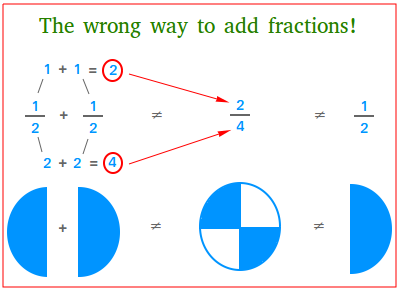
According to the figure above, if you could add the denominators, it would mean that adding half and half will still give half. Does this make sense? Of course not!
We all know that half a pizza plus another half of the same pizza is equal to 1 pizza as the following figure shows.
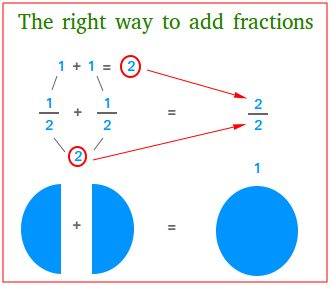
What have we learned so far?
- You can only add the numerators when the denominators are the same for both fractions.
- Since we don't add the denominators, the denominator stays the same.
Therefore, 1/2 + 1/2 = 1
Example #1
Add: 3/2 and 1/2
Observe that both fractions have the same denominator, which is 2. This means you can add the numerators (3 + 1 = 4) and your denominator will stay the same.
What Do We Do Then When Adding Fractions With Different Denominators?
When the denominators are different, you need to find equivalent fractions that give a common denominator for both fractions. All you need to do is to look for the least common multiple (LCM) of the denominators.
Example #2: 23 + 36
Did you make the following observations for example #2 below?
- The denominator is not the same for both fractions, so we cannot add 2 and 3 to get 5.
- You need to look for a common denominator and then you can add the numerators.
- Since 6 is the least common multiple of 3 and 6, you can use 6 as a common denominator.
- Multiply the numerator and the denominator of 2 / 3 by 2, you will get 4 / 6
Example #3: 35 + 24
Notice that it is not easy to multiply one denominator by a number to get the second denominator as we did before in example #2.
As a rule of thumb, when the denominators do not have any common factor(s), you can just multiply them to get a common denominator. Since 4 and 5 have no common factors, the common denominator is 4 times 5 = 20.
Test Yourself: Interactive 10-Question Quiz
Now check what you learned. You won’t need paper or a pencil. Every answer is explained, and each time you play you get a new mix of questions.
Your score