Laws of Exponents
The laws of exponents help us to simplify terms containing exponents. We derive these laws here using some good examples.
In this lesson, you will learn
- why you add the exponents to multiply powers with the same base
- why you subtract the exponents to divide powers with the same base
- why you multiply the exponents to raise a power to a power
- how to use the three laws together to simplify a problem
Law 1: Multiplying Powers with the Same Base
A little reminder before we derive these laws of exponents:
Recall that 2 × 2 × 2 = 23. We call 2 the base and 3 the exponent.
Let us now try to perform the following multiplication: 23 × 22
Multiply by writing out every factor
23 × 22 = (2 × 2 × 2) × (2 × 2) = 2 × 2 × 2 × 2 × 2 = 25
Notice that we can get the same answer by adding the exponents: 3 + 2 = 5.
In the same way,
Another example
43 × 44 = (4 × 4 × 4) × (4 × 4 × 4 × 4) = 47
In general, add exponents to multiply numbers with the same base.
Law #1: an × am = an + m
If a stands for any number, a × a × a × a = a4.
By the same token, if a stands for any number, a × a × a × a × a × a × a = a7.
a4 × a7 = a4 + 7 = a11
Multiplying the bases too. 23 × 22 is 25, not 45. The base stays the same: you are still multiplying 2s, just more of them. Also, the law only works when the bases are the same: 23 × 32 can't be written as one power.
Simplify 34 × 35.
Show answer
39. Same base, so add the exponents: 4 + 5 = 9.
Law 2: Dividing Powers with the Same Base
Let's do 5855.
Write out every factor
5855 = 5 × 5 × 5 × 5 × 5 × 5 × 5 × 55 × 5 × 5 × 5 × 5
Rewrite the problem: 5 × 5 × 5 × 5 × 55 × 5 × 5 × 5 × 5 × 5 × 5 × 5
Notice that 5 × 5 × 5 × 5 × 55 × 5 × 5 × 5 × 5 = 1.
The reason for this is that whenever you divide a number (other than 0) by itself, the answer is always 1.
The problem becomes 1 × 5 × 5 × 5 = 5 × 5 × 5 = 53.
Notice that you can get the same answer if you do 8 − 5 = 3.
Let's also do 71579.
Write out every factor
71579 = 7 × 7 × 7 × 7 × 7 × 7 × 7 × 7 × 7 × 7 × 7 × 7 × 7 × 7 × 77 × 7 × 7 × 7 × 7 × 7 × 7 × 7 × 7
Rewrite the problem: 7 × 7 × 7 × 7 × 7 × 7 × 7 × 7 × 77 × 7 × 7 × 7 × 7 × 7 × 7 × 7 × 7 × 7 × 7 × 7 × 7 × 7 × 7
Notice once again that the fraction with nine 7s on top and nine 7s at the bottom is equal to 1, because a number divided by itself is 1.
The problem becomes 1 × 7 × 7 × 7 × 7 × 7 × 7 = 76.
Notice that you can get the same answer if you do 15 − 9 = 6.
In general, when dividing with exponents, you can just subtract the exponent of the denominator from the exponent of the numerator.
Law #2: aman = am − n
The base a can't be 0, because you can't divide by 0.
What about 79715?
It is the same problem as before. However, this time 9 is on top and 15 is at the bottom. We can just use the formula:
79715 = 79 − 15 = 7−6
A negative exponent means "one over". Write out the factors: nine 7s on top cancel nine of the fifteen 7s at the bottom, and six 7s stay at the bottom. So 7−6 = 176.
Dividing the exponents or the bases. 5855 is 53: subtract the exponents and keep the base. It is not 58 ÷ 5, and it is not 13.
Simplify 107103.
Show answer
104. Same base, so subtract the exponents: 7 − 3 = 4.
Law 3: Raising a Power to a Power
Try now (83)4.
An important observation: in (83)4, the blue part is the base now, and 4 is the exponent.
Therefore, you can multiply 83 by itself 4 times.
Write out the four factors
83 × 83 × 83 × 83 = 83 + 3 + 3 + 3 = 812
Notice that you can get 12 by multiplying 3 and 4, since 3 × 4 = 12.
Law #3: (an)m = an × m
All the laws of exponents are very useful, especially the last one. The last one makes it easy to simplify (65)200. Just multiply 5 and 200 to get 1000, and the answer is 61000.
Adding instead of multiplying. (23)2 = 23 × 23 = 26, not 25. A power of a power means you multiply the exponents.
- Law #3: (23)2 = 23 × 2 = 26.
- Law #1: 26 × 24 = 26 + 4 = 210.
- Law #2: 21025 = 210 − 5 = 25.
- 25 = 2 × 2 × 2 × 2 × 2 = 32.
The expression simplifies to 25, which is 32.
Simplify (x4)3.
Show answer
x12. Multiply the exponents: 4 × 3 = 12.
Summary
This figure summarizes the laws of exponents.
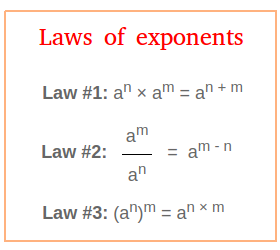
- The laws work only when the bases are the same.
- Multiply powers: keep the base and add the exponents.
- Divide powers: keep the base and subtract the exponents. A negative exponent means one over the power.
- Power of a power: multiply the exponents.
- You can use the laws one after another to simplify a longer problem.
For more rules, such as the zero exponent, see Properties of exponents.
Test Yourself: 10-Question Quiz
Now check what you learned. Every answer is explained, and each time you play you get new questions.
Your result
Keep learning