Scientific Notation
Scientific notation is a convenient way to deal with very large or very small numbers. It provides an easier way to write numbers and makes multiplication and division of very large or very small numbers a lot easier.
In this lesson, you will learn
- what scientific notation is, and what a and n mean in a × 10n
- how to convert a large number by moving the decimal point to the left
- how to convert a small number by moving the decimal point to the right
- how to check your work with the step-by-step converter
What Is Scientific Notation?
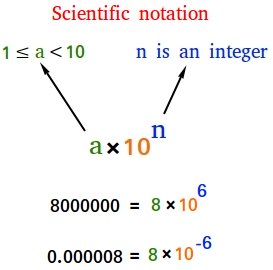
A number is in scientific notation if we can write it as:
a × 10n
with 1 ≤ a < 10 and n is an integer.
1 ≤ a < 10 means that a is a number greater than or equal to 1, but less than 10.
Thus, a can be 1, 2.5, 7.25 or 9.99, but not 10, 25 or 0.8.
A simple example: 500
Let's start with something simple. Write 500 in this useful notation:
500 = 5 × 100 = 5 × 10²
You can also say that there is a decimal point after the last 0 and write 500.0
Then, move the decimal point 2 places to the left, between 5 and 0, to get 5.000, which is the same as 5.
Since you moved it two places to the left, you know that your exponent is 2. Your base is always 10.
Thus, 500 = 5 × 10²
Is 12 × 104 written in scientific notation?
Show answer
No. The number in front, 12, is not less than 10. In scientific notation it is 1.2 × 10⁵.
Scientific Notation Converter: See Every Step
Type any positive number, or tap an example. Then move the decimal point one place at a time, or play the animation.
Try:
Convert a Large Number: Move the Decimal Point Left
Move the decimal point until the number in front is at least 1 and less than 10. Count the places you moved it. When you move the decimal point to the left, the exponent is positive.
Example 1: Convert 75000 into scientific notation.
75000 = 75000.0
Move the decimal point 4 places to the left, between 7 and 5.
We get 7.5000, which is the same as 7.5.
Since we moved it 4 places to the left, the exponent is 4, and the base is still 10.
Thus, 75000 = 7.5 × 10⁴
Example 4: Convert 650000 into scientific notation.
Move the decimal point 5 places to the left.
The answer is 6.5 × 10⁵
- Put the decimal point at the end: 3040000.
- Move it to the left until one digit, 3, is in front of it: 3.040000. That is 6 places.
- Drop the zeros at the end: 3.040000 = 3.04. Keep the 0 between 3 and 4.
- Moving left 6 places gives the exponent 6.
3,040,000 = 3.04 × 10⁶
Write 92,000 in scientific notation.
Show answer
9.2 × 10⁴. Move the decimal point 4 places to the left, from 92000. to 9.2000.
Convert a Small Number: Move the Decimal Point Right
Sometimes, instead of moving your decimal point to the left, you have to move it to the right, as the following examples demonstrate.
When you move your decimal point to the right, your exponent is negative.
Example 2: Convert 0.002 into scientific notation.
Move your decimal point 3 places to the right, after the 2, to get 0002. and 0002. is the same as 2. or 2
Since you had to move it 3 places to the right, your exponent is −3, and the base is still 10.
Thus, 0.002 = 2 × 10⁻³
Example 3: Convert 0.000065 into scientific notation.
Move the decimal point 5 places to the right.
The answer is 6.5 × 10⁻⁵
Counting the zeros instead of the places. 0.002 has two zeros after the decimal point, but the decimal point moves 3 places, past the 2. So the exponent is −3, not −2. Count every place the decimal point moves.
Write 0.00041 in scientific notation.
Show answer
4.1 × 10⁻⁴. Move the decimal point 4 places to the right, from 0.00041 to 00004.1.
Summary
- A number in scientific notation looks like a × 10n, with 1 ≤ a < 10 and n an integer.
- Move the decimal point until the number in front is at least 1 and less than 10, and count the places.
- Moving left gives a positive exponent: 75000 = 7.5 × 10⁴.
- Moving right gives a negative exponent: 0.002 = 2 × 10⁻³.
- Count the places the decimal point moves, not the zeros.
Test Yourself: Scientific Notation Quiz
Convert each number to scientific notation. Type the number in front and the exponent, then press Check. Every answer is explained, and each round has 10 new numbers.
Convert this number to scientific notation: