How to derive the number pi = π = 3.1415926...
What Is the Number Pi?
Pi (written π) is the number you get when you divide the circumference C of any circle by its diameter d.
It is the same number for every circle, big or small.
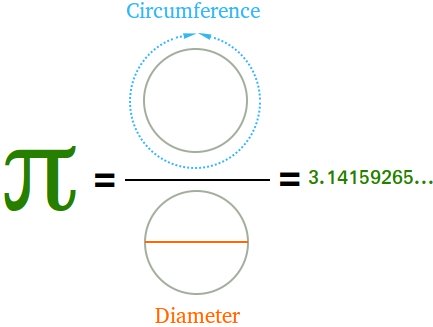
A concrete example: a can of soup is about 7 cm across. Wrap a string once around it and the string is about 22 cm long. That is a little more than 3 times the width of the can: 22 ÷ 7 ≈ 3.14.
In fact, if you roll any circle out flat, its circumference is always 3 diameters plus a little piece, about 0.14 of a diameter:
In this lesson, you will learn
- How to find pi yourself with a string and a ruler
- How Archimedes trapped pi between two numbers
- Which famous facts about pi are true and which are myths
- How to use pi to find the circumference and the area of a circle
An Experiment You Can Do at Home to Find Pi
Ever wondered where pi came from or why pi is equal to 3.14159…? You can find it yourself with a piece of string and a ruler.
- Take a piece of string and measure its length with a ruler. Write down the length on a piece of paper.
- Now play with the string until you make a circle with it. Then use the ruler to measure the diameter of the circle.
- Divide the length of the string by the diameter.
Press Next step to do the experiment one step at a time. Then change the length of the string and do it again.
String experiment © Basic-mathematics.com. All rights reserved.
The length of the string is also the perimeter, or circumference, of the circle after you make a circle with the string.
- Length of the string (the circumference): C = 22 cm
- Diameter of the circle made with the string: d = 7 cm
- Cd = 227 ≈ 3.14
The string is about 3.14 times as long as the diameter.
Try it again with a shorter and a longer string. You will get about the same answer each time, because the circumference divided by the diameter is the same for every circle:

A ruler can't measure perfectly, so your answer will be close to π but not exact, maybe 3.1 or 3.2. That is why mathematicians needed a better method to find the digits of pi.
A string 31.4 cm long makes a circle. What should its diameter be?
Show answer
About 10 cm. 31.4 ÷ 3.14 = 10.
How Archimedes Found the Digits of Pi
About 2,250 years ago, the Greek mathematician Archimedes found pi without measuring anything. He used a circle with a diameter of 1.
So for this circle, π is the circumference. Finding π means finding the length around the circle.
A curved length is hard to calculate, but the perimeter of a polygon is easy, because its sides are straight. So Archimedes drew one polygon inside the circle and one outside it:
The two perimeters are approximations of the circumference, so they are also approximations of π: one a little too small, one a little too big.
Proof: the inside hexagon has a perimeter of 3
- Draw lines from the center to the 6 corners. They cut the hexagon into 6 equal triangles.
- The angle at the center of each triangle is 360° ÷ 6 = 60°.
- Two sides of each triangle are radii, so they are equal: both are ½.
- The two other angles are equal, so each is (180° − 60°) ÷ 2 = 60°.
- All three angles are 60°, so the triangle is equilateral: the third side, a side of the hexagon, is also ½.
- Perimeter of the hexagon = 6 × ½ = 3
The hexagon is inside the circle, so 3 < π. Archimedes' first result: π is more than 3.
The more sides the polygons have, the closer they hug the circle, and the closer the two perimeters get to π. Move the slider, or press − and +, to change the number of sides:
With 6 sides: π is between 3.0000 and 3.4641.
Archimedes polygons © Basic-mathematics.com. All rights reserved.
Archimedes did not have a calculator, so he doubled the number of sides again and again: 6, 12, 24, 48 and finally 96 sides. With 96 sides he showed that π is between 22371 ≈ 3.1408 and 227 ≈ 3.1429. That is where the famous approximation 227 comes from.
Why does the inside polygon always give a number smaller than π?
Show answer
Its perimeter is shorter than the circle. Each side is a straight line, and a straight line is the shortest path between two points, so it is shorter than the arc of the circle it cuts across.
Pi Facts and Myths
- π is exactly 227 or exactly 3.14 Myth
227 = 3.142857… and 3.14 are just close approximations. They are good enough for most homework, but they are not π. - The digits of π end or repeat at some point Myth
π is an irrational number: its decimals go on forever without a repeating pattern. Johann Lambert proved this in 1761. - π is the same for every circle True
A coin, a pizza and the equator all give the same answer when you divide the circumference by the diameter. - Scientists need thousands of digits of π Myth
For its most accurate calculations, which are for steering spacecraft between planets, NASA's Jet Propulsion Laboratory uses only 15 decimal places: 3.141592653589793. - Pi Day is March 14 True
In the month/day format, March 14 is written 3/14, the first digits of π.
Using Pi to Find the Circumference and the Area
Once you know π, you don't need a string any more. If you know the radius r or the diameter d of a circle (d = 2r):
- CircumferenceC = π × d = 2 × π × r
- AreaA = π × r2
- C = π × d
- C ≈ 3.14 × 50 = 157
One turn of the wheel moves it about 157 cm forward.
- A = π × r2
- A ≈ 3.14 × 15 × 15 = 3.14 × 225 = 706.5
The area of the pizza is about 706.5 cm2.
Mixing up the radius and the diameter. C = π × d uses the diameter, but A = π × r2 uses the radius. If you are given the diameter, divide it by 2 before finding the area.
The calculator uses the full value of π, so its answers are a little more exact than answers found with 3.14.
A circle has a diameter of 10 m. What is its area? Use π ≈ 3.14.
Show answer
78.5 m2. The radius is 10 ÷ 2 = 5 m, so A ≈ 3.14 × 5 × 5 = 78.5.
Summary
- Pi (π) is the circumference of a circle divided by its diameter: π = C ÷ d.
- π ≈ 3.14159… and it is the same for every circle.
- You can estimate π with a string and a ruler, but measuring is never perfect.
- Archimedes trapped π between the perimeters of polygons inside and outside a circle.
- 22/7 and 3.14 are approximations. π is irrational, so its digits never end or repeat.
- Circumference: C = π × d = 2πr. Area: A = πr2.
Test Yourself: 10-Question Quiz
Now check what you learned. Every answer is explained, and each time you play you get new questions.
Quiz complete!