Irrational Numbers
Irrational numbers include the square root, cube root, fourth root, and nth root of many numbers. Whenever a number is preceded with a radical sign, the number is called a radical.
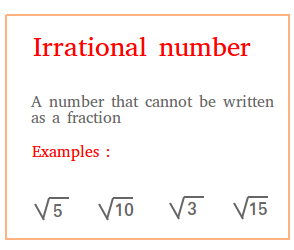
In general, the root of a perfect square is not an irrational number.
More examples of irrational numbers
How do you know a number is irrational?
Why are the radicals above irrational?
Reason #1: They are irrational because the decimal expansion is neither terminating nor repeating.
Non-repeating:Take a close look at the decimal expansion of every radical above, you will notice that no single number or group of numbers repeat themselves as in the following examples.
1.222222222222 (The 2 repeats itself, so it is not irrational)
4.3636363636 (36 repeats itself, so it is not irrational)
There are basically no patterns!
Non-terminating:
The radicals above are not terminating. This means that the decimal expansion has an infinite amount of numbers.
We wrote only 7 digits after the decimal point. However, you can get more numbers.
More digits
Even more digits
It never ends...
Whenever a number is irrational, all we can get is an approximation. We can never write the number completely.
Reason #2: They are irrational because the decimal expansion cannot be written as a fraction a/b, where a and b are integers and b is not equal to zero.
Famous irrational numbers
- The number π or pi that is equal to 3.141592653589793238...
- The golden ratio ϕ that is equal to 1.61803398874989484820...
- The Euler's number e that is equal to 2.718281828459045235...
- The square root of 2 or √2 that is equal to 1.41421356237309...
√2 is the first invented irrational number. Greek philosopher and mathematician Hippasus discovered that √2 could not be expressed as a fraction. His discovery set ablaze the Pythagoreans' strong belief in whole numbers. Legend has it that they drowned him at sea for revealing his secret.
Properties of irrational numbers
1. If a decimal number is non-repeating and non-terminating, then it is an irrational number.
2. The sum of a rational number and an irrational number is an irrational number. Suppose a is a rational number and b is an irrational number. Then a + b is an irrational number.
3. The product of any nonzero rational number and an irrational number is an irrational number. Suppose a is a nonzero rational number and b is an irrational number. Then a×b is an irrational number.
4. The product of two irrational numbers could be rational or irrational.
5. The sum of two irrational numbers could be rational or irrational.
6. The least common multiple (LCM) of two irrational numbers may or may not exist
7. The square root of any prime number is an irrational number. Suppose a is a prime number. Then, √a is an irrational number
Difference between rational and irrational numbers.
1. Rational numbers can be expressed as a ratio of two numbers a/b, where a and b are integers and b is not equal to zero. For example you can write 15.845184518451 as 17604/1111. However, an irrational number is a type of real number that cannot be written as a fraction.
Mathematicians have tried to find fractions that are close approximations for some irrational numbers. However, these approximations are not close to the real answers. For example, an approximation for pi is 22/7.
2. Although rational numbers can go on and on with an infinite amount of numbers, they nonetheless have a pattern. Irrational numbers don't have a pattern.
3. The decimal expansion of an irrational number is non-terminating and non-repeating. However, the decimal expansion of a rational number is either terminating or repeating.
How to find out if a radical is irrational
There are a couple of ways to check if a number is rational:
- If you can quickly find a root for the radical, the radical is rational.
- If you are only looking for the square-root, you could use the square root algorithm. Of course, the method above is lengthy and time-consuming!
- You could use a calculator. This may be the best way to check.
Find the following cube-root symbol on your calculator:
Depending on your calculator, you will either enter 125 and then hit the symbol. Or hit the symbol first and then enter 125.
You should get 5
5 is terminating, so it is not an irrational number.
Example #2:
Find the following n-root symbol on your calculator:
3.179630631616273 is non terminating and non repeating, so it is irrational.
Proof that square root of 5 is irrational