Circumference of a Circle - Definition, Formula, and Examples
In this lesson, you will learn
- What the circumference of a circle is
- Three ways to find the circumference of a circle
- How to use C = π × d and C = 2 × π × r
- How to find the circumference when you know the area
Roll a circle to see its circumference
The circumference is the distance around a circle. Roll the circle one full turn along the ground: the distance it travels is exactly its circumference. The red part of the circle is what is still left to roll out.
Turned: 0%Distance rolled: 0 units
What is the Circumference of a Circle?
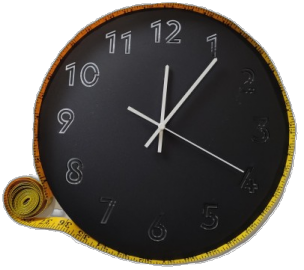
The circumference of a circle, also called the perimeter of a circle, is the distance around a circle or any circular object such as a clock, a pizza, or a dinner plate.
For example, the distance around a circular clock is the circumference of the clock.
How to Find the Circumference of a Circle?
Method 1
You could use a flexible measuring tape like the one used in the image above to measure the perimeter of the clock. As you wrap the tape measure around the clock, just stretch the measuring tape as much as possible so the measurement can be as accurate as possible. Then, read the number you see on the measuring tape.
Method 2
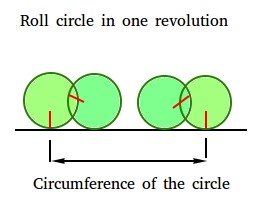
Mark a point on the edge of any circular object. This is shown below with a vertical red mark. Roll the circular object either to the left or to the right until it makes one revolution. The distance between the vertical red marks is the circumference of the circular object.
Method 3
Another way to find the perimeter of a circle or any circular object is to use a special formula.
A bike wheel makes exactly one full turn along the ground. What does the distance it travels tell you?
Show answer
The circumference of the wheel. In one revolution, every point of the edge touches the ground once, so the wheel travels exactly the distance around it. This is Method 2.
Circumference Formula
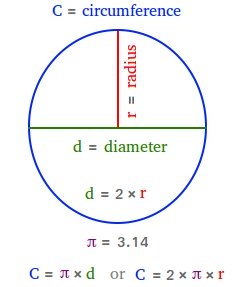
The perimeter of the circle can be found using either C = πd = π × d or C = 2 × π × r.
Pi or π is a special mathematical constant, and the value of pi is approximately equal to 227 or 3.14. The reason that we use 3.14 is because pi is an irrational number with unlimited digits after the decimal point. The lesson about the number π will tell you more about pi. It will also show how to derive the formula and explain why the circle's circumference is C = π × d or C = 2 × π × r.
If either the radius of a circle (r) or the diameter of a circle (d) is known, you can find the circumference by simply substituting the known value for r or d in the formula.
The circumference is expressed in linear units.
- If r or d is measured in meters, then the circumference is also measured in meters or m.
- If r or d is measured in kilometers, then the circumference is measured in kilometers or km.
- If r or d is measured in inches, then the circumference is measured in inches or in.
Writing the circumference in square units, such as cm2. The circumference is a length, so it uses the same unit as the radius: a circle with r = 3 cm has a circumference of 18.84 cm, not 18.84 cm2. Square units are for the area.
The radius of a round table is 0.5 meters. In which unit is its circumference measured?
Show answer
Meters (m). The circumference uses the same linear unit as the radius.
How to Find Circumference of a Circle Using the Diameter?
The product of the constant π and the diameter of the circle is equal to the circumference of the circle.
You just have to find the length of the diameter and then multiply by 3.14 to get the circumference. To get the diameter, use a ruler or a measuring tape. Measure from one edge of the circle to another edge making sure that you go through the midpoint or center of the circle (or clock). After I measured the diameter of the clock you see below, I found something close to 11.90 inches.
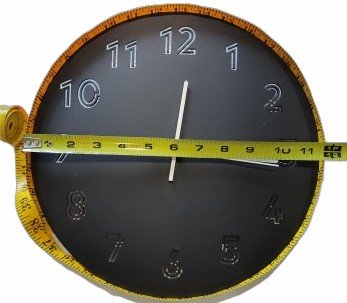
C = 3.14 × d = 3.14 × 11.9 = 37.366 ≈ 37.37 inches. Looking at the measuring tape around the clock, we can see that the circumference is indeed close to 37.3 inches!
How to Find Circumference of a Circle Using the Radius?
Twice the product of the constant π and the radius of the circle is equal to the circumference of the circle.
You just have to find the length of the radius r and then multiply by 2 and then by 3.14 to get the circumference. To get the radius, measure from the center of the circle (or clock) to the edge of the circle. After I measured the radius of the clock you see below, I found something close to 5.95 inches.
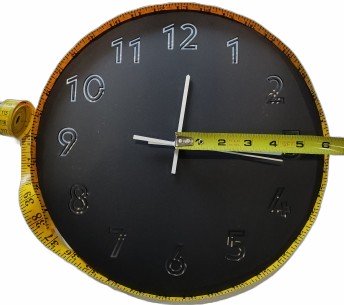
C = 2(3.14) × r = 2(3.14) × 5.95 = 37.366 ≈ 37.37 inches. Again, looking at the measuring tape around the clock, we can see that the circumference is indeed close to 37.3 inches!
The radius of a plate is 5 inches. What is its circumference? Use π = 3.14.
Show answer
31.4 inches. C = 2 × 3.14 × 5 = 31.4. You get the same answer with the diameter: d = 10 inches and 3.14 × 10 = 31.4.
A Few More Examples Showing How to Find the Circumference of a Circle
Example #1: Calculate the circumference of a circle if r = 2 inches.
C = 2 × π × r = 2 × 3.14 × 2 = 12.56 inches
Example #2: Calculate the circumference of a circle if r = 4 inches.
C = 2 × π × r = 2 × 3.14 × 4 = 25.12 inches
- You have two choices. You can first find r and then substitute its value for r in the formula.
- r is half the diameter, so r = 10 divided by 2
r = 5 cm
C = 2 × π × r = 2 × 3.14 × 5 = 31.4 cm - Otherwise, you can just use the formula C = π × D
C = 3.14 × 10 = 31.4 cm
Both ways give a circumference of 31.4 cm.
A Challenging Exercise about the Circumference of a Circle
Example #4: The circumference of circle A is four times the circumference of circle B. The diameter of circle B is 7. What is the diameter of circle A?
Let CA be the circumference of circle A
Let CB be the circumference of circle B
Let DA be the diameter of circle A
Let DB be the diameter of circle B
Since the ratio of circumference to diameter is the same for all circles, you can use the following proportion to solve this problem.
Things that we know:
Replace these in the proportion
If 25 = 820, then 2 × 20 = 5 × 8.
If 4 × CBDA = CB7, then 4 × CB × 7 = DA × CB
Divide both sides by CB
DA = 28
The circumference of circle P is 3 times the circumference of circle Q. The diameter of circle Q is 5. What is the diameter of circle P?
Show answer
15. The ratio of circumference to diameter is the same for all circles, so 3 times the circumference means 3 times the diameter: 3 × 5 = 15.
How to Calculate the Circumference if the Area is Given
Solve for r using A = πr2.
Substitute √Aπ for r in C
The area of a circle is 78.5 cm2. What is its circumference? Use π = 3.14.
Show answer
31.4 cm. C = 2√3.14 × 78.5 = 2√246.49 = 2 × 15.7 = 31.4. Check: the radius is 5 cm, and 2 × 3.14 × 5 = 31.4.
Summary
- The circumference of a circle is the distance around it. It is also called the perimeter of the circle.
- You can find it by wrapping a measuring tape around the circle, by rolling the circle one full turn, or with a formula.
- C = π × d or C = 2 × π × r, with π ≈ 3.14 or 227.
- The circumference is a length, so it uses the same unit as the radius or diameter.
- When you know the area A, the circumference is C = 2√π × A.
Test Yourself: Interactive 10-Question Quiz
Now check what you learned. Use π = 3.14 unless the question says otherwise. Every answer is explained, and each time you play you get new questions.
Quiz complete!