Area of a Circle
In this lesson, you will learn
- what the area of a circle is and the formula A = π × r2
- how to find the area from the radius, the diameter or the circumference
- how to find the radius when the area is given
- why the formula works, by cutting a circle into wedges
Area of Circle Formula
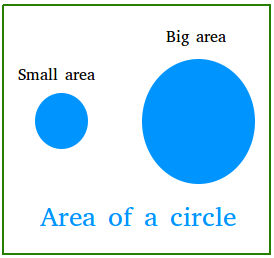
The area of a circle is the space taken by the circle in a two-dimensional plane.
In the figure below, notice that the space occupied or taken by the circle on the left is less. Therefore, the area of the smaller circle on the left is less.
The most common way to find the area of a circle is to use the formula shown below in blue.
A = area
pi or π is a special mathematical constant, and it is approximately equal to 227 or 3.14.
Pi is also the ratio of a circle's circumference to its diameter. If you want to know why pi is used in the formula to find area of a circle, check this lesson about the number pi to get the full answer.
If r or the radius of a circle is known, you simply need to multiply 3.14 by the square of the radius.
The area is expressed in square units.
- If r is measured in meters, then the area is measured in square meters or m2.
- If r is measured in centimeters, then the area is measured in square centimeters or cm2.
- If r is measured in inches, then the area is measured in square inches or in.2
The radius of a circle is 3 cm. What is its area? Use 3.14 for π.
Show answer
28.26 cm2. A = 3.14 × 32 = 3.14 × 9 = 28.26.
What Is the Surface Area of a Circle?
Here is something important to keep in mind!
The surface area of a circle is absolutely the same as the area of the circle.
Surface area is an expression that is usually associated with 3-D figures such as a sphere. Since a circle is not a 3-D figure, "area" and "surface area" refer to the same thing.
To find the surface area, just use any of the formulas discussed in this lesson.
There are three ways to find the area of a circle:
- You can use the radius of a circle
- You can use the diameter of a circle
- You can use the circumference of a circle
How to Find the Area of a Circle Using the Radius
The radius of a circle is the distance from the center of the circle to a point on the circle. Once you know this distance, you simply need to substitute the known value for r in the formula.
Example #1: Using the area of a circle formula, calculate the area if the radius is 4 inches.
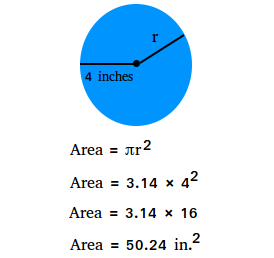
Area = pi × r2 = 3.14 × 42 = 3.14 × 16 = 50.24 in.2
Notice that the unit (inches) is squared to show that it was multiplied by itself.
Example #2: Calculate the area if the radius is 6 inches.
Area = pi × r2 = 3.14 × 62 = 3.14 × 36 = 113.04 in.2
- Write the formula: A = π × r2.
- Square the radius: 72 = 7 × 7 = 49.
- In terms of π: A = 49π m2.
- Using 3.14: A = 3.14 × 49 = 153.86.
The area is 49π m2, or about 153.86 m2.
How to Find the Area of a Circle Using the Diameter
The formula to use if you know the diameter of the circle is:
The diameter of a circle is the distance from one point on the circle to another point on the circle and passing through the center of the circle. The diameter is twice as big as the radius. Once you know this distance, you simply need to substitute the known value for d in the formula.
Example #3: Calculate the area of the circle if the diameter is 20 cm.
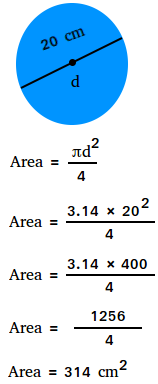
Next, we show you how to express the formula in terms of diameter.
The radius is half the diameter
r = d2
Replace r into the formula A = πr2.
Notice that r2 = r × r
r × r = d2 × d2
r × r = d × d2 × 2
r × r = d24
A = π × d24
Let us use the formula right above to find the area.
A = 3.14 × 2024
A = 3.14 × 4004
A = 3.14 × 100
A = 314 cm2
The other way to solve example #3 is to get r and then replace its value.
Since r is half the diameter, r = 20 divided by 2.
r = 10 cm
A = pi × r2 = 3.14 × 102 = 3.14 × 100 = 314 cm2
Using the diameter in A = π × r2. With a diameter of 20 cm, the radius is 10 cm, so A = 3.14 × 102 = 314 cm2, not 3.14 × 202 = 1,256 cm2.
The diameter of a circle is 10 m. What is its area? Use 3.14 for π.
Show answer
78.5 m2. The radius is 10 ÷ 2 = 5 m, so A = 3.14 × 52 = 3.14 × 25 = 78.5.
How to Find the Area of a Circle in Terms of Circumference
The formula to use if you know the circumference of the circle is:
First, let us quickly derive the formula.
Let C be the circumference. The formula to use to find the circumference of a circle, also called length of its boundary, is C = 2πr, then r = C2π.
Learn how to find the perimeter of a circle
Substitute C2π for r in the area formula
Area = π × r2 = π × r × r
Area = π × C2π × C2π
Area = π1 × C2π × C2π
Area = π × C × C1 × 2π × 2π
Area = π × C24π × π
Cancel π
Area = C24π
Example #4: Calculate the area of the circle if the circumference is 157.079 meters
Area = 157.07924(3.14)
Area = 24,673.81212.56
Area is approx. 1,964 m2
The circumference of a circle is 62.8 cm. What is its area? Use 3.14 for π.
Show answer
314 cm2. r = 62.8 ÷ (2 × 3.14) = 10 cm, so A = 3.14 × 102 = 314. The formula C24π gives the same: 3,943.84 ÷ 12.56 = 314.
Finding the Radius When the Area Is Given
Example #5: If A = 78.5 in.2, find r or the radius of the circle
Review solving multiplication equations before looking at the solution below.

r = 5 inches because 52 = 5 × 5 = 25
The area of a circle is 314 cm2. What is its radius? Use 3.14 for π.
Show answer
10 cm. 314 ÷ 3.14 = 100 = r2, and 10 × 10 = 100.
How to Derive the Area of a Circle
Draw a large circle using a compass. Draw two diameters, one that is horizontal and the other vertical. Fold the circle vertically and horizontally. Then, cut or slice the circle into four wedges on the fold lines.
Cut each wedge into 4 equal sections. The total number of sections is 16. Use the 16 wedges or sections to make the figure below looking "somewhat" like a parallelogram.
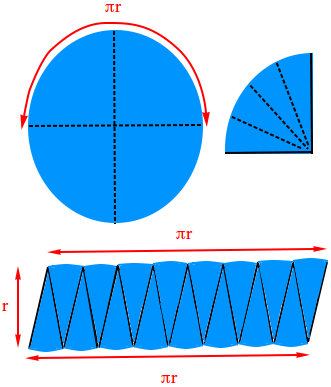
The base of the figure is formed by arcs of the circle. You need 8 arcs (8 sections) to form the base.
Notice that 8 arcs is equivalent to half the circumference of the circle. The more you increase the number of wedges, the more the figures you create will look like rectangles with base π × r and height r.
The area of these rectangles is base × height = π × r × r = π × r2
Why is the base of the rearranged figure π × r?
Show answer
It is half the circumference. The circumference is 2πr, and half of it is πr.
Summary
- The area of a circle is the space it takes up: A = π × r2, with π ≈ 3.14.
- The area is in square units, such as cm2, m2 or in.2.
- From the diameter: A = πd24, or first halve the diameter to get r.
- From the circumference: A = C24π.
- From the area: divide by π to get r2, then find the number that times itself gives r2.
- Cutting a circle into wedges makes a near-rectangle with base πr and height r, so its area is πr2.
Test Yourself: Interactive 10-Question Quiz
Now check what you learned about the area of a circle. Use 3.14 for π. Every answer is explained, and each time you play you get new numbers.
Quiz Complete! 🎉