What is a Circle? Definition and Parts of a Circle
In this lesson, you will learn
- What a circle is, and what the word locus means
- The lines that cut a circle: chord, diameter, radius, secant and tangent
- The difference between minor and major arcs, and minor and major segments
- How the radius and the diameter of a circle are related
Interactive Lesson about the Circle and the Circle Parts
Part 1 of 13
Circle
What is the highlighted part of the circle?
The circle and its points
Lines and line segments
Arcs and regions
What Is a Circle?
In geometry, a circle is the locus of points located at the same distance from a given fixed point.
The word locus sounds complicated, but it means the set of all points that meet a given condition. The fixed point is called the center of the circle.
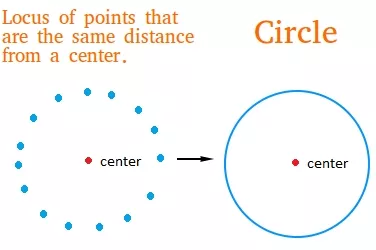
Another way then to define a circle is to say that it is the set of all points that are located at the same distance from a fixed point.
Looking at the figure above, all the blue dots are located at the same distance from the red dot (fixed point or center of the circle) and they form the locus of points mentioned above.
You can put a great number of blue dots until you get a closed curved line figure. The figure above shows a circle resulting from connecting the locus of all the points equidistant from the center.
Point A is on a circle with center O, and OA = 6 cm. Point B is also on the circle. How long is OB?
Show answer
OB = 6 cm. Every point on a circle is the same distance from the center.
Real-Life Examples of Circles
- Bicycle wheels
- Dinner plates
- Coins such as dimes, quarters, nickels and pennies
- CDs
- Pizzas
- Darts
Below, we show a pizza and a dart as real-life examples of circles.

Chord, Diameter and Radius of a Circle
Lines on a circle are given different names depending on how the line cuts the circle. There are five such lines and line segments: the chord, the diameter, the radius, the secant and the tangent.
Chord of a circle
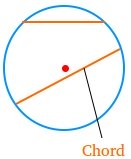
A line segment joining two points on the circle is a chord. In other words, a chord is a segment whose endpoints are on the boundary of the circle. A chord divides a circle into two unequal parts unless the chord goes through the center of the circle. The following two orange lines are examples of two chords.
Diameter of a circle
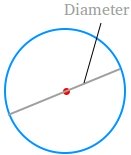
When a chord passes through the center of the circle, we call the chord a diameter. In other words, the longest chord of a circle is the diameter. A diameter divides a circle into two equal halves, and each half is called a semi-circle. The following gray line is an example of a diameter.
Radius of a circle
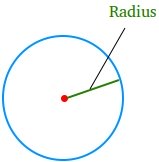
Half a diameter is called a radius. In other words, 2 radii = diameter as long as we are dealing with the same circle. The radius of a circle can also be defined as the distance between the center of the circle and any point on the circle. The following green line is the radius of the circle.
- The diameter is made of 2 radii: diameter = 2 × radius.
- Replace the radius with 7 cm: diameter = 2 × 7 cm.
- Multiply: 2 × 7 = 14.
Answer: the diameter is 14 cm.
Calling every chord a diameter. A chord is a diameter only when it passes through the center. Every diameter is a chord, but most chords are not diameters, and they are shorter than the diameter.
The diameter of a circle is 18 inches. What is the radius?
Show answer
9 inches. The radius is half the diameter: 18 ÷ 2 = 9.
Secant and Tangent of a Circle
Secant of a circle
A secant is a line that intersects a circle at two points. A secant of a circle is shown in black below.
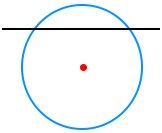
Did you see the difference between the secant and the other lines, especially the chord? The secant is not contained within the circle. It is extended beyond the two points where it meets the boundary of the circle.
Tangent to a circle
The tangent to a circle is a line that touches the boundary of the circle at exactly one point. If the line touches the boundary in two points, it is a chord as already stated, not a tangent!
The tangent of a circle is shown in red in the figure below. Notice how the red line touches the circle in exactly one point. The point where a circle and a tangent intersect is called the point of tangency, and it is shown with a green dot.
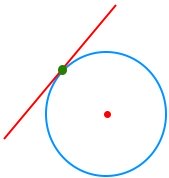
Count the points the line shares with the circle. A tangent touches the circle at 1 point. A secant crosses it at 2 points and keeps going. A chord also meets the circle at 2 points, but it stops there.
A line meets a circle at exactly one point. What is it called?
Show answer
A tangent. The point where it touches the circle is the point of tangency.
Arcs and Segments of a Circle
Arc of a circle
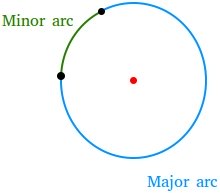
An arc is a portion of the boundary of a circle. Suppose you put your finger on the boundary of the circle. If you move your finger on the boundary of the circle and the distance you cover is less than the perimeter of the circle, what you end up with is an arc. In other words, if you use a compass and draw something less than 360 degrees or a full circle, then what you have drawn is an arc.
An arc can be a minor arc or a major arc as shown in the figure above. The minor arc is shown in green and the major arc is shown in blue.
Segments of a circle
A segment of a circle is a portion of the circle created by a chord and either the minor arc or the major arc.
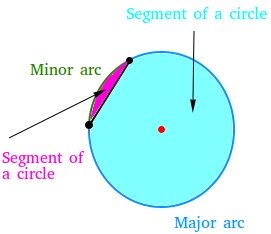
The figure above shows the segments of the circle. The one shown in purple is a minor segment, and the one shown in turquoise is a major segment.
Mixing up an arc and a segment. An arc is only a piece of the curved boundary, like a piece of string. A segment is a whole region, the area between a chord and an arc.
An arc measures 300°. Is it a minor arc or a major arc?
Show answer
A major arc. It is more than half of the circle (more than 180°).
Summary
- A circle is the set of all points that are the same distance from a fixed point, the center.
- A chord joins two points on the circle. A diameter is a chord through the center, and it is the longest chord.
- A radius goes from the center to the circle, and diameter = 2 × radius.
- A secant crosses the circle at two points and extends beyond it. A tangent touches the circle at exactly one point.
- An arc is part of the boundary, and a segment is the region between a chord and an arc. Each can be minor (smaller) or major (larger).
Test Yourself: 10-Question Quiz
Now check what you learned. Every answer is explained, and each time you play you get new questions.
Quiz Complete!
Keep learning