Front-End Estimation
Front-end estimation is a valuable mathematical strategy that simplifies complex calculations by rounding numbers to their leftmost place value and performing operations based on these approximations. Whether you're adding, subtracting, multiplying, or dividing, front-end estimation can help you quickly arrive at a reasonable estimate, enhancing both your mental math skills and your ability to check the reasonableness of your answers.
In this lesson, you will learn
- which place value to round each number to, based on its number of digits
- how to estimate sums and differences with front-end estimation
- how to estimate products and quotients with front-end estimation
- when front-end estimation works well and when it can be far off
What is Front-End Estimation?
Front-end estimation involves rounding numbers to the nearest place value (tens, hundreds, thousands, etc.) based on the number of digits they contain. After rounding, you perform the desired operation using only the leftmost digits, with all other digits replaced by zeros. This approach simplifies calculations, making them easier to perform mentally or quickly on paper.
Key Principle:
- Single-Digit NumbersUse the number as is.
- Two-Digit NumbersRound to the nearest ten.
- Three-Digit NumbersRound to the nearest hundred.
- And so forth...
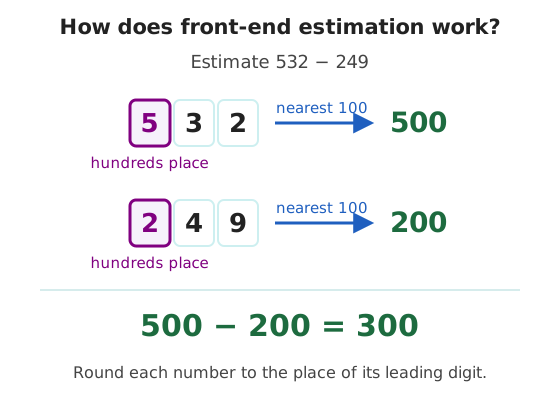
Cutting off the other digits without rounding. 45 is a two-digit number, so it rounds to the nearest ten: 50, not 40. Look at the digit after the leading digit to decide whether to round up or down.
What does 7,640 become in front-end estimation?
Show answer
8,000. 7,640 has four digits, so round it to the nearest thousand. The last three digits, 640, are 500 or more, so round up.
Addition and Subtraction Using Front-End Estimation
Combining addition and subtraction under front-end estimation streamlines the process of handling these fundamental operations by focusing on the largest place value of the numbers involved.
Steps for Both Addition and Subtraction:
- Identify the Place to Round: Determine the appropriate place value to use to round each number based on the key principle above.
- Round each number in the addition or subtraction: Round based on the key principle above and convert all digits except the leftmost to zero.
- Perform the Operation: Add or subtract the rounded numbers using only the leftmost digits.
Examples:
1. Two-Digit Addition
45 + 38
- Round each number to the nearest ten
- Rounding: 50 + 40
- Estimate: 90
2. Four-Digit and Three-Digit Addition
1234 + 876
- Round 1234 to the nearest thousand and 876 to the nearest hundred
- Rounding: 1000 + 900
- Estimate: 1900
3. Five-Digit Subtraction
48693 − 15768
- Round each number to the nearest ten-thousand
- Rounding: 50000 − 20000
- Estimate: 30000
Key Insights:
- SimplicityBy focusing solely on the leftmost digits, complex calculations become manageable.
- ConsistencyApplying the same rounding rules ensures uniformity across different operations and number sizes.
- EfficiencyThis method significantly reduces the time needed to perform mental calculations or quick paper estimates.
- Both numbers have four digits, so round each one to the nearest thousand.
- 6,281 rounds to 6,000 (the last three digits, 281, are less than 500). 2,734 rounds to 3,000 (734 is 500 or more).
- Subtract the rounded numbers: 6,000 − 3,000 = 3,000.
6,281 − 2,734 is about 3,000. (The exact difference is 3,547.)
Use front-end estimation to estimate 67 + 24.
Show answer
90. 67 rounds to 70 and 24 rounds to 20, so 70 + 20 = 90.
Multiplication Using Front-End Estimation
Front-end estimation can also be applied to multiplication, though it requires careful consideration to maintain a reasonable estimate.
Steps:
- Identify the Place to Round: Determine the appropriate place value to use to round each number based on the key principle above.
- Round each number in the multiplication: Round based on the key principle above and convert all digits except the leftmost to zero.
- Perform the Operation: Multiply the rounded numbers using only the leftmost digits.
Examples:
Two-Digit Multiplication
34 × 27
- Round each number to the nearest ten
- Rounding: 30 × 30
- Estimate: 900
Three-Digit Multiplication
164 × 690
- Round each number to the nearest hundred
- Rounding: 200 × 700
- Estimate: 140,000
Note: While front-end estimation simplifies multiplication, the estimates can be significantly off for large numbers. It’s best used for quick approximations rather than precise calculations.
Use front-end estimation to estimate 52 × 38.
Show answer
2,000. 52 rounds to 50 and 38 rounds to 40, so 50 × 40 = 2,000.
Division Using Front-End Estimation
Division with front-end estimation involves simplifying both the dividend and the divisor to their most significant digits. The steps are the same as multiplication.
Examples:
Two-Digit Division
84 ÷ 21
- Round each number to the nearest ten
- Rounding: 80 ÷ 20
- Estimate: 4
Three-Digit and Two-Digit Division
335 ÷ 45
- Round 335 to the nearest hundred and 45 to the nearest ten
- Rounding: 300 ÷ 50
- Estimate: 6
Note: Similar to multiplication, front-end estimation in division provides a rough approximation. For more accurate results, especially with large or complex numbers, more precise methods should be employed.
Use front-end estimation to estimate 612 ÷ 29.
Show answer
20. 612 rounds to 600 and 29 rounds to 30, so 600 ÷ 30 = 20.
Benefits of Front-End Estimation
- SpeedQuickly arrive at approximate answers without detailed calculations.
- Mental Math EnhancementStrengthen your ability to manipulate numbers in your head.
- Error CheckingUse estimates to verify the plausibility of exact answers.
Tips for Effective Front-End Estimation
- Practice Rounding: Become comfortable with quickly rounding numbers to the appropriate place value.
- Understand Place Value: A strong grasp of place value helps in identifying which digit to focus on.
- Use for Estimation, Not Precision: Remember that front-end estimation is for approximations. For exact answers, perform precise calculations.
- Combine with Back-End Estimation: For more accurate estimates, sometimes combining front-end (leftmost digit) and back-end (remaining digits) estimation can yield better results.
- Apply Consistently: Regularly use front-end estimation in various mathematical problems to enhance proficiency.
Summary
- Front-end estimation rounds each number to the place value of its leading digit.
- Two-digit numbers round to the nearest ten, three-digit numbers to the nearest hundred, four-digit numbers to the nearest thousand, and so forth.
- After rounding, only the leftmost digit is not zero, so the operation is easy to do mentally.
- It works for addition, subtraction, multiplication and division.
- Estimates for multiplication and division can be far from the exact answer, so use them for quick checks.
Test Yourself: Interactive 10-Question Quiz
Do you really know how to estimate with front-end estimation? Take the 10-question quiz to find out. You won’t need paper or a pencil. Every answer is explained, and each time you play you get new numbers.
Quiz complete!
Keep learning