Estimating a Sum by Rounding: Achieving the Best Estimates
In mathematics, precision is valuable, but so is efficiency. Often, especially in everyday situations, obtaining an exact answer isn’t necessary. Instead, a good estimate suffices. This lesson focuses on estimating sums by rounding to achieve the best possible approximation without the need for exact calculations.
In this lesson, you will learn
- how to estimate a sum of two-digit numbers by rounding to the nearest ten
- how to estimate a sum of three-digit numbers by rounding to the nearest hundred or ten
- how to decide which rounding gives the better estimate
- why rounding every number in the same direction can make an estimate less accurate
Estimating with Two-Digit Numbers
When dealing with two-digit numbers, estimation becomes straightforward because you typically round to the nearest ten. Since two-digit numbers don't extend beyond the tens place, there's only one logical level to round to, ensuring a single, clear estimate.
Examples
1) 36 + 21
Rounding: 36 rounds to 40, and 21 rounds to 20.
Estimated Sum: 40 + 20 = 60
Exact Sum: 36 + 21 = 57
Analysis: The estimate of 60 is very close to the exact sum of 57, demonstrating the effectiveness of rounding to the nearest ten.
2) 74 + 15
Rounding: 74 rounds to 70, and 15 rounds to 20.
Estimated Sum: 70 + 20 = 90
Exact Sum: 74 + 15 = 89
Analysis: The estimate of 90 nearly matches the exact sum of 89, showcasing how rounding provides a quick and accurate approximation.
3) 85 + 26
Rounding: 85 rounds to 90, and 26 rounds to 30.
Estimated Sum: 90 + 30 = 120
Exact Sum: 85 + 26 = 111
Analysis: The estimate of 120 is considerably higher than the exact sum of 111, demonstrating how rounding both numbers up can lead to an overestimation. By rounding 85 to 90 and 26 to 30, the combined increase results in a larger gap from the actual total. This example highlights that while rounding provides a quick approximation, it can sometimes produce less accurate results when multiple numbers are rounded in the same direction.
Estimate 47 + 32 by rounding to the nearest ten.
Show answer
80. 47 rounds to 50 and 32 rounds to 30, so 50 + 30 = 80. The exact sum is 79.
Estimating with Three-Digit Numbers
When working with three-digit numbers, estimation offers more flexibility. You can choose to round to the nearest hundred or the nearest ten, each providing a different level of approximation. This dual approach allows for greater control over the precision of your estimate.
Examples
1) 176 + 432
Rounding to the Nearest Hundred: 176 rounds to 200, and 432 rounds to 400. Estimated Sum: 200 + 400 = 600
Rounding to the Nearest Ten: 176 rounds to 180, and 432 rounds to 430. Estimated Sum: 180 + 430 = 610
Exact Sum: 176 + 432 = 608
Analysis: The exact sum of 608 is closer to the estimate of 610 (rounded to the nearest ten) than to 600 (rounded to the nearest hundred). Therefore, in this case, rounding to the nearest ten provides a more accurate estimate.
2) 250 + 845
Rounding to the Nearest Hundred: 250 rounds to 300, and 845 rounds to 800. Estimated Sum: 300 + 800 = 1100
Rounding to the Nearest Ten: 250 remains 250 and 845 rounds to 850. Estimated Sum: 250 + 850 = 1100
Exact Sum: 250 + 845 = 1095
Analysis: Both rounding methods yield the same estimate of 1100, which is very close to the exact sum of 1095. This demonstrates that sometimes, either rounding strategy can be effectively employed to achieve a good estimate.
3) 984 + 220
Rounding to the Nearest Hundred: 984 rounds to 1000, and 220 rounds to 200. Estimated Sum: 1000 + 200 = 1200
Rounding to the Nearest Ten: 984 rounds to 980, and 220 remains 220. Estimated Sum: 980 + 220 = 1200
Exact Sum: 984 + 220 = 1204
Analysis: Here, both rounding methods give 1200, which is very close to the exact sum of 1204.
Rounding a number like 250 down to 200. When rounding to the nearest hundred, look at the last two digits: 50 or more rounds up, so 250 rounds to 300.
- Nearest hundred: 263 rounds to 300 and 418 rounds to 400, so the estimate is 300 + 400 = 700.
- Nearest ten: 263 rounds to 260 and 418 rounds to 420, so the estimate is 260 + 420 = 680.
- The exact sum is 263 + 418 = 681. 680 is only 1 away, while 700 is 19 away.
Rounding to the nearest ten gives the better estimate: 680.
Estimate 312 + 489 by rounding to the nearest hundred.
Show answer
800. 312 rounds to 300 and 489 rounds to 500, so 300 + 500 = 800. The exact sum is 801.
The Purpose of Estimation
Estimation simplifies complex calculations, allowing for quicker decision-making and problem-solving. By rounding numbers appropriately, you can swiftly determine a reasonable approximation of a sum, which is particularly useful in scenarios like budgeting, shopping, or time management. Importantly, while exact answers provide precision, estimates offer speed and practicality, especially when minor deviations from the exact value are acceptable.
Guidelines for Effectively Estimating a Sum
When estimating sums involving three-digit numbers, consider the following guidelines to achieve the most accurate approximation:
- 1. Evaluate the NumbersDetermine whether rounding to the nearest ten or hundred will yield an estimate closer to the exact sum. Examine the individual numbers to see how much they deviate from the nearest ten or hundred.
- 2. Flexibility in RoundingUse your judgment to decide which rounding level (ten or hundred) provides a better approximation based on the specific numbers involved. Remember that no single method is universally superior; the effectiveness of rounding depends on the context of the problem.
- 3. Understand the PurposeRecognize that the goal of estimation is to achieve a reasonable approximation quickly, not to find an exact answer. Use estimation as a tool to simplify complex calculations and facilitate faster decision-making.
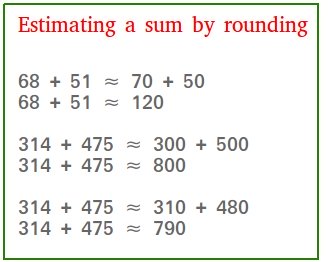
Here is a summary showing how to estimate a sum.
Summary
- To estimate a sum, round each number, then add the rounded numbers.
- For two-digit numbers, round to the nearest ten.
- For three-digit numbers, you can round to the nearest hundred or to the nearest ten. The nearest ten is often closer, but not always.
- When all the numbers are rounded in the same direction, the estimate can be further from the exact sum.
- Estimation gives a quick, reasonable answer when an exact answer is not needed.
Test Yourself: Interactive 10-Question Quiz
Now check what you learned. Every answer is explained, and each time you play you get new questions.
Quiz complete!