Cluster Estimation: An Effective Technique for Estimating Sums and Products
Cluster estimation is a valuable mathematical technique used to estimate sums and products, particularly when the numbers involved are close in value or cluster around a single number. By identifying a central value around which the numbers group, you can simplify complex calculations and obtain quick, reasonable estimates.
In this lesson, you will learn
- what cluster estimation is and when to use it
- how to estimate a sum by multiplying the cluster value by the number of terms
- how to estimate a product by using the cluster value as a factor once for each number
- why estimates of sums are usually closer than estimates of products
Understanding Cluster Estimation
Cluster estimation leverages the proximity of numbers to a central value to simplify addition or multiplication. When numbers are tightly grouped around a specific value, replacing each number with that central value allows for easier computation while still providing an estimate that is close to the actual result.
Using cluster estimation when the numbers are not close together. For 12 + 48 + 95, no single number represents all three, so a cluster estimate would be far off. Round each number instead.
Can you use cluster estimation for 398 + 405 + 402 + 396? What is the estimate?
Show answer
Yes: 400 × 4 = 1,600. All four numbers are close to 400. The real sum is 1,601.
Estimating a Sum with Cluster Estimation
Example 1: Estimating a Sum
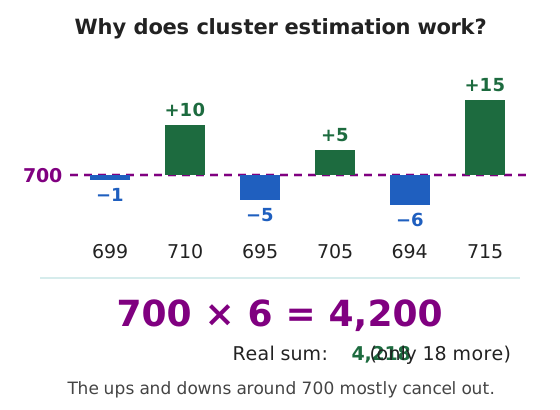
- Examine the Numbers: The numbers 699, 710, 695, 705, 694, and 715 are all close to 700.
- Choose the Cluster Value: Use 700 as the central value for estimation.
- Compute the Estimate: Instead of adding each number individually, multiply the cluster value by the number of terms: 700 × 6 = 4,200
- Compare with the Actual Sum: The real sum is 699 + 710 + 695 + 705 + 694 + 715 = 4,218
Thus, 4,200 is a good estimate of the actual sum.
Example 2: Estimating Another Sum
- Examine the Numbers: The numbers 257, 247, 255, and 245 are all close to 250.
- Choose the Cluster Value: Use 250 as the central value for estimation.
- Compute the Estimate: Multiply the cluster value by the number of terms: 250 × 4 = 1,000
- Compare with the Actual Sum: The real sum is 257 + 247 + 255 + 245 = 1,004
Thus, 1,000 is indeed close to the real answer.
Estimate 498 + 503 + 505 + 497 + 501 with cluster estimation.
Show answer
500 × 5 = 2,500. The five numbers cluster around 500. The real sum is 2,504.
Estimating a Product with Cluster Estimation
Example 3: Estimating a Product
- Examine the Numbers: The numbers 23, 18, 22, and 17 are all close to 20.
- Choose the Cluster Value: Use 20 as the central value for estimation.
- Compute the Estimate: Multiply, using the cluster value four times: 20 × 20 × 20 × 20
- Simplify the Calculation: Multiply the base numbers first: 2 × 2 × 2 × 2 = 16. Then, add four zeros: 160,000
- Compare with the Actual Product: The real product is 23 × 18 × 22 × 17 = 154,836
While 160,000 is not extremely close, it serves as a reasonable estimate.
In general, addition provides better estimates than multiplication in cluster estimation.
In a sum, the small differences from the cluster value are only added, and they often cancel out. In a product, they are multiplied, so they grow.
Example 4: Estimating Another Product
- Examine the Numbers: The numbers 8, 11, and 12 are all close to 10.
- Choose the Cluster Value: Use 10 as the central value for estimation.
- Compute the Estimate: Multiply, using the cluster value three times: 10 × 10 × 10 = 1,000
- Compare with the Actual Product: The real product is 8 × 11 × 12 = 1,056
Thus, 1,000 is a good estimate of the actual product.
Multiplying the cluster value by the number of factors. For 23 × 18 × 22 × 17, the estimate is 20 × 20 × 20 × 20 = 160,000, not 20 × 4 = 80. Multiplying by the number of terms works only for sums.
Estimate 31 × 29 × 32 with cluster estimation.
Show answer
30 × 30 × 30 = 27,000. Multiply 3 × 3 × 3 = 27, then add three zeros. The real product is 28,768.
Summary: Key Takeaways
- Identifying Clusters: Carefully examine the numbers involved in the calculation to identify if they cluster around a particular value.
- Choosing the Right Cluster Value: Select a central value that closely represents the group of numbers to ensure the estimate is as accurate as possible.
- Simplifying Calculations: Replace each number with the cluster value and perform the multiplication or addition accordingly. This approach simplifies complex calculations and provides quick estimates.
- Accuracy Considerations: While cluster estimation is effective for obtaining quick and reasonable estimates, especially for addition, the accuracy may vary for multiplication problems. Estimates for sums are generally closer to the actual values compared to products.
Test Yourself: Interactive 10-Question Quiz
Now check what you learned. Every answer is explained, and each time you play you get new questions.
Quiz complete!