What Are Rounding and Estimating?
Rounding and estimating are fundamental mathematical techniques that simplify numbers and calculations, making them more manageable in everyday situations. Whether you're budgeting, cooking, or analyzing data, these skills enhance numerical comprehension and facilitate quicker decision-making.
In this lesson, you will learn
- what rounding is and when it is useful
- what estimating is and when it is useful
- how to round to the nearest whole number and to a decimal place
- how cluster estimation and front-end estimation work
Understanding Rounding
Rounding involves adjusting a number to a specific degree of precision, typically to the nearest ten, hundred, or decimal place. This process makes numbers easier to work with without significantly altering their value.
Example: Suppose you have the number 16.87. Rounding this to the nearest whole number gives you 17. This simplification is useful in contexts where exact precision is unnecessary.
When is Rounding Necessary?
Rounding is essential in various scenarios, including:
- BudgetingPrecise figures can be cumbersome. For instance, instead of tracking expenses to the penny, you might round costs to the nearest dollar for simplicity.
Example: If your monthly rent is $1,235, you might round it to $1,200 to streamline your budget planning. - CookingRecipes often require measurements that are easier to handle. Rounding can simplify ingredient quantities without compromising the dish.
Example: Instead of using 2.7 cups of flour, you might round to 3 cups for convenience. - Statistics and Data PresentationWhen presenting data, especially large datasets, rounding helps maintain clarity and readability.
Example: An average score of 78.6 can be rounded to 79 to make reports more straightforward.
Round 6.48 to the nearest whole number.
Show answer
6. The decimal part, 0.48, is less than 0.5, so you round down.
Understanding Estimating
Estimating provides an approximate value rather than an exact one. This technique is invaluable when quick assessments are needed, and precision is less critical.
Example: Imagine you’re tracking your weight loss over 10 months. The pounds lost each month are as follows: 2.4, 2.5, 2.6, 2.3, 2.45, 2.60, 2.41, 2.35, 2.56, 2.49
Instead of adding each precise figure, you can estimate by rounding each to 2.5 pounds. Multiplying 2.5 by 10 months gives an estimated total loss of 25 pounds.
The exact total is 24.66 pounds, so the estimate of 25 pounds is very close, and it took only one multiplication.
When is Estimating Necessary?
Estimating is useful in situations where:
- Time ConstraintsWhen decisions need to be made quickly, such as during a meeting or while shopping.
Example: Estimating whether you have enough money for groceries without calculating each item’s exact price. - Complex CalculationsWhen dealing with large numbers or complex operations, estimates can provide a quick sense of scale.
Example: Estimating the total cost of a home renovation project by rounding individual expenses. - General AssessmentsWhen precision is less important than the overall trend or pattern.
Example: Assessing whether a team is generally improving in performance without analyzing every game statistic in detail.
Estimate 4.9 + 5.2 + 5.1 + 4.8.
Show answer
About 20. All four numbers are close to 5, so 5 × 4 = 20. The exact sum is 20.
Some Key Techniques for Rounding and Estimating
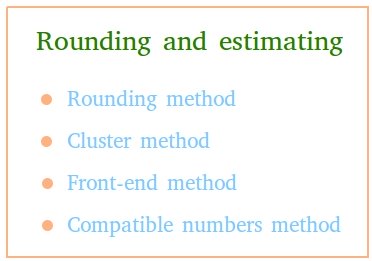
Rounding to the Nearest Whole Number
If the decimal is 0.5 or higher, round up. If the decimal is less than 0.5, round down.
Example: 3.6 rounds to 4, while 3.4 rounds to 3.
Rounding in two steps. To round 3.45 to the nearest whole number, look only at the decimal 0.45, which is less than 0.5, so 3.45 rounds to 3. Rounding first to 3.5 and then to 4 is wrong.
Rounding to a Specific Decimal Place
- Decide the level of precision needed.
- Apply the rounding rules based on the digit following the desired place.
Example: Rounding 2.456 to two decimal places gives 2.46.
- One decimal place is the tenths place. The tenths digit is 3.
- Look at the next digit, the hundredths digit: it is 8.
- 8 is 5 or more, so round the tenths digit up from 3 to 4, and drop the digits after it.
7.384 rounded to one decimal place is 7.4.
Cluster Estimation
Group similar numbers to find an average or representative value.
Example: From the weight loss figures (2.4, 2.5, 2.6, etc.), identifying that most values cluster around 2.5 pounds.
Front-End Estimation
Round each number to the place value of its leading digit.
Example: Estimating 198 + 47 by considering 200 + 50 = 250. Leading digit is 1 for 198, so we round 198 to the nearest hundred: 200. Leading digit is 4 for 47, so we round 47 to the nearest ten: 50.
Use front-end estimation to estimate 312 + 58.
Show answer
About 360. 312 rounds to 300 (nearest hundred), and 58 rounds to 60 (nearest ten): 300 + 60 = 360.
Practical Applications
Rounding
- Everyday ShoppingWhen making purchases, rounding prices to whole numbers can simplify budgeting. For example, if five items are priced around $9.75 each, rounding each to $10 helps quickly estimate a total of $50.
- Travel PlanningEstimating travel time by rounding distances and average speeds allows for better scheduling and time management.
- Financial PlanningRounding monthly expenses and incomes aids in creating realistic budgets. For instance, if your income is $3,245, rounding to $3,200 makes it easier to allocate funds without getting bogged down by exact figures.
Estimating
- Project ManagementEstimating the time and resources needed for tasks helps in setting realistic deadlines and expectations.
- Health and FitnessTracking progress, such as weight loss or workout durations, through estimates can motivate without the pressure of exact numbers.
- ConstructionEstimating materials needed for building projects ensures that you purchase sufficient supplies without excessive precision.
Summary
- Rounding changes a number to a simpler number close to it, such as the nearest ten, hundred, whole number or decimal place.
- Estimating gives an approximate answer when an exact answer is not needed.
- To round to the nearest whole number, round up if the decimal is 0.5 or higher, and round down if it is less than 0.5.
- Cluster estimation replaces numbers that are close together with one representative value.
- Front-end estimation rounds each number to the place value of its leading digit: 198 + 47 is about 200 + 50 = 250.
Test Yourself: Interactive 10-Question Quiz
Now check what you learned. Every answer is explained, and each time you play you get new questions.
Quiz complete!
Keep learning