Rounding Whole Numbers
Rounding whole numbers is the process by which we make numbers look a little nicer. The numbers that look nice in our mind are numbers that usually end with a zero such as 10, 30, 200. Therefore, when rounding numbers, it usually means that you are going to try to put zero(s) at the end.
In this lesson, you will learn
- how to round on a number line by comparing distances
- how to round to the nearest ten, hundred and thousand by looking at digits
- what rounding up and rounding down mean
- how to round to the nearest ten-thousand, hundred-thousand and million
Interactive Number Line: Learn to Round Whole Numbers
Select whether you want to round to the nearest ten, hundred, or thousand. The number line will help us visualize the distances.
Looking at the number:
Round to the boundary that is closer. When the number is exactly in the middle, round up.
How to Round Whole Numbers by Focusing on Digits
There is another simple method for rounding whole numbers to the nearest ten, hundred, thousand, ten-thousand, and so forth...
We do so by focusing on digits.
Study the two examples in the figure below carefully and then keep reading in order to get a deeper understanding.
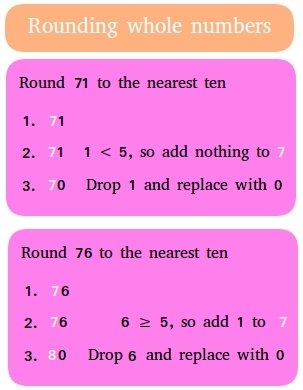
Rounding Whole Numbers to the Nearest Ten
When rounding to the nearest ten, if the last digit ends with 1, 2, 3, or 4, round to the next number that is smaller than the number given and ending with a zero.
For instance, round 43 to the nearest ten. The last digit is 3, so the next number smaller than 43 with an ending of zero is 40.
On the other hand, if the last digit is 5, 6, 7, 8, or 9, round to the next number bigger than the given number and ending with zero.
For instance, round 45 to the nearest ten. The last digit is 5, so the next number bigger than 45 and ending with zero is 50.
Other examples: round 23, 36, 55, and 99.
For 23, the last digit is 3, so the answer is 20.
For 36, the last digit is 6, so the answer is 40.
For 55, the last digit is 5, so the answer is 60.
For 99, the last digit is 9, so the answer is 100.
Round 84 to the nearest ten.
Show answer
80. The last digit is 4, so round down to the next number ending with a zero.
Rounding to the Nearest Hundred
When rounding to the nearest hundred, you will need to look at the last two digits. If the last two digits are 49 or less, round to the next number that is smaller than the number given and ending with two zeros.
For instance, round 549 to the nearest hundred. The last two digits are 49, so the next number smaller than 549 with an ending of two zeros is 500.
On the other hand, if the last two digits are 50 or more, round to the next number bigger than the given number and ending with two zeros.
For instance, round 865 to the nearest hundred. The last two digits are 65 and 65 is bigger than 50, so the next number bigger than 865 and ending with two zeros is 900.
Other examples: round 648, 121, 950, and 351.
For 648, the last two digits are 48, so the answer is 600.
For 121, the last two digits are 21, so the answer is 100.
For 950, the last two digits are 50, so the answer is 1000.
For 351, the last two digits are 51, so the answer is 400.
Looking only at the last digit. To round 549 to the nearest hundred, look at the last two digits, 49, not just the 9. 49 is less than 50, so 549 rounds down to 500, not up to 600.
Round 735 to the nearest hundred.
Show answer
700. The last two digits are 35, which is 49 or less, so round down.
Rounding Whole Numbers to the Nearest Thousand
When rounding to the nearest thousand, you will need to look at the last three digits. If the last three digits are 499 or less, round to the next whole number that is smaller than the number given and ending with three zeros.
For instance, round 2437 to the nearest thousand. The last three digits are 437, so the next whole number smaller than 2437 with an ending of three zeros is 2000.
On the other hand, if the last three digits are 500 or more, round to the next number bigger than the given number and ending with three zeros.
For instance, round 7500 to the nearest thousand. The last three digits are 500, so the next whole number bigger than 7500 and ending with three zeros is 8000.
Other examples: round 1648, 1121, 3950, and 9351.
For 1648, the last three digits are 648, so the answer is 2000.
For 1121, the last three digits are 121, so the answer is 1000.
For 3950, the last three digits are 950, so the answer is 4000.
For 9351, the last three digits are 351, so the answer is 9000.
- Rounding to the nearest thousand means looking at the last three digits: 382.
- 382 is 499 or less, so round down.
- Keep the thousands, 47, and replace the last three digits with zeros.
47,382 rounded to the nearest thousand is 47,000.
Rounding Up, Rounding Down and Bigger Place Values
When rounding whole numbers to a number smaller than the given number, we can also say that we are rounding down.
When rounding whole numbers to a number bigger than the given number, we can also say that we are rounding up.
Rounding whole numbers to the nearest ten-thousand
If the last 4 digits are 5000 or more, round up. Otherwise, round down.
Rounding to the nearest hundred-thousand
If the last 5 digits are 50000 or more, round up. Otherwise, round down.
Rounding to the nearest million
If the last 6 digits are 500000 or more, round up. Otherwise, round down.
Round 65,000 to the nearest ten-thousand.
Show answer
70,000. The last 4 digits are 5000, which is 5000 or more, so round up.
Summary
- Rounding gives a nearby number that ends in one or more zeros.
- On a number line, round to the boundary that is closer. A number exactly in the middle rounds up.
- To round to the nearest ten, look at the last digit: 0 to 4 rounds down, 5 to 9 rounds up.
- To round to the nearest hundred or thousand, look at the last two or three digits: 49 or less (or 499 or less) rounds down, 50 or more (or 500 or more) rounds up.
- Rounding to a smaller number is rounding down, and rounding to a bigger number is rounding up.
Test Yourself: Interactive 10-Question Quiz
Now check what you learned. Every answer is explained, and each time you play you get new questions.
Quiz complete!
Keep learning