Substitution Method
In this lesson, you will learn
- the four steps of the substitution method
- how to solve one equation for a variable and put it into the other equation
- how to use parentheses so the multiplication is done correctly
- how to spot a system with infinitely many solutions or no solution
Steps to Follow to Solve a System of Linear Equations by Substitution
Systems of linear equations, also called simultaneous equations, can also be solved using the substitution method. This lesson will show how to solve a pair of linear equations with two unknown variables.
Before you read this lesson, make sure you understand how to solve linear equations.
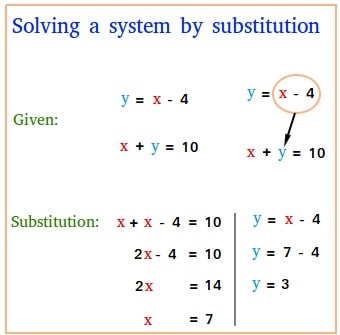
- Pick an equation and solve either for x or for y. It may be beneficial to pick the equation where it is easy to solve for the variable.
- If you solved for x in step 1, substitute the value of x into the other equation. Otherwise, if you solved for y, substitute the value of y into the other equation.
- If you solved for x in step 1 and substituted the value of x into the other equation, you will end up with a linear equation where the variable is y. Solve for y! If on the other hand, you solved for y in step 1 and substituted the value of y into the other equation, you will end up with a linear equation where the variable is x. Solve for x!
- Plug the value of the variable you found in step 3 into one of the original equations in order to find the value of the other variable.
When you substitute, put the whole expression in parentheses. Then the number in front of the variable multiplies every term of the expression.
Solve x + y = 9 for y.
Show answer
y = 9 − x. Subtract x from both sides.
Example #1: Solving for x First
Example #1: Solve the following system using the substitution method
x + y = 20
x − y = 10
Step 1
You have two equations. Pick either the top equation or the bottom equation and solve for either x or y.
Since I am the one solving it, I have decided to choose the equation at the bottom (x − y = 10) and I will solve for x.
x − y = 10
Add y to both sides
x − y + y = 10 + y
x = 10 + y
Step 2
Since you used the equation at the bottom and solved the equation for the variable x, you will substitute x into the equation on top (x + y = 20)
Using x + y = 20, erase x and write 10 + y since x = 10 + y
We get 10 + y + y = 20
Step 3
Solve for y
10 + y + y = 20
10 + 2y = 20
Subtract 10 from both sides
10 − 10 + 2y = 20 − 10
2y = 10
Divide both sides by 2
y = 5
Step 4
Since you have found the value of the variable y, you can plug its value into either the top equation or the bottom to get x.
Replacing y into x + y = 20 gives x + 5 = 20
Subtract 5 from both sides
x + 5 − 5 = 20 − 5
x = 15
The solution to the system is x = 15 and y = 5
Indeed 15 + 5 = 20 and 15 − 5 = 10
Example #2: Solving for y First
Example #2: Solve the following system using the substitution method
3x + y = 10
−4x − 2y = 2
Step 1
You have two equations. Pick either the first equation (top) or the second equation (bottom) and solve for either x or y.
I have decided to choose the equation on top (3x + y = 10) and I will solve for y.
3x + y = 10
Subtract 3x from both sides
3x − 3x + y = 10 − 3x
y = 10 − 3x
Step 2
Since you used the equation on top to solve for y, you will substitute y into the equation at the bottom (−4x − 2y = 2)
Using −4x − 2y = 2, erase y and write 10 − 3x keeping in mind that there is a multiplication between 2 and y.
We get −4x − 2 × (10 − 3x) = 2
Step 3
Solve for x
−4x − 2 × (10 − 3x) = 2
−4x − 20 + 6x = 2 (After multiplying −2 by 10 and −2 by −3x)
2x − 20 = 2
Add 20 to both sides
2x − 20 + 20 = 2 + 20
2x = 22
Divide both sides by 2
x = 11
Step 4
Now you have x, you can replace its value into either the first equation on top or the second equation at the bottom to get y.
Replacing x into 3x + y = 10 gives 3 × 11 + y = 10
33 + y = 10
Subtract 33 from both sides
33 − 33 + y = 10 − 33
y = −23
The solution to the system is x = 11 and y = −23
Indeed, 3 × 11 + (−23) = 33 + (−23) = 10 and −4 × 11 − 2 × (−23) = −44 + 46 = 2
Multiplying only the first term in the parentheses. −2 × (10 − 3x) is −20 + 6x, not −20 − 3x: the −2 multiplies both 10 and −3x.
You should have noticed so far that the reason we call this method the substitution method is that after you have solved for a variable in one equation, you substitute the value of that variable into the other equation.
- The first equation is already solved for y: y = 2x − 1.
- Substitute 2x − 1 for y in the second equation: 3x + 2(2x − 1) = 12.
- Multiply out: 3x + 4x − 2 = 12, so 7x − 2 = 12.
- Add 2 to both sides: 7x = 14, so x = 2.
- Put x = 2 into y = 2x − 1: y = 2(2) − 1 = 3.
- Check: 3(2) + 2(3) = 6 + 6 = 12.
x = 2 and y = 3
After substituting y = 5 − x into 2x + 3y = 13, what equation do you get once you multiply out?
Show answer
2x + 15 − 3x = 13, which simplifies to −x + 15 = 13, so x = 2 and y = 3.
Using the Substitution Method to Show That a System Has Infinitely Many Solutions or No Solution
Example #3: Solve the following system using the substitution method
2x + y = 8
2x + y = 8
Step 1
Pick the equation on top and solve for y.
2x + y = 8
2x − 2x + y = 8 − 2x
y = 8 − 2x
Step 2
Substitute the value of y in the equation at the bottom.
2x + 8 − 2x = 8
8 = 8
Notice that instead of finding a value for x, we end up with a true statement (8 = 8)
When this happens, it means that the system has an infinite number of solutions. Any ordered pair (x, y) that solves 2x + y = 8 is a solution. Find ordered pairs by choosing anything you want for x and then solve for y.
For example, if I choose 1 for x, then 2(1) + y = 8
2 + y = 8
y = 6
A solution is (1, 6). You can find infinitely many solutions if you keep choosing arbitrary values for x.
Example #4: Solve the following system using the substitution method
2x + y = 4
2x + y = 8
Step 1
Pick the equation on top and solve for y.
2x + y = 4
2x − 2x + y = 4 − 2x
y = 4 − 2x
Step 2
Substitute the value of y in the equation at the bottom.
2x + 4 − 2x = 8
4 = 8
Notice that instead of finding a value for x, we end up with a false statement (4 = 8)
If you solve a system by substitution and you end up with a true statement, it means that the system has an infinite number of solutions.
If you solve a system by substitution and you end up with a false statement, it means that the system has no solution.
Substituting y = 7 − x into x + y = 5 gives x + 7 − x = 5. What does this tell you?
Show answer
The system has no solution. It simplifies to 7 = 5, a false statement.
Summary
- Solve one equation for x or for y. Pick the variable that is easiest to get alone.
- Substitute that expression, in parentheses, into the other equation.
- Multiply out, solve the equation with one variable, then plug that value back in to find the other variable.
- Check the answer in both original equations.
- A true statement such as 8 = 8 means infinitely many solutions; a false statement such as 4 = 8 means no solution.
Interactive Practice: Solve 3 Systems by Substitution
You work in a substitution layout, the way you would on paper. Problem 1 guides you through every small step, problem 2 has fewer, bigger steps with a hint for each, and problem 3 is your turn with key steps only. You can skip a problem at any time, and each play gives new systems.
Practice Complete! 🎉