Solving Two-Step Equations
In this lesson, you will learn
- the two steps for solving ax + b = c and ax − b = c
- why you must do the same thing to both sides of an equation
- how to solve two-step equations with fractions and decimals
- a quick formula for checking multiple-choice answers
The Two Steps
When solving two-step equations, these equations will have the following linear form: ax + b = c or ax − b = c, where a is called the coefficient and b and c are called constants.
Of course, only two steps are needed as shown below:
- Step 1: Isolate ax
- Step 2: Isolate x
Remember also the Golden Rule of Algebra. Whatever you do to one side of an equation, you must also do the same to the other side of the equation in order to keep the equation balanced.
What is the first step to solve 3x + 5 = 20?
Show answer
Subtract 5 from both sides. That isolates 3x: 3x = 15. Then divide both sides by 3 to get x = 5.
Interactive Balance Scale: Solve Two-Step Equations
Step 1: change the left side and the right side, each with its own operation and number. If the two sides get different changes, the scale tips. Step 2: put a value for x on the scale and watch it tilt until it balances.
3x + 5 = 20
Step 1: Change the left side and the right side
Left side
Right side
Step 2: Check your answer in the original equation
Solving Two-Step Equations of the Form ax − b = c
Example #1
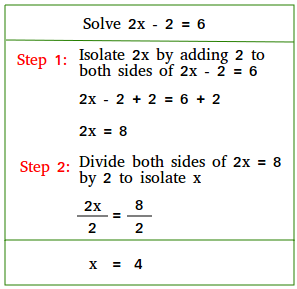
Solve 2x − 2 = 6
Step 1:
Isolate 2x by adding 2 to both sides of 2x − 2 = 6
2x − 2 + 2 = 6 + 2
2x = 8
Step 2:
Divide both sides of 2x = 8 by 2 to isolate x
2x2 = 82
x = 4
You can check to see if x = 4 is indeed a solution by replacing x with 4 in the original equation.
2(4) − 2 = 8 − 2 = 6 ✓
Generally speaking, when solving equations of the form ax − b = c, you can add b to both sides of the equation to isolate ax (step 1) and then divide both sides by a to isolate x (step 2).
ax − b = c
Step 1:
ax − b + b = c + b
ax + 0 = c + b
ax = c + b
Step 2:
axa = c + ba
Solve 4x − 3 = 9.
Show answer
x = 3. Add 3 to both sides: 4x = 12. Divide both sides by 4: x = 3. Check: 4(3) − 3 = 9.
Solving Two-Step Equations of the Form ax + b = c
Example #2
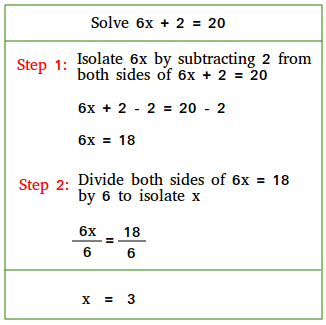
Solve 6x + 2 = 20
Step 1:
Isolate 6x by subtracting 2 from both sides of 6x + 2 = 20
6x + 2 − 2 = 20 − 2
6x = 18
Step 2:
Divide both sides of 6x = 18 by 6 to isolate x
6x6 = 186
x = 3
In general, when solving equations of the form ax + b = c, you can subtract b from both sides of the equation to isolate ax (step 1) and then divide both sides by a to isolate x (step 2).
ax + b = c
Step 1:
ax + b − b = c − b
ax + 0 = c − b
ax = c − b
Step 2:
axa = c − ba
There is nothing special about subtracting b or adding b to both sides and then dividing by a! In practice, mathematicians prefer to add or subtract something from both sides and then divide by a because calculations are usually easier.
Notice though that there is another way to solve example #1 above with just two steps as well.
- The first step is to divide both sides of the equation by a
- The second step is to either add something to both sides of the new equation or subtract something from both sides of the new equation.
Solve 2x − 2 = 6 by following the two steps outlined immediately above
Step 1:
Divide both sides of 2x − 2 = 6 by 2
2x − 22 = 62
x − 1 = 3
Step 2:
Add 1 to both sides of x − 1 = 3
x − 1 + 1 = 3 + 1
x = 4
Dividing only one term. When you divide 2x − 2 by 2, both terms get divided: 2x − 22 = x − 1, not x − 2.
Solve 5x + 4 = 29.
Show answer
x = 5. Subtract 4 from both sides: 5x = 25. Divide both sides by 5: x = 5.
Solving Two-Step Equations Involving Fractions
Example #3
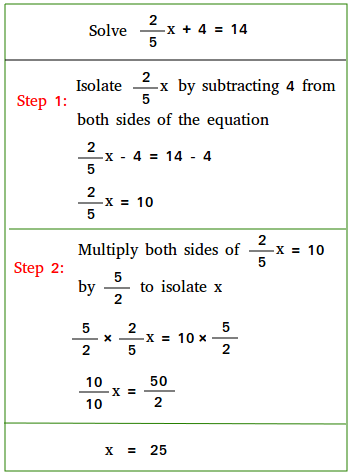
Solve 25x + 4 = 14
Step 1:
Isolate 25x by subtracting 4 from both sides of 25x + 4 = 14
25x + 4 − 4 = 14 − 4
25x = 10
Step 2:
Multiply both sides of 25x = 10 by the reciprocal of 25 or 52.
(52)25x = 10(52)
1010x = 502
x = 25
Multiplying by the reciprocal of a fraction is the same as dividing by the fraction. 25 times its reciprocal 52 is 1, so only x is left.
Again, we can also solve example #3 by dividing both sides by 25 first.
25x + 4 = 14
Divide both sides by 25
[(25) ÷ (25)]x + 4 ÷ 25 = 14 ÷ 25
[1]x + 41 ÷ 25 = 141 ÷ 25
x + 41 × 52 = 141 × 52
x + 202 = 702
x + 10 = 35
Subtract 10 from both sides
x + 10 − 10 = 35 − 10
x + 0 = 25
x = 25
Solve 34x − 2 = 7.
Show answer
x = 12. Add 2 to both sides: 34x = 9. Multiply both sides by 43: x = 363 = 12.
Solving Two-Step Equations Involving Decimals
The steps to follow are the same when solving two-step equations involving decimals.
Example #4
Solve 3.1x + 1.2 = 7.4
Subtract 1.2 from both sides of 3.1x + 1.2 = 7.4 to isolate 3.1x
3.1x + 1.2 − 1.2 = 7.4 − 1.2
3.1x = 6.2
Divide both sides of 3.1x = 6.2 by 3.1 to isolate x
3.1x3.1 = 6.23.1
x = 2
Solve 0.5x + 1.5 = 4.
Show answer
x = 5. Subtract 1.5 from both sides: 0.5x = 2.5. Divide both sides by 0.5: x = 5.
The Super Fast Way to Solve Two-Step Equations
When taking a test, there is no need to follow all the steps above if all you need to do is to choose the right answer from a list of multiple choices.
To solve ax + b = c, just use x = c − ba
You can solve example #2 or 6x + 2 = 20 very fast.
x = 20 − 26 = 186 = 3
Similarly, you can solve example #1 or 2x − 2 = 6 very fast.
x = c + ba = 6 + 22 = 82 = 4
- Step 1: subtract 8 from both sides to isolate −3x: −3x + 8 − 8 = 2 − 8, so −3x = −6.
- Step 2: divide both sides by −3 to isolate x: x = −6−3 = 2.
- Check: −3(2) + 8 = −6 + 8 = 2.
- Fast way: x = c − ba = 2 − 8−3 = −6−3 = 2.
x = 2
Summary
- A two-step equation has the form ax + b = c or ax − b = c.
- Step 1: add or subtract to isolate ax. Step 2: divide by a to isolate x.
- Whatever you do to one side of the equation, do the same to the other side.
- With a fraction coefficient, multiply both sides by its reciprocal; decimals use the same steps.
- Check your answer by putting it back into the original equation.
Test Yourself: Interactive 10-Question Quiz
Now check what you learned. Every answer is explained, and each time you play you get new questions.
Quiz Complete!