Solve Equations Using the Distributive Property
In this lesson, you will learn
- how to use the distributive property to remove parentheses in an equation
- how to finish the solution as a two-step equation
- how to solve equations with parentheses on both sides
- how to handle negative numbers when you distribute
How the Distributive Property Helps You Solve Equations
Learn to solve equations using the distributive property with the following three good examples.
The distributive property says a(b + c) = ab + ac. The number outside the parentheses multiplies every term inside.
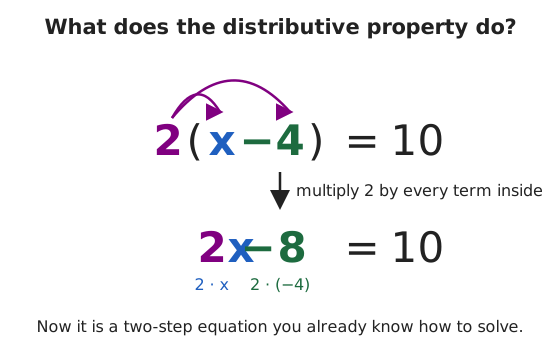
First remove the parentheses with the distributive property. Then solve the new equation the same way you solve a two-step equation.
Example #1: Solve 2(x − 4) = 10
Solve 2(x − 4) = 10 using the distributive property
2(x − 4) = 10
Use the distributive property
2x − 8 = 10
Isolate x by adding 8 to both sides of the equation
2x − 8 = 10
2x − 8 + 8 = 10 + 8
2x = 18
Divide each side by 2
2x2 = 182
x = 9
Solve 3(x + 2) = 21.
Show answer
x = 5. Distribute: 3x + 6 = 21. Subtract 6 from both sides: 3x = 15. Divide both sides by 3: x = 5.
Example #2: Solve 6(x − 2) = 2(9 − 2x)
Solve 6(x − 2) = 2(9 − 2x) using the distributive property
6(x − 2) = 2(9 − 2x)
Use the distributive property
6x − 12 = 18 − 4x
Isolate x by adding 12 to both sides of the equation and by adding 4x to both sides of the equation.
6x + 4x − 12 + 12 = 18 + 12 − 4x + 4x
6x + 4x = 18 + 12
Simplify
10x = 30
Divide both sides by 10
10x10 = 3010
x = 3
Multiplying only the first term. 2(9 − 2x) is 18 − 4x, not 18 − 2x. The 2 must multiply the 9 and the −2x.
Solve 4(x − 1) = 2(x + 3).
Show answer
x = 5. Distribute: 4x − 4 = 2x + 6. Subtract 2x and add 4 on both sides: 2x = 10. Divide by 2: x = 5.
Example #3: Solve −2x + 4(x + 3) = 2(−3x + (−6))
Solve −2x + 4(x + 3) = 2(−3x + (−6)) using the distributive property
−2x + 4(x + 3) = 2(−3x + (−6))
Use the distributive property
−2x + 4x + 12 = −6x + (−12)
Isolate x by subtracting 12 from each side of the equation and by adding 6x to both sides of the equation
−2x + 4x + 12 − 12 + 6x = −6x + 6x + (−12) − 12
−2x + 4x + 6x = −12 − 12
Simplify
8x = −24
Divide both sides by 8
8x8 = −248
x = −3
- Distribute the −3 to both terms: −3 · x = −3x and −3 · (−2) = +6. So −3x + 6 = 15.
- Subtract 6 from both sides: −3x = 9.
- Divide both sides by −3: x = −3.
- Check: −3(−3 − 2) = −3(−5) = 15. It works.
x = −3
Losing a sign when the number outside is negative. −3(x − 2) is −3x + 6, not −3x − 6, because a negative times a negative is positive.
Solve 5(x − 2) = 3(x + 4).
Show answer
x = 11. Distribute: 5x − 10 = 3x + 12. Subtract 3x and add 10 on both sides: 2x = 22. Divide by 2: x = 11.
How to solve an equation with a variable on both sides of the equation.
Summary
- Use the distributive property, a(b + c) = ab + ac, to remove the parentheses first.
- Multiply the number outside by every term inside, and keep track of the signs.
- Collect the x terms on one side and the numbers on the other side by doing the same thing to both sides.
- Divide both sides by the number in front of x, then check your answer in the original equation.
Test Yourself: Interactive 10-Question Quiz
Now check what you learned. Every answer is explained, and each time you play you get new questions.
Quiz Complete! 🎉