Elimination Method
In this lesson, you will learn
- the four steps of the elimination method
- how adding the two equations can cancel one variable
- what to do when nothing cancels: multiply an equation first
- how to find the second variable and check your answer
The Steps to Follow When Solving With the Elimination Method
Systems of linear equations can also be solved using the elimination method. We will show how to solve them with some carefully chosen examples. Before you learn this lesson, make sure you understand how to solve linear equations.
- Try to eliminate a variable as you add the left sides and the right sides of the two equations.
- Set the sum resulting from adding the left sides equal to the sum resulting from adding the right sides.
- Solve for the variable that was not cancelled or eliminated.
- Use the answer found in step 3 to solve for the other variable by substituting this value in one of the two equations.
Whenever you add the left sides, add the right sides too, so the equation stays balanced.
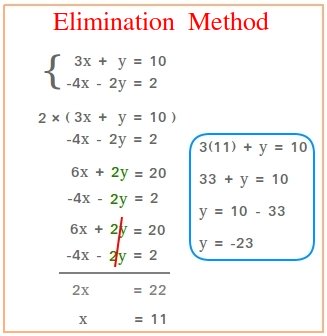
First, read the example in the figure carefully and then keep reading to see more detailed explanations on how to solve using the elimination method.
Which variable cancels when you add x + 3y = 7 and 2x − 3y = 8?
Show answer
y. 3y + (−3y) = 0, and adding gives 3x = 15, so x = 5.
Example #1: Adding the Equations
Example #1: Solve the following system using the elimination method.
x + y = 20
x − y = 10
Step 1
Examine the two equations carefully. After a close examination, notice that you can eliminate or cancel the variable y by adding the left sides (x + y and x − y).
However, since you are adding the left sides, you have to add the right sides (20 and 10) of the two equations also to keep the equation balanced.
For the system above, it turns out that it is easy to eliminate y while adding the left sides since x + y + x − y = x + x + y − y = x + x + 0 = 2x.
Step 2
The sum for the left sides is 2x and the sum for the right sides is 20 + 10 = 30
Setting them equal, we get 2x = 30
Step 3
Solve 2x = 30 for x by dividing both sides of this equation by 2.
2x = 30
22x = 302
x = 15
Step 4
You can substitute 15 for x in either x + y = 20 or x − y = 10 to get y.
Choosing the first one, we get 15 + y = 20
Subtract 15 from both sides to get y = 5
Now check yourself that the answer is still the same if you had chosen to substitute 15 for x in x − y = 10
Do that check: substitute 15 for x in x − y = 10. What is y?
Show answer
y = 5. 15 − y = 10, so y = 5, the same answer.
Example #2: Multiplying an Equation First
Example #2: Solve the following system using the elimination method.
3x + y = 10
−4x − 2y = 2
Step 1
First, notice that nothing can be eliminated when adding the left sides since 3x + y + (−4x) − 2y = −x − y
However, in 3x + y = 10, if I can turn y into 2y, I could eliminate the variable y by adding 2y to −2y in −4x − 2y = 2
Therefore, turn y into 2y by multiplying the whole equation by 2
2 × (3x + y = 10) gives the new equation 6x + 2y = 20
Adding the left side of 6x + 2y = 20 to the left side of −4x − 2y = 2 gives what you see below:
6x + 2y + (−4x) − 2y = 6x + (−4x) + 2y − 2y = 2x + 0 = 2x
Adding the right sides gives us 20 + 2 = 22
Step 2
The sum for the left sides is 2x and the sum for the right sides is 22
Setting them equal, we get 2x = 22
Step 3
Solve for x by dividing both sides of this equation by 2
2x = 22
22x = 222
x = 11
Step 4
You can substitute 11 for x in either 3x + y = 10 or −4x − 2y = 2 to get y
Choosing the first one, we get 3 × 11 + y = 10
33 + y = 10
Subtract 33 from both sides to get y = −23
Multiplying only the left side. 2 × (3x + y = 10) is 6x + 2y = 20, not 6x + 2y = 10. Multiply every term on both sides.
You should have noticed that the reason we call this method the elimination method is that the first thing you do is eliminate a variable.
Check the answer x = 11 and y = −23 in the second equation, −4x − 2y = 2.
Show answer
It works. −4(11) − 2(−23) = −44 + 46 = 2.
One More Example, Step by Step
- Adding the equations as they are gives 4x − 2y = 12, which still has both variables. To cancel y, turn 2y into 4y: multiply the first equation by 2 to get 2x + 4y = 16.
- Add the left sides and the right sides: (2x + 4y) + (3x − 4y) = 16 + 4, so 5x = 20.
- Divide both sides by 5: x = 4.
- Substitute 4 for x in x + 2y = 8: 4 + 2y = 8, so 2y = 4 and y = 2.
- Check in the second equation: 3(4) − 4(2) = 12 − 8 = 4.
x = 4 and y = 2
Summary
- The elimination method adds the two equations so that one variable cancels.
- Whatever you add to the left side, add to the right side too.
- If nothing cancels, multiply a whole equation (both sides) by a number first.
- Solve the one-variable equation, then substitute that value into one of the equations to find the other variable.
- Check the answer in the equation you did not use.
Interactive Practice: Solve 3 Systems by Elimination
You work in an elimination layout, the way you would on paper. Problem 1 guides you through every small step, problem 2 has fewer, bigger steps with a hint for each, and problem 3 is your turn with key steps only. You can skip a problem at any time, and each play gives new systems.
Practice Complete! 🎉