Solving Quadratic Equations by Factoring
Solving quadratic equations by factoring is often the simplest and quickest method, as long as you know how to factor. If factoring is new to you or a little rusty, do not worry. This interactive lesson shows you how to factor each equation one step at a time, starting with simple examples and building up to harder ones.
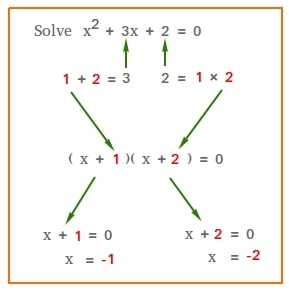
To solve a quadratic equation by factoring, write it as a product of two factors equal to 0, like (x + )(x + ) = 0. Find the numbers that go in the boxes, then set each factor equal to 0. This works because of the zero product property: if a product equals zero, at least one of its factors must be zero.
Examples of solving quadratic equations by factoring
Reveal each solution one step at a time, or show all the steps at once.
x² + 3x + 2 = 0
| Try | Cross multiply and add |
|---|---|
| xx12 | 2x + x = 3x ✓ |
| xx−1−2 | −2x − x = −3x |
Why is the grid arranged like that?
(x + 1)(x + 2) xx 12 This is the grid that gave 3x, shown with its two factors, (x + 1) and (x + 2). Press Next to see how they match.= x² + 2x + x + 2 = x² + 3x + 2 ✓The two middle products, x · 2 and 1 · x, are the diagonals of the grid.
x + 2 = 0 → x = −2
(−2)² + 3(−2) + 2 = 4 − 6 + 2 = 0 ✓
x² − 3x + 2 = 0
| Try | Cross multiply and add |
|---|---|
| xx12 | 2x + x = 3x |
| xx−1−2 | −2x − x = −3x ✓ |
x − 2 = 0 → x = 2Compare with Example 1: flipping the sign of the middle term flips the signs of the solutions.
2² − 3(2) + 2 = 4 − 6 + 2 = 0 ✓
x² + x − 30 = 0
| Try | Cross multiply and add |
|---|---|
| xx1−30 | −30x + x = −29x |
| xx−130 | 30x − x = 29x |
| xx2−15 | −15x + 2x = −13x |
| xx−215 | 15x − 2x = 13x |
| xx3−10 | −10x + 3x = −7x |
| xx−310 | 10x − 3x = 7x |
| xx5−6 | −6x + 5x = −x |
| xx−56 | 6x − 5x = x ✓ |
x + 6 = 0 → x = −6
(−6)² + (−6) − 30 = 36 − 6 − 30 = 0 ✓
x² − x − 30 = 0
| Try | Cross multiply and add |
|---|---|
| xx1−30 | −30x + x = −29x |
| xx−130 | 30x − x = 29x |
| xx2−15 | −15x + 2x = −13x |
| xx−215 | 15x − 2x = 13x |
| xx3−10 | −10x + 3x = −7x |
| xx−310 | 10x − 3x = 7x |
| xx5−6 | −6x + 5x = −x ✓ |
| xx−56 | 6x − 5x = x |
x − 6 = 0 → x = 6
6² − 6 − 30 = 36 − 6 − 30 = 0 ✓
6x² + 27x + 30 = 0
(3x + )(2x + )
or (6x + )(x + )The first terms must multiply to 6x². With whole numbers, that means 3x and 2x, or 6x and x. The two numbers in the boxes must multiply to 30.
| Try | Cross multiply and add |
|---|---|
| 6xx301 | 6x + 30x = 36x |
| 6xx152 | 12x + 15x = 27x ✓ |
| 6xx65 | 30x + 6x = 36x |
| 3x2x301 | 3x + 60x = 63x |
| 3x2x152 | 6x + 30x = 36x |
| 3x2x65 | 15x + 12x = 27x ✓ |
= 6x² + 12x + 15x + 30 = 6x² + 27x + 30 ✓The columns are the factors (6x + 15) and (x + 2). The top row gives 6x², the bottom row gives 30, and the diagonals, 6x · 2 and 15 · x, give 12x + 15x = 27x.
(3x + 6)(2x + 5) = 0Both multiply back out to 6x² + 27x + 30. Either one gives the same solutions.
x + 2 = 0 → x = −2
2x + 5 = 0 → x = −52
6(−52)² + 27(−52) + 30 = 37.5 − 67.5 + 30 = 0 ✓
Steps for solving a quadratic equation by factoring
Every example above follows the same steps.
- Write the equation in standard form, ax² + bx + c = 0. Move every term to one side so the other side is 0.
- Factor out the greatest common factor (GCF), if there is one.
- Factor into two sets of boxes, like (x + )(x + ). Cross multiply the possible numbers until the middle term matches.
- Set each factor equal to 0 and solve.
- Check each solution in the original equation.
For x² + bx + c, cross multiplying just adds the two numbers, so you don't need the table. A quick look is enough: find two numbers that multiply to c and add to b. The signs follow this pattern:
| If c is… | and b is… | then the two numbers are… | Example |
|---|---|---|---|
| positive | positive | both positive | x² + 7x + 12: 3 and 4 |
| positive | negative | both negative | x² − 7x + 12: −3 and −4 |
| negative | positive or negative | one positive, one negative; the larger one (ignoring signs) has the same sign as b | x² + x − 12: 4 and −3 x² − x − 12: −4 and 3 |
The solutions have the opposite signs of the two numbers. If the numbers are 4 and −3, the factors are (x + 4)(x − 3), and the solutions are x = −4 and x = 3.
Special cases, step by step
Each tab shows a situation that often trips students up. Pick one to see it solved step by step.
x² = 5x + 14
| Try | Cross multiply and add |
|---|---|
| xx1−14 | −14x + x = −13x |
| xx−114 | 14x − x = 13x |
| xx2−7 | −7x + 2x = −5x ✓ |
| xx−27 | 7x − 2x = 5x |
7² = 49 and 5(7) + 14 = 49 ✓
3x² − 12x = 0
x − 4 = 0 → x = 4
3(4)² − 12(4) = 48 − 48 = 0 ✓
x² − 49 = 0
| Try | Cross multiply and add |
|---|---|
| xx1−49 | −49x + x = −48x |
| xx−149 | 49x − x = 48x |
| xx7−7 | −7x + 7x = 0 ✓ |
| xx−77 | 7x − 7x = 0 ✓ |
x² − 10x + 25 = 0
| Try | Cross multiply and add |
|---|---|
| xx125 | 25x + x = 26x |
| xx−1−25 | −25x − x = −26x |
| xx55 | 5x + 5x = 10x |
| xx−5−5 | −5x − 5x = −10x ✓ |
2x² + 5x − 3 = 0
| Try | Cross multiply and add |
|---|---|
| 2xx1−3 | −6x + x = −5x |
| 2xx−31 | 2x − 3x = −x |
| 2xx−13 | 6x − x = 5x ✓ |
| 2xx3−1 | −2x + 3x = x |
x + 3 = 0 → x = −3
2(−3)² + 5(−3) − 3 = 18 − 15 − 3 = 0 ✓
−x² + 2x + 15 = 0
| Try | Cross multiply and add |
|---|---|
| xx1−15 | −15x + x = −14x |
| xx−115 | 15x − x = 14x |
| xx3−5 | −5x + 3x = −2x ✓ |
| xx−35 | 5x − 3x = 2x |
−(5)² + 2(5) + 15 = −25 + 10 + 15 = 0 ✓
A rectangle is 3 meters longer than it is wide. Its area is 40 square meters. Find its width and length.
| Try | Cross multiply and add |
|---|---|
| ww1−40 | −40w + w = −39w |
| ww−140 | 40w − w = 39w |
| ww2−20 | −20w + 2w = −18w |
| ww−220 | 20w − 2w = 18w |
| ww4−10 | −10w + 4w = −6w |
| ww−410 | 10w − 4w = 6w |
| ww5−8 | −8w + 5w = −3w |
| ww−58 | 8w − 5w = 3w ✓ |
Your turn
Which is the equation in standard form, with 0 on one side?
What is the greatest common factor of all the terms in ?
Set each factor equal to 0 and solve for x. If a factor can never be 0, press Never 0. You can type a fraction like 3/2 or a decimal like 1.5.
Solve by factoring. Choose the complete set of solutions.
When factoring doesn't work
Not every quadratic equation can be factored with whole numbers. Take x² + x − 1 = 0. The two numbers would have to multiply to −1 and add to 1, and the only whole-number pairs that multiply to −1 are 1 and −1, which add to 0. When no pair works, solve the equation with the quadratic formula instead. Factoring is fastest when it works, so it's worth trying first.
Common mistakes
- Factoring before the equation equals 0. In x² + 3x = 10, writing x(x + 3) = 10 doesn't help. Subtract 10 first: x² + 3x − 10 = 0, so (x + 5)(x − 2) = 0.
- Giving the numbers instead of the solutions. (x + 6)(x − 5) = 0 has the solutions x = −6 and x = 5. The signs flip when you solve each factor.
- A pair that multiplies right but adds wrong. For x² + x − 30, the pair 5 and −6 multiplies to −30 but adds to −1, not 1. Check both conditions.
- Dividing both sides by x. In 3x² = 12x, dividing by x loses the solution x = 0. Move everything to one side and factor out 3x instead.
- Only one answer for x² = 49. x² − 49 = (x + 7)(x − 7), so x = 7 and x = −7.
- Two answers for a perfect square. (x − 5)² = 0 has only one solution, x = 5.
- Keeping answers that don't make sense. In a word problem, a negative length or width is not a real answer. Check each solution against the situation.