Zero Product Property
What Is the Zero Product Property?
In this lesson, you will learn
- what the zero product property says, for two factors and for any number of factors
- how to tell whether an equation is ready for the property
- four steps to solve equations with it, including when you must factor first
- the most common mistakes, and why the property fails for matrices
- The rule
- What must be zero?
- Is it ready?
- Worked examples
- Your turn
- Matrices
- Common mistakes
- Summary
- Quiz
The zero product property says that if a product equals zero, at least one of its factors must be zero. It turns one hard equation into several easy ones. The catch is that it only works when one side is exactly 0 and the other side is written as factors multiplied together, so most of the work is getting the equation into that shape. Since in many cases there can be more than 2 factors, we can generalize the zero product property as shown below.
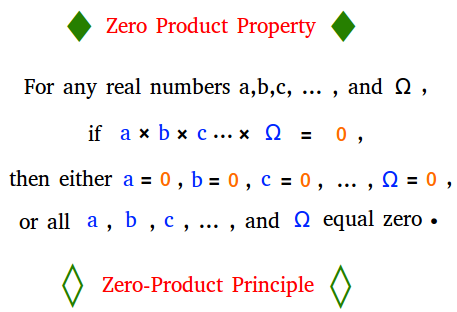
The Zero Product Property Rule
If a · b = 0, then a = 0 or b = 0 (or both).
The general rule, for any number of factors
At least one of the factors must be 0. More than one can be 0 at the same time, and all of them can be 0. This rule is also called the zero-product principle.
Why it works. Two numbers that aren't 0 never multiply to 0: 3 · 5 = 15 and −2 · 4 = −8. The only way to get a product of 0 is for at least one factor to be 0.
It only works when the product is 0. If a · b = 6, you can't conclude that a = 6 or b = 6. The factors could be 2 and 3, or 1 and 6, or −2 and −3. Only a product of 0 tells you what one of the factors must be.
Four steps
- Get 0 alone on one side. Add or subtract terms until one side is 0.
- Factor the other side completely.
- Set each factor equal to 0 and solve. A number factor like 5 can never be 0, so it gives no solution.
- Check each answer in the original equation.
7(x + 2) = 0. What is x?
Show answer
x = −2. The factor 7 can never be 0, so x + 2 must be 0.
What Must Be Zero?
Before solving any equations, get a feel for the rule itself. Each product below tells you something about its factors. Decide what it tells you.
Is It Ready?
You can use the zero product property only when one side is 0 and the other side is a product. Decide for each equation: can you set the factors equal to 0 right now, or does it need work first?
Worked Examples
Try each example yourself first. Press Step through it to reveal one step at a time, or Show all steps to see the full solution.
(x − 3)(x + 5) = 0
- Is it ready? Yes. The right side is 0 and the left side is a product of two factors.
- Set each factor equal to 0.x − 3 = 0 or x + 5 = 0
- Solve each one.x = 3 or x = −5
- Check.(3 − 3)(3 + 5) = 0 · 8 = 0 ✓(−5 − 3)(−5 + 5) = −8 · 0 = 0 ✓
x = 3 or x = −5
2x(x − 7) = 0
- Is it ready? Yes. The factors are 2, x and (x − 7), and their product is 0.
- Look at each factor.2 = 0 or x = 0 or x − 7 = 0
- The factor 2 gives nothing. 2 = 0 is never true, so the number 2 gives no solution.
- Solve the rest.x = 0 or x = 7x = 0 is the solution students forget most often.
- Check.2 · 0 · (0 − 7) = 0 ✓2 · 7 · (7 − 7) = 0 ✓
x = 0 or x = 7
x² − 9x + 20 = 0
- Is it ready? Not yet. The left side is a sum of three terms, not a product.
- Factor.(x − 4)(x − 5) = 0Two numbers that multiply to 20 and add to −9 are −4 and −5.
- Set each factor equal to 0.x − 4 = 0 or x − 5 = 0
- Solve.x = 4 or x = 5
- Check in the original equation.4² − 9 · 4 + 20 = 16 − 36 + 20 = 0 ✓5² − 9 · 5 + 20 = 25 − 45 + 20 = 0 ✓
x = 4 or x = 5
4x² = 64x
- The tempting shortcut.4x = 64 → x = 16Dividing both sides by x loses a solution. When x = 0, dividing by x means dividing by 0, so x = 0 quietly disappears.
- Get 0 on one side.4x² − 64x = 0Subtract 64x from both sides.
- Factor out 4x.4x(x − 16) = 0
- Set each factor equal to 0.4x = 0 or x − 16 = 0
- Solve.x = 0 or x = 16
- Check.4 · 0² = 0 and 64 · 0 = 0 ✓4 · 16² = 1024 and 64 · 16 = 1024 ✓
x = 0 or x = 16
x(x − 5) = 6
- The trap.x = 6 or x − 5 = 6 → x = 11Check x = 11: 11(11 − 5) = 66, not 6. Many pairs multiply to 6 (2 · 3, 1 · 6, −2 · −3), so neither factor has to be 6. The property only works for 0.
- Multiply out.x² − 5x = 6
- Get 0 on one side.x² − 5x − 6 = 0Subtract 6 from both sides.
- Factor.(x − 6)(x + 1) = 0−6 and 1 multiply to −6 and add to −5.
- Solve.x = 6 or x = −1
- Check in the original equation.6(6 − 5) = 6 · 1 = 6 ✓−1(−1 − 5) = −1 · −6 = 6 ✓
x = 6 or x = −1
(x + 2)(3x − 1)(x − 4) = 0
- Is it ready? Yes. Three factors multiply to 0, so at least one of them is 0.
- First factor.x + 2 = 0 → x = −2
- Second factor.3x − 1 = 0 → 3x = 1 → x = 13Don't forget to divide by 3.
- Third factor.x − 4 = 0 → x = 4
- Solutions.x = −2, x = 13 or x = 4Three factors give up to three solutions.
- Check x = 1/3.The middle factor is 3 · 13 − 1 = 0, so the whole product is 0 ✓
x = −2, x = 1/3 or x = 4
40x⁴ − 760x² − 1200x = 0
- Is it ready? Not yet. One side is 0, but the other side is a sum of terms. Factor it first.
- Factor out the GCF, 40x.40x(x³ − 19x − 30) = 0
- Factor the cubic.40x(x + 2)(x − 5)(x + 3) = 0You can check this by multiplying (x + 2)(x − 5)(x + 3) back out to get x³ − 19x − 30.
- At least one factor is 0. The four factors are not all 0 at once. Each one gives its own solution.
- Solve each one.40x = 0 → x = 0x + 2 = 0 → x = −2x − 5 = 0 → x = 5x + 3 = 0 → x = −3
x = −3, −2, 0 or 5
Your Turn: Practice
Solve one step at a time. Each new problem has new numbers. Use I'm stuck for a hint, or Show solution to see every step.
Does It Work for Matrices?
No. The zero product property is about real numbers. With matrices, two matrices that are not the zero matrix can multiply to give the zero matrix.
Neither A nor B is the zero matrix, yet A × B is. So a zero product of matrices doesn't tell you that one of the matrices is zero.
Each entry is a row of A times a column of B.
- Row 1, column 1: 0 · 0 + 0 · 0 = 0
- Row 1, column 2: 0 · (−2) + 0 · 1 = 0
- Row 2, column 1: 3 · 0 + 6 · 0 = 0
- Row 2, column 2: 3 · (−2) + 6 · 1 = −6 + 6 = 0
Every entry is 0, so A × B is the zero matrix.
What about B × A? Multiply the same two matrices in the opposite order.
- Row 1: 0 · 0 + (−2) · 3 = −6, 0 · 0 + (−2) · 6 = −12
- Row 2: 0 · 0 + 1 · 3 = 3, 0 · 0 + 1 · 6 = 6
Same two matrices, opposite order, and the product is not zero. Matrix multiplication depends on the order. That's another way matrices behave differently from numbers.
With real numbers, two numbers that aren't 0 never multiply to 0. Matrices don't have that guarantee, so the property can fail for them.
Common Mistakes
- Using it when the product isn't 0. x(x − 5) = 6 does not mean x = 6 or x − 5 = 6. Subtract 6 first, then factor.
- Dividing both sides by x. In 4x² = 64x, dividing by x gives only x = 16 and loses x = 0. Move everything to one side and factor instead.
- Saying all the factors equal 0. Only one factor has to be 0. In (x − 2)(x + 3) = 0, x is 2 or −3, never both at once.
- Rushing the last step. Once you set each factor equal to 0, solve each small equation carefully. In (x + 5)(3x − 1) = 0, the solutions are x = −5 and x = 1/3, not 5 and 1.
- Losing x = 0. In 2x(x − 7) = 0, the factor x gives the solution x = 0. Don't drop it.
- Treating a number factor as a solution. In 2x(x − 7) = 0, the factor 2 can never equal 0, so it doesn't give a value of x. The solutions are only x = 0 and x = 7.
- Trying it on a sum. (x − 2) + (x + 3) = 0 is not a product. Combine like terms instead.
Summary
- If a product equals 0, at least one of its factors is 0. This works for any number of factors.
- Use it only when one side is exactly 0 and the other side is a product of factors.
- Four steps: get 0 on one side, factor completely, set each factor equal to 0 and solve, then check.
- A number factor like 2 or 40 never gives a solution, but a factor of x gives x = 0.
- Never divide both sides by x, and never use the property when the product is not 0.
- The property is true for real numbers, but not for matrices.
Test Yourself: 10-Question Quiz
Now check what you learned. Every answer is explained, and each time you play you get new numbers.
Quiz Complete!