Introduction to Percents
In this lesson, you will learn
- What a percent means: a number out of 100
- How to convert between percents, fractions and decimals
- How to find a percentage of a number and how to increase or decrease a number by a percentage
- How percents are used for discounts, commissions, savings and loans
Understanding percents is a fundamental skill that you'll use in everyday life, from calculating discounts while shopping to interpreting statistics in the news. This lesson is designed to give you a good introduction and help you explore the topic with real-life applications, ensuring you build a strong foundation for more advanced mathematical concepts.
What Is a Percent?
A percent is a way to express a number as a fraction of 100. The word "percent" comes from the Latin per centum, meaning "by the hundred." It's represented by the symbol %.
For example:
- 50% means 50 out of 100, or simply half.
- 25% means 25 out of 100, which is one-quarter.
Visual example: Imagine a pizza divided into 100 equal slices. If you eat 25 slices, you've eaten 25% of the pizza. The grid below shows the same idea with 100 equal squares.
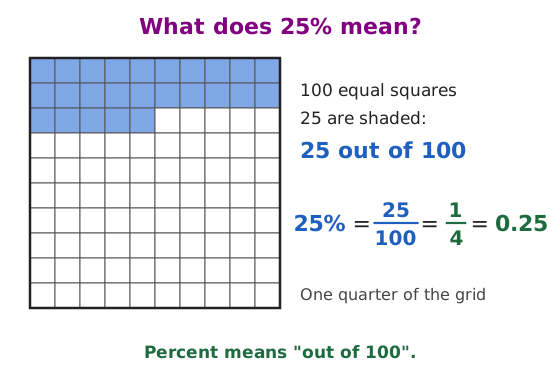
In a grid of 100 squares, 40 squares are shaded. What percent of the grid is shaded?
Show answer
40%. 40 out of 100 is 40%.
Converting Between Percents, Fractions, and Decimals
Understanding how to convert between these forms is essential for working with percents.
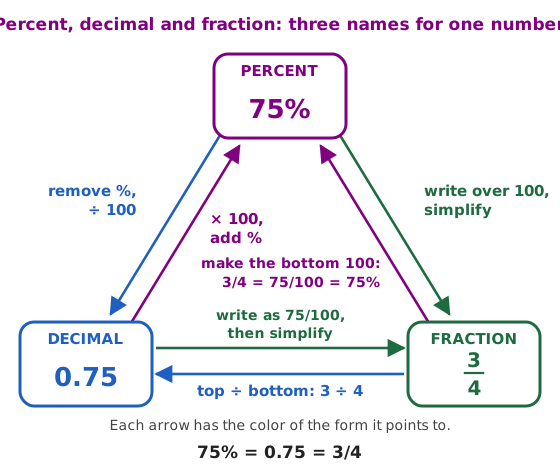
Percent to fraction
75% = 75100 = 34
Percent to decimal
20% = 0.20
Fraction to percent
15 = 20100 = 20%
Decimal to percent
0.85 = 85%
Quick tip: To convert a percent to a decimal, divide by 100. To convert a decimal to a percent, multiply by 100. Dividing by 100 moves the decimal point 2 places to the left; multiplying by 100 moves it 2 places to the right.
Writing 5% as 0.5. Dividing by 100 moves the decimal point 2 places, not 1: 5% = 0.05. (0.5 is 50%.)
Write 8% as a decimal and as a fraction in simplest form.
Show answer
0.08 and 225. 8 ÷ 100 = 0.08, and 8100 = 225.
Basic Percentage Calculations
Let's explore how to perform some basic percentage calculations. In each formula, write the percentage as a decimal first.
Finding a percentage of a number
Formula: percentage × number
Example: What is 30% of 200?
Calculation: 0.30 × 200 = 60
Increasing a number by a percentage
Formula: number + (percentage × number)
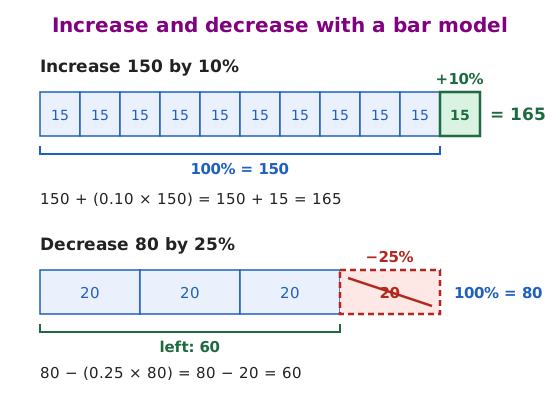
Example: Increase 150 by 10%.
Calculation: 150 + (0.10 × 150) = 150 + 15 = 165
Decreasing a number by a percentage
Formula: number − (percentage × number)
Example: Decrease 80 by 25%.
Calculation: 80 − (0.25 × 80) = 80 − 20 = 60
- Write the percentage as a decimal: 15% = 0.15.
- Find the increase: 0.15 × 2,400 = 360.
- Add it to the starting number: 2,400 + 360 = 2,760.
The town now has 2,760 people.
Decrease 60 by 10%.
Show answer
54. 0.10 × 60 = 6, and 60 − 6 = 54.
Real-Life Applications of Percents
Percents are everywhere! Here are some common scenarios where you'll use percents.
1. Shopping discounts
You may have heard people say that they will give you a 5% discount if you purchase two T-shirts or five pairs of pants. If a jacket is marked down by 20% and the original price is $50:
Discount: 0.20 × 50 = $10
Sale price: $50 − $10 = $40
2. Earnings and jobs
Some jobs, such as car sales, pay based on a percentage of sales. If a car salesperson earns a 10% commission on a $20,000 car sale:
Commission: 0.10 × 20,000 = $2,000
3. Savings and interest
If you have a savings account, the bank may give you 3% interest every year. Say you have $1,000 in a savings account:
Interest: 0.03 × 1,000 = $30
Total after one year: $1,000 + $30 = $1,030
4. Credit and loans
Credit card companies charge high interest, often 20% or more per year, depending on your credit. If you owe $500 on a credit card with a 15% interest rate:
Interest: 0.15 × 500 = $75
Total owed after one year: $500 + $75 = $575
The savings and credit card examples use simple interest for one year to keep the math easy. Real banks and credit card companies usually add interest more often (for example, every month), so the real amounts are a little higher.
An $80 pair of shoes is on sale for 25% off. What is the sale price?
Show answer
$60. 0.25 × 80 = $20 off, and $80 − $20 = $60.
A review of fractions and proportions may help you understand this unit. Therefore, go back and review them if time permits.
Summary
- A percent is a number out of 100: 25% means 25 out of 100.
- Percent to decimal: divide by 100 (25% = 0.25). Decimal to percent: multiply by 100 (0.85 = 85%).
- Percent to fraction: write it over 100 and simplify (75% = 34).
- A percentage of a number: change the percent to a decimal and multiply.
- To increase or decrease by a percentage, find that part of the number, then add it or subtract it.
Test Yourself: Interactive 10-Question Quiz
Now check what you learned. Every answer is explained, and each time you play you get new questions.
Quiz Complete!
Have A Great Math Problem About Percentage?
Share your problem here along with the solution!
This form is being moved to the new site. It will be connected before launch.
What Other Visitors Have Said
Click below to see contributions from other visitors to this page...
A percent word problem 

A factory has 800 workers. 40% of them are females. The management decides to employ more female workers to cope with the increasing demands of the workload …