Fractions to Decimals
In this lesson, you will learn
- Why a fraction is a division: ab = a ÷ b
- Three ways to change a fraction to a decimal: a calculator, a power of 10, and long division
- How to tell if a decimal will end or repeat
Key Idea: A Fraction Is a Division
The fraction bar means "divided by". So 350 = 3 ÷ 50, and changing a fraction to a decimal means dividing the numerator by the denominator.
You may have three choices when changing fractions to decimals. The method you use depends on circumstances and/or what you are trying to accomplish.
- A calculator: the fastest way, when you are allowed to use one.
- A power of 10: change the denominator to 10, 100, 1000, and so on.
- Long division: works for every fraction.
Method 1: Use a Calculator
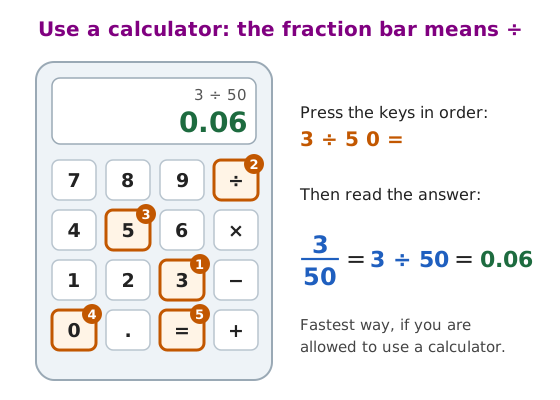
If you are in a hurry to get an answer, then the easiest and fastest way is to use a calculator, provided that you have one in your possession and you are allowed to use one.
Example #1: Convert 350 to a decimal
Suppose you want to convert 350 to a decimal. Just hit the buttons 3, ÷, 50, and = in that order on the calculator. You can then just read off the answer as 0.06.
Method 2: Change the Denominator to a Power of 10
Changing fractions to decimals by looking for an equivalent fraction that changes the denominator to a power of ten.
Suppose you do not have a calculator or you are not supposed to use one. Then I think this is the next easiest way to convert fractions to decimals since it is relatively easy to change the denominator to a power of ten in many cases.
Power of 10 means that your denominator will look something like 10, 100, 1000, 10000, and so forth.
Once the denominator is a power of 10, the number of zeros in the denominator tells you the number of decimal places: 410 = 0.4, 6100 = 0.06 and 321000 = 0.032.
Let us illustrate this method with three examples.
Example #2: Change 350 to a decimal
350 = 3 × 250 × 2 = 6100 = 0.06
Notice that 50 was multiplied by 2 to get 100. Just remember that whatever you do for your denominator, you have to do it for your numerator.
Example #3: Change 25 to a decimal
25 = 2 × 25 × 2 = 410 = 0.4
Example #4: Change 4125 to a decimal
4125 = 4 × 8125 × 8 = 321000 = 0.032
Notice here that 125 was multiplied by 8 to get 1000 because 125 × 8 = 1000.
Therefore, when doing those problems, one of the big challenges is to find the number that you need to multiply the denominator by to get 10, 100, 1000, 10000, and so forth.
You can find it by doing division. For instance, 1000 ÷ 125 = 8.
This method only works when the denominator (in simplest form) has no prime factors other than 2 and 5, such as 2, 4, 5, 8, 20, 25, 40, 50 or 125. For a denominator like 3, 7 or 12 there is no power of 10 to reach, so use long division.
- Keep the whole number 2 and change only the fraction 34.
- 100 ÷ 4 = 25, so multiply the top and the bottom by 25: 3 × 254 × 25 = 75100.
- 75100 = 0.75, so 2 34 = 2 + 0.75.
2 34 = 2.75
Writing the numerator and the denominator side by side: 35 is not 3.5. The fraction 35 is less than 1, so its decimal must be less than 1: 35 = 610 = 0.6.
Change 720 to a decimal.
Show answer
0.35. 100 ÷ 20 = 5, so 720 = 7 × 520 × 5 = 35100 = 0.35.
Method 3: Use Long Division
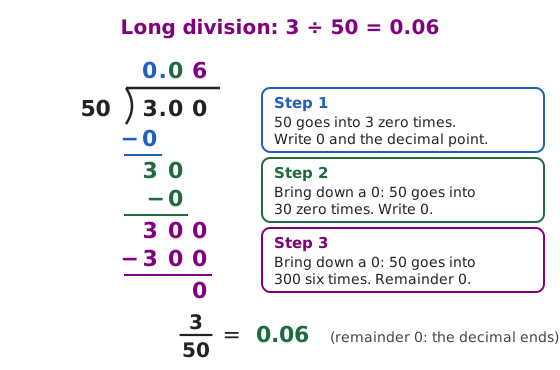
If you do not have a calculator, then you could also perform long division.
This is my least favorite method because long division can be hard and time-consuming. But it always works, even when you cannot change the denominator to a power of 10.
Example #5: Convert 350 by performing long division
Use long division to change 58 to a decimal.
Show answer
0.625. 50 ÷ 8 = 6 remainder 2, 20 ÷ 8 = 2 remainder 4, 40 ÷ 8 = 5 remainder 0.
When the Decimal Repeats
Sometimes the long division never ends. When a remainder comes back that you have already had, the same digits come back too, and the decimal repeats forever. We write a bar over the digits that repeat.
Example #6: Change 211 to a decimal
20 ÷ 11 = 1 remainder 9
90 ÷ 11 = 8 remainder 2
20 ÷ 11 = 1 remainder 9, the same as the first step, so the digits 1 and 8 repeat.
211 = 0.181818… = 0.18
A fraction in simplest form gives a terminating decimal (one that ends) when its denominator has only the prime factors 2 and 5. Any other denominator gives a repeating decimal, such as 13 = 0.3.
Will 712 give a terminating decimal or a repeating decimal?
Show answer
A repeating decimal. 12 = 2 × 2 × 3 has the prime factor 3. In fact, 712 = 0.58333… = 0.583.
Interactive Converter: Change Any Fraction to a Decimal
Type a numerator and a denominator, then press Convert. The converter shows the power-of-10 method when it works and every step of the long division, and it marks the remainder that repeats.
Try:
Common Fractions and Their Decimals
These fractions come up often. Knowing them by heart saves time.
| Fraction | Decimal | Fraction | Decimal |
|---|---|---|---|
| 12 | 0.5 | 15 | 0.2 |
| 14 | 0.25 | 18 | 0.125 |
| 34 | 0.75 | 110 | 0.1 |
| 13 | 0.3 | 23 | 0.6 |
Summary
- A fraction is a division: ab = a ÷ b.
- With a calculator, divide the numerator by the denominator.
- Without one, multiply the top and the bottom by the same number to get a denominator of 10, 100, 1000, and so on; the number of zeros is the number of decimal places.
- Long division works for every fraction. If a remainder repeats, the decimal repeats; write a bar over the repeating digits.
- A fraction in simplest form terminates only when its denominator has no prime factors other than 2 and 5.
Test Yourself: Interactive 10-Question Quiz
Now check what you learned. Every answer is explained, and each time you play you get new questions.
Quiz Complete!