Newton's Second Law
Newton's second law of motion is an equation that shows how force and mass work together to produce acceleration.
It states the following:
- The unit of a (acceleration) is m/s2.
- The unit of F (force) is newtons (N).
- The unit of m (mass) is kilograms (kg).
Before you do the math, you have to make sure that a, F, and m are already in the units mentioned above.
In this lesson, you will learn
- what Newton's second law says, and the units of force, mass and acceleration
- why the force goes on top and the mass goes on the bottom of the formula
- how to use a = F/m to find an acceleration
How Did Newton Come Up with Such a Formula?
Newton's second law is the result of some keen observations by Newton.
How can you get an object to move or to accelerate? You must apply some force to this object. To be more precise, you must apply some net force that is not equal to zero.
- What makes an airplane move and fly away?
- What makes your car move?
- What makes a soccer ball fly in the air until it reaches the goalkeeper?
- What makes a book fly in the air?
I think you got the point! Some force was applied to the object. The force in an engine, a kick, and the force in your hand are all good examples of force that can make things move.
Acceleration is the result of force. This simple sentence is the starting point for an equation:
However, whenever there is a mass, you know it makes the acceleration smaller.
More importantly, the bigger the mass of the object, the more the object will resist motion and the less the object will accelerate.
How do we incorporate the mass? Dividing by a bigger number makes a quantity smaller. Therefore, dividing F by the mass makes sense, since a bigger mass gives a smaller acceleration.
This is the great idea behind the formula above:
What must you apply to an object to make it accelerate?
Show answer
A net force that is not zero. With zero net force, the acceleration is zero.
Some Important Observations with Newton's Second Law: Why Mass Goes on the Bottom
The acceleration depends on the force and the mass.
In the formula, the force is on top and the mass is at the bottom.
Mathematically, it makes sense, as we are about to show.
Let's talk about mass first. Suppose you put the mass on top. What will happen as we increase the mass and apply the same force?
Let us pretend that a = m × F
m = 2 kg and F = 4 N: a = 2 × 4 = 8
m = 8 kg and F = 4 N: a = 8 × 4 = 32
The acceleration is getting bigger, yet this does not make sense. Since the mass is getting bigger, it is supposed to resist acceleration, not increase it.
Let's put the mass at the bottom instead.
a = F / m
m = 2 kg and F = 4 N: a = 4 N2 kg = 2 m/s2
m = 8 kg and F = 4 N: a = 4 N8 kg = 0.5 m/s2
The acceleration got smaller as we increased the mass. The formula makes sense now.
As the mass gets bigger and bigger, the acceleration gets smaller and smaller. As the mass gets smaller and smaller, the acceleration gets bigger and bigger.
This makes perfect sense, since it is easier to accelerate a small mass.
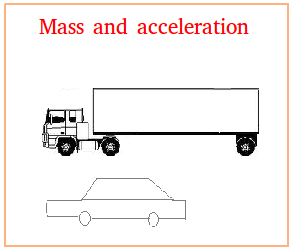
Look at the two vehicles below. If both vehicles ran out of gas, which one would be easier to push or accelerate?
The same force pushes a 4 kg cart and then a 12 kg cart. Which cart has the bigger acceleration?
Show answer
The 4 kg cart. The smaller the mass, the bigger the acceleration. Its acceleration is 3 times as big.
Why the Force Goes on Top
Now what about the force? Is it fair to say that the bigger the force, the bigger the acceleration?
Most definitely! For example, if you double the force, you also double the acceleration. If you triple the force, you triple the acceleration.
The force has to be on top then. Putting it at the bottom would defy this logic.
Remember what happened when the mass was at the bottom?
The bigger the mass, the smaller the acceleration. Putting the force at the bottom would have the exact same effect.
Multiplying the force by the mass to find the acceleration. To find the acceleration, divide: a = F ÷ m. Multiplying, F = m × a, gives the force.
A net force gives a box an acceleration of 3 m/s2. What is the acceleration if the force is doubled?
Show answer
6 m/s2. Doubling the force doubles the acceleration.
Using Newton's Second Law: a = F / m
In its simplest form, Newton's second law can be written as
The same law can be written as F = m × a. That is why 1 newton is the force that gives a 1 kg mass an acceleration of 1 m/s2.
- Check the units: the force is in newtons and the mass is in kilograms.
- Use the formula: a = Fm = 3,600 N1,200 kg.
- Divide: 3,600 ÷ 1,200 = 3.
The car's acceleration is 3 m/s2.
A net force of 10 N acts on a 5 kg ball. What is its acceleration?
Show answer
2 m/s2. a = 10 ÷ 5 = 2.
This ends our lesson about Newton's second law of motion.
Summary
- Newton's second law: acceleration = net force ÷ mass, or a = F/m.
- Units: a in m/s2, F in newtons (N), m in kilograms (kg).
- The bigger the force, the bigger the acceleration: double the force, double the acceleration.
- The bigger the mass, the smaller the acceleration: double the mass, half the acceleration.
- The same law can be written as F = m × a.
Test Yourself: 10-Question Quiz
Now check what you learned. Every answer is explained, and each time you play you get new questions.
Your result
Keep learning