Third Law of Newton
In this lesson, you will learn
- what Newton's third law, the law of action and reaction, says
- how to find the action force and the reaction force in everyday examples
- why action and reaction forces are always equal in size and opposite in direction
Punching a Wall: An Example of Newton's Third Law
A good example of the third law of Newton is when you punch a wall (made with concrete blocks) really hard and you hurt your hand.
There are two things going on here although many people don't realize it.
#1: You punch the wall with a force.
#2: The wall punches back at you with the same force.
For many people #1 is clear yet #2 is not so clear.
Think of it this way. If #2 did not exist, then you would never hurt your hand.
Moreover, you actually did some damage to the wall as well although it could be insignificant. I think it depends on how strong you are.
The picture below illustrates what I just said.
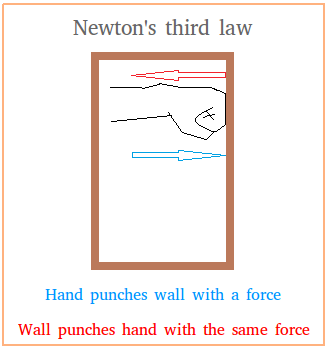
You hit the wall with a force. This force is shown with the blue arrow.
The wall hits back with the same force. This force is shown with the red arrow.
Newton's Third Law: Action and Reaction Forces
This is basically Newton's third law. It states that:
Whenever an object exerts a force on a second object, the second object exerts a force that is equal and opposite on the first object.
The force you exert on the wall could be called the action force and the force the wall exerts on your hand is called the reaction force.
The third law of Newton is also known as the law of action and reaction.
It does not matter which force is called the action force or the reaction force.
The important thing to keep in mind is that one does not exist without the other. Instead, they are two parts of a single interaction.
Thinking that the action and reaction forces cancel each other out. They act on two different objects (one on the wall, one on your hand), so they never cancel.
You push a door with a force of 30 Newtons. How hard does the door push on your hand?
Show answer
30 Newtons, in the opposite direction. The door pushes back on your hand with a force that is equal and opposite.
Interactive Action–Reaction Lab: Two Skaters Push Apart
Two skaters stand on smooth ice and push on each other's hands. Choose who pushes, set the masses and the push, then press Push. Watch the arms straighten: the force arrows appear only while the skaters push (N stands for Newtons).
Other Examples of the Third Law of Newton
a. Hitting a nail with a hammer: The hammer exerts a force on the nail and the nail also exerts the same force on the hammer.
b. Swimming: You push the water backward. The water pushes you forward.
- Find the two objects that push on each other: the swimmer's hands and the water.
- Action force: the swimmer pushes the water backward with 40 Newtons.
- Reaction force: the water pushes the swimmer with a force of the same size, 40 Newtons, in the opposite direction, so forward.
Action: swimmer pushes water backward, 40 Newtons. Reaction: water pushes swimmer forward, 40 Newtons.
Some action and reaction forces are not easy to identify as we shall see next.
c. What are the action and reaction forces when a car accelerates?
Most people will say that the engine is the action force. If that is true, then tell me why the car refuses to move when there is no friction or not enough friction such as when driving the car on an icy road?
In such a situation, you can push the gas pedal as much as you like, the wheels will just spin and the car will not move forward.
In reality, the rotating tires will push back on the road. This is the action force. The road now pushes forward on the tires. This is the reaction force.
A rocket pushes hot gas down out of its engine. What is the reaction force?
Show answer
The gas pushes the rocket up. The rocket pushes the gas down (action), so the gas pushes the rocket up with the same force (reaction).
Does a Falling Ball Pull the Earth?
d. A ball is dropped from the third floor.
Action force: earth's gravity pulls down the ball.
Reaction force: the ball pulls the earth.
If you are having problems understanding this one, think of it as said below:
If X is pulling Y, then Y is also pulling X.
Therefore, if the earth is pulling the ball, then the ball is also pulling the earth.
But I don't see the earth moving!
A different lesson will show you why you don't see the earth moving!
Know that it does move, but only a tiny distance.
Newton's third law and why you do not see the earth moving
The earth pulls on you with your weight. Do you pull on the earth, and if so, how hard?
Show answer
Yes, with the same force. If the earth is pulling you, then you are also pulling the earth with a force equal to your weight, upward on the earth.
Summary
- Newton's third law: whenever an object exerts a force on a second object, the second object exerts an equal and opposite force on the first object.
- It is also called the law of action and reaction. It does not matter which force is called the action force.
- Action and reaction forces always come in pairs: one does not exist without the other.
- The two forces act on different objects, so they do not cancel each other out.
- Examples: hand and wall, hammer and nail, swimmer and water, tires and road, ball and earth.
Test Yourself: Interactive 10-Question Quiz
Now check what you learned about action and reaction. Every answer is explained, and each time you play you get new questions.
Quiz Complete! 🎉
Keep learning