Different Types of Forces
A force is a push or a pull on an object. Forces are measured in newtons (N), and every force has a size and a direction.
A list of some different types of forces that are encountered regularly in physics is shown below.
In this lesson, you will learn
- the difference between contact forces and non-contact forces
- the definition, direction and symbol of six common forces
- how to decide which forces act on an object, and draw them as arrows
Contact Forces and Non-Contact Forces
Forces come in two big groups. A contact force needs the two objects to touch. A non-contact force acts across a distance, even through empty space.
- Contact forcesnormal force, friction, tension, thrust, the force of a spring, air resistance, and the push of your hand
- Non-contact forcesgravity (an object's weight), magnetic force, and electric force
Weight is the only force in this lesson that does not need contact. The earth pulls on you even when you jump into the air.
Normal Force
The normal force is the force exerted by a surface on an object.
- DirectionPerpendicular to and away from the surface.
- SymbolFN
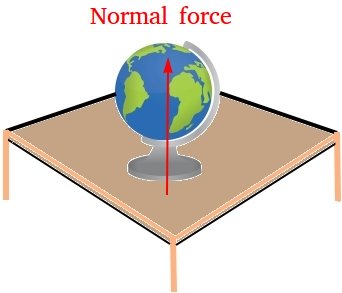
Example: Put a book or a globe on a table. The table exerts a normal force on the book or the globe which prevents the book or the globe from falling down.
Thinking the normal force always points straight up. It points away from the surface, at a right angle to it. On a ramp it tilts, and if you lean on a wall, the wall’s normal force on you points sideways.
Learn more: What is a normal force?
Frictional Force
The frictional force is the force that resists sliding motion between surfaces.
- DirectionParallel to the surface and opposite the direction of sliding.
- SymbolFf
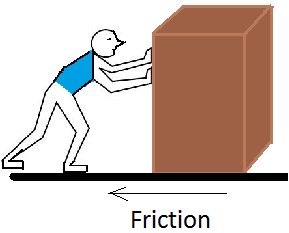
Example: You put a book on the floor and you kick it so it slides on the floor. The book will eventually stop sliding because of the force of friction.
A sled slides to the left down a snowy hill. Which way does the friction on the sled point?
Show answer
To the right, up the hill. Friction points opposite the direction of sliding.
Learn more: What does friction mean?
Weight
The weight is the force of gravity on an object. It is caused by the gravitational attraction between two objects. Generally this force happens between the earth and an object.
- DirectionStraight down toward the center of the earth.
- SymbolFg
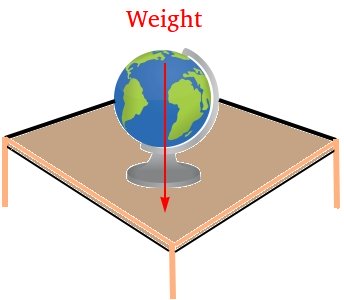
Example: Every time you jump into the air, your weight is the force that keeps pulling you down. If you put a globe on a table, its weight pulls the globe down toward the earth, and the table pushes back up on the globe with the normal force.
Mixing up weight and mass. Mass is the amount of matter in an object, measured in kilograms. Weight is a force, measured in newtons. On the moon your mass stays the same, but your weight is about one sixth of your weight on earth.
You throw a ball straight up. While it is still rising, which way does its weight point?
Show answer
Down. Weight always points toward the center of the earth, whether the ball goes up, comes down, or stays still.
Learn more: Weight of an object
Tension
The tension is the pull exerted by a rope, cable, or string when attached to an object and stretched tight.
- DirectionAway from the object or the point of attachment and parallel to the rope, cable, or string.
- SymbolFT
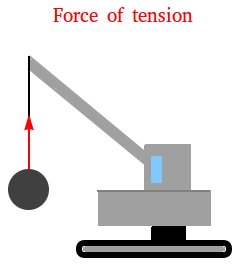
Example: Wrap a rope around a box and use your hand to drag the box with the rope. A tension force will be created along the rope.
A rope can only pull. You can’t push a box with a rope, so tension always points along the rope, away from the object.
Practice: Tension word problems
Thrust
The thrust is the force that moves objects such as airplanes, rockets, and boats. An engine or a propeller pushes air, water, or hot gas backward, and the air, water, or gas pushes the vehicle forward.
- DirectionOpposite the direction in which the engine pushes the air, water, or gas out.
- SymbolFthrust
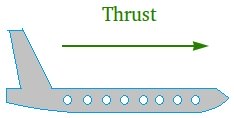
Example: A rocket’s engines push hot gas down out of the nozzle. The gas pushes the rocket up with a force called thrust. At liftoff, the thrust must be greater than the rocket’s weight.
A jet engine blows air out toward the back of the plane. Which way does the thrust on the plane point?
Show answer
Forward. Thrust points opposite to the direction the air is pushed out.
Force of a Spring
The force of a spring is the push or pull a spring exerts on an object.
- DirectionOpposite the displacement of the object from the spring’s resting position: a stretched spring pulls back, and a squeezed spring pushes back.
- SymbolFsp
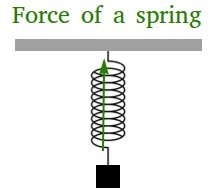
Example: A weight hanging from a spring stretches the spring downward. The spring pulls up on the weight.
The more you stretch or squeeze a spring, the bigger its force. This is called Hooke’s law.
Interactive Force Detective: Which Forces Act on the Object?
Read each situation, switch on every force that acts on the object, then press Check to see the force arrows. A drawing of an object with all its force arrows is called a free-body diagram.
- The earth pulls on the box: weight, pointing down.
- The box presses on the floor, so the floor pushes up: normal force.
- The tight rope pulls the box to the right: tension.
- The box slides on the floor, so friction points to the left, opposite the sliding.
Four forces act on the box: weight, normal force, tension and friction.
Summary
Summary of the different types of forces discussed in this lesson:
| Force | Symbol | Direction | Type |
|---|---|---|---|
| Normal force | FN | Perpendicular to and away from the surface | Contact |
| Force of friction | Ff | Along the surface, opposite the sliding | Contact |
| Weight | Fg | Straight down, toward the center of the earth | Non-contact |
| Tension | FT | Along the rope, away from the object | Contact |
| Thrust | Fthrust | Opposite the direction the gas, air or water is pushed out | Contact |
| Force of a spring | Fsp | Back toward the spring’s resting position | Contact |
- A force is a push or a pull, measured in newtons (N).
- Only forces that act on the object go in its free-body diagram. Once your foot leaves a ball, your kick is no longer a force on it.
- Weight is a force; mass is not.
Test Yourself: Interactive 10-Question Quiz
Now check what you learned. Every answer is explained, and each time you play you get new questions.
Quiz complete!
Keep learning