Multiply Using Partial Products
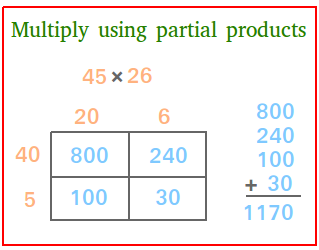
The 5 steps below will quickly show you how to multiply using partial products. Here, we will do the multiplication for a two-digit number by another two-digit number. For example, the figure below shows how to quickly multiply 26 by 45.
If you did not quite understand the example in the figure below, keep reading since we broke the multiplication down into 5 steps.
If you multiply a two-digit number by another two-digit number, you will have 4 partial products.
In this lesson, you will learn
- what a partial product is
- how to find the 4 partial products when you multiply two two-digit numbers
- why each digit is used with its place value
- how to add the partial products to get the answer
Here Is How to Multiply Using Partial Products Step by Step
Step 1
| Tens | Ones | ||||
| 4 | 5 | ||||
| × | 2 | 6 | |||
| partial product | 8 | 0 | 0 |
Multiply the tens by the tens: 2 tens × 4 tens = 20 × 40 = 800.
Step 2
| Tens | Ones | ||||
| 4 | 5 | ||||
| × | 2 | 6 | |||
| partial product | 1 | 0 | 0 |
Multiply the ones by the tens: 5 ones × 2 tens = 5 × 20 = 100.
Step 3
| Tens | Ones | ||||
| 4 | 5 | ||||
| × | 2 | 6 | |||
| partial product | 2 | 4 | 0 |
Multiply the tens by the ones: 4 tens × 6 ones = 40 × 6 = 240.
Step 4
| Tens | Ones | ||||
| 4 | 5 | ||||
| × | 2 | 6 | |||
| partial product | 3 | 0 |
Multiply the ones by the ones: 5 ones × 6 ones = 30 ones = 30
Multiplying the digits without their place values. In step 1, 2 tens × 4 tens is 20 × 40 = 800, not 2 × 4 = 8.
What is the partial product for 3 tens × 6 tens?
Show answer
1,800. 3 tens is 30 and 6 tens is 60, so 30 × 60 = 1,800.
Step 5: Add the Partial Products
| Tens | Ones | ||||
| 4 | 5 | ||||
| × | 2 | 6 | |||
| carries | 1 | ||||
| 8 | 0 | 0 | |||
| 1 | 0 | 0 | |||
| 2 | 4 | 0 | |||
| + | 3 | 0 | |||
| answer | 1 | 1 | 7 | 0 |
Just add the four partial products to get the answer: 800 + 100 + 240 + 30 = 1,170
So, 26 × 45 = 1,170
Write the partial products in columns by place value: ones under ones, tens under tens and hundreds under hundreds. Then add from right to left and carry when a column adds up to 10 or more.
- Multiply the tens by the tens: 5 tens × 3 tens = 50 × 30 = 1,500.
- Multiply the ones by the tens: 7 ones × 5 tens = 7 × 50 = 350.
- Multiply the tens by the ones: 3 tens × 2 ones = 30 × 2 = 60.
- Multiply the ones by the ones: 7 ones × 2 ones = 14.
- Add the partial products: 1,500 + 350 + 60 + 14 = 1,924. In the tens column, 5 + 6 + 1 = 12, so write 2 and carry 1.
| Tens | Ones | ||||
| 3 | 7 | ||||
| × | 5 | 2 | |||
| carries | 1 | ||||
| 1 | 5 | 0 | 0 | ||
| 3 | 5 | 0 | |||
| 6 | 0 | ||||
| + | 1 | 4 | |||
| answer | 1 | 9 | 2 | 4 |
37 × 52 = 1,924
The partial products of 34 × 21 are 600, 80, 30 and 4. What is 34 × 21?
Show answer
714. 600 + 80 + 30 + 4 = 714.
Summary
- When you multiply a two-digit number by another two-digit number, you get 4 partial products.
- Multiply the tens by the tens, the ones by the tens, the tens by the ones, and the ones by the ones.
- Use each digit with its place value: 2 tens × 4 tens = 20 × 40 = 800.
- Line up the partial products by place value and add them to get the answer.
Interactive Practice: Solve 3 Partial Products Problems
Problem 1 guides you through every step. In problem 2, you find each partial product and the answer with a hint for each step. In problem 3, you fill in the whole grid on your own. You can skip a problem at any time, and each time you play you get new problems.
Practice complete!
Interactive Partial Products Grid: Try Your Own Problem
Type two two-digit numbers (from 10 to 99). Fill in the 4 partial products and the answer, then check your work. The green boxes for carries are optional.