Russian Peasant Multiplication
In this lesson, you will learn
- How to multiply two whole numbers by halving and doubling
- Which rows to cross out and which numbers to add
- How to check your answer with the regular multiplication
What Is Russian Peasant Multiplication?
The Russian peasant multiplication, also called the Russian peasant algorithm, uses a halving and doubling method to multiply whole numbers. I will illustrate the method with some good examples that you should study carefully.
Do you understand the example shown in the figure below? If not, do not worry at all. Just keep reading this lesson and you will realize that it is easy and straightforward.
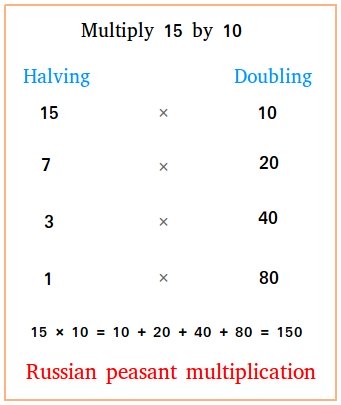
In the Russian peasant multiplication, you halve one number again and again until you get 1, and you double the other number the same number of times. The answer is the sum of the doubled numbers that sit next to an odd number in the halving column.
A Few Important Things to Keep in Mind When Using the Russian Peasant Multiplication
- The first row always has the multiplication problem that you are doing.
- When halving, disregard any remainder. Just put the quotient in the halving column. For example, suppose 15 is already in your halving column. 15 = 2 × 7 + 1. Put 7 in the halving column beneath 15.
- When a number in the halving column is 1, cross out all rows that have an even number in the halving column.
- The halving column may not have any even numbers even if it has a 1 in it.
- The answer is found by adding the remaining numbers in the doubling column.
Keeping these guidelines in mind, you could also do the multiplication of 15 times 10 by putting 10 in the halving column and 15 in the doubling column. The answer is still the same as shown below. Notice also how we crossed out all rows that have an even number in the halving column. We did this because, as already stated, there is a 1 in the halving column.
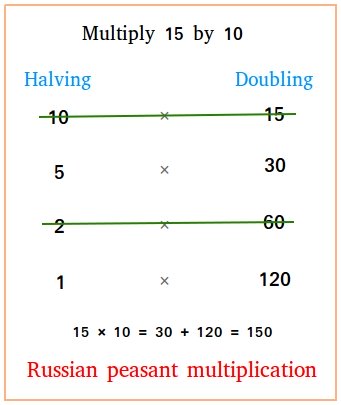
Adding every number in the doubling column. In the table above, 15 + 30 + 60 + 120 = 225, which is wrong. Cross out the rows with an even halving number first; only 30 + 120 = 150 is left.
The number 25 is in the halving column. What number goes below it?
Show answer
12. 25 = 2 × 12 + 1. Disregard the remainder 1 and write 12.
More Examples Showing How to Multiply Using the Russian Peasant Multiplication
Crossed-out rows have an even number in the halving column. The numbers in green are the ones you add.
Example #1: 11 × 12
| Halving | Doubling | |
|---|---|---|
| 11 | × | 12 |
| 5 | × | 24 |
| 2 | × | 48 |
| 1 | × | 96 |
Using the Russian peasant multiplication, the sum is 12 + 24 + 96 = 132.
Example #2: 37 × 42
| Halving | Doubling | |
|---|---|---|
| 37 | × | 42 |
| 18 | × | 84 |
| 9 | × | 168 |
| 4 | × | 336 |
| 2 | × | 672 |
| 1 | × | 1344 |
Using the Russian peasant multiplication, the sum is 42 + 168 + 1344 = 1554.
Example #3: 20 × 20
| Halving | Doubling | |
|---|---|---|
| 20 | × | 20 |
| 10 | × | 40 |
| 5 | × | 80 |
| 2 | × | 160 |
| 1 | × | 320 |
Using the Russian peasant multiplication, the sum is 80 + 320 = 400.
- Write 13 in the halving column and 14 in the doubling column.
- Halve 13 and disregard the remainder: 6. Double 14: 28.
- Keep going until the halving column reaches 1: 6 → 3 → 1 and 28 → 56 → 112.
- Cross out the row with an even halving number: 6 × 28.
- Add the doubling numbers that are left: 14 + 56 + 112 = 182.
- Check with the regular multiplication: 13 × 14 = 182.
| Halving | Doubling | |
|---|---|---|
| 13 | × | 14 |
| 6 | × | 28 |
| 3 | × | 56 |
| 1 | × | 112 |
13 × 14 = 182
You can put either number in the halving column, and the answer is the same. Putting the smaller number in the halving column gives you fewer rows.
Use the Russian peasant multiplication to find 9 × 15. Put 9 in the halving column.
Show answer
135. Halving: 9, 4, 2, 1. Doubling: 15, 30, 60, 120. Cross out the rows with 4 and 2, then add 15 + 120 = 135.
Your Turn: Multiply Using the Russian Peasant Multiplication
Try the following few multiplications using the Russian peasant multiplication.
- 16 × 15
- 100 × 6
- 24 × 24
- 100 × 1
- 100 × 100
Check your answers.
Show answers
16 × 15 = 240, 100 × 6 = 600, 24 × 24 = 576, 100 × 1 = 100 and 100 × 100 = 10,000.
Summary
- Write the two numbers in the first row: one in the halving column, the other in the doubling column.
- Halve the left number (disregard any remainder) and double the right number until the halving column reaches 1.
- Cross out every row that has an even number in the halving column.
- Add the numbers left in the doubling column. That sum is the answer.
- Either number can go in the halving column; the answer is the same.
Test Yourself: Interactive 10-Question Quiz
Now check what you learned. Every answer is explained, and each time you play you get new questions.
Quiz Complete!