Duplication Algorithm for Multiplication
The best way to understand the duplication algorithm is with examples along with some explanations.
In this lesson, you will learn
- how to make a doubling table for a number
- how to write a number as a sum of powers of 2
- how to add rows of the doubling table to multiply
- when the duplication algorithm is a good choice
The Technique: Multiply by Doubling
To multiply 8 and 12, keep multiplying 12 by powers of 2 until the last power of 2 is 8.
Powers of 2 are 2, 4, 8, 16 and so forth. Each power of 2 is double the one before it.
Here is how you can multiply 8 and 12.
8 × 12
2 × 12 = 24
4 × 12 = 48
8 × 12 = 96
All you do here is a succession of doubling operations. Every time you double the power of 2, you also double the number on the right of the equal sign. Now that you have the technique, we can do some more interesting multiplication problems.
Make a doubling table for 15: 2 × 15 = 30. What are 4 × 15 and 8 × 15?
Show answer
4 × 15 = 60 and 8 × 15 = 120. Double 30 to get 60, then double 60 to get 120.
More Examples Showing How the Duplication Algorithm Works
Example #1: 14 × 12
If doubling 8 gave 14, we could just do that and then just double 96 to get the answer. However, doubling 8 gives 16, not 14. Therefore, we have to find a way to play with the numbers to get what we need.
Notice that 14 = 8 + 4 + 2, so
14 × 12 = (8 + 4 + 2) × 12 = 8 × 12 + 4 × 12 + 2 × 12
We already have answers for 8 × 12, 4 × 12, and 2 × 12.
All we need to do is to add 24, 48, and 96.
24 + 48 + 96 = 168
14 × 12 = 168
Write the first number as a sum of powers of 2. Then add the rows of the doubling table that match those powers of 2.
Example #2: 26 × 20
Solution: the doubling table for 20
2 × 20 = 40
4 × 20 = 80
8 × 20 = 160
16 × 20 = 320
32 × 20 = 640
Again, we cannot really use 32 × 20 = 640.
We need to rewrite 26 × 20.
26 × 20 = (16 + 8 + 2) × 20 = 16 × 20 + 8 × 20 + 2 × 20
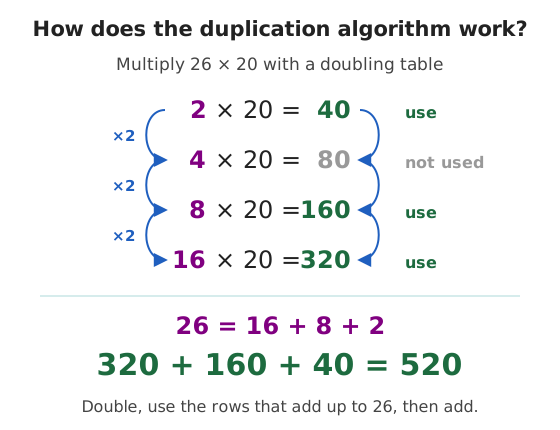
We already have answers for 16 × 20, 8 × 20, and 2 × 20.
320 + 160 + 40 = 320 + 200 = 520
Using a power of 2 that is bigger than the number. For 26 × 20, the row 32 × 20 = 640 cannot be used, because 32 is more than 26. Only use powers of 2 that add up to exactly 26.
Which powers of 2 add up to 12?
Show answer
8 and 4. 8 + 4 = 12, so 12 × 20 = 8 × 20 + 4 × 20 = 160 + 80 = 240.
Example #3: 48 × 25
Solution: the doubling table for 25
2 × 25 = 50
4 × 25 = 100
8 × 25 = 200
16 × 25 = 400
32 × 25 = 800
64 × 25 = 1600
For the last time, we cannot really use 64 × 25 = 1600.
We need to rewrite 48 × 25.
48 × 25 = (32 + 16) × 25 = 32 × 25 + 16 × 25
We already have answers for 32 × 25 and 16 × 25.
800 + 400 = 1200
- Make the doubling table for 15: 2 × 15 = 30, 4 × 15 = 60, 8 × 15 = 120, 16 × 15 = 240. Stop at 16, because 32 is more than 22.
- Write 22 as a sum of powers of 2: 22 = 16 + 4 + 2.
- Add the matching rows: 240 + 60 + 30 = 330.
22 × 15 = 330
Use the doubling table for 25 to find 40 × 25.
Show answer
1,000. 40 = 32 + 8, so add 32 × 25 = 800 and 8 × 25 = 200.
Why Use the Duplication Algorithm?
What is the point of using the duplication algorithm? Maybe doubling numbers is a friendly way of doing multiplication. Sometimes, it may simplify the problem yet other times it may complicate the problem.
It is up to you what you use, but it is a good thing to know how to use the duplication algorithm. It is one more tool at your disposal when performing multiplication!
Summary
- Powers of 2 are 2, 4, 8, 16, 32 and so forth. Each one is double the one before.
- Make a doubling table: start with 2 × the number, then double both sides on each new row.
- Stop before the power of 2 gets bigger than the number you multiply by.
- Write that number as a sum of powers of 2, for example 26 = 16 + 8 + 2.
- Add the matching rows of the table to get the answer.
Interactive Practice: Solve 3 Duplication Algorithm Problems
Problem 1 guides you through every step. Problem 2 has fewer, bigger steps with a hint for each. In problem 3, you build the doubling table and find the answer on your own. You can skip a problem at any time, and each time you play you get new problems.
Practice complete!
Interactive Doubling Table: Try Your Own Problem
Type an even number from 4 to 126 and a whole number from 2 to 999. Fill in the doubling table, mark the rows you use, and type the answer.
Keep learning