Understanding the Metric Measurement System
In this lesson, you will learn
- the three basic metric units: the gram, the liter and the meter
- what the prefixes kilo-, hecto-, deka-, deci-, centi- and milli- mean
- how to change between metric units by multiplying by 10, 100 or 1,000
- how metric units compare with customary units such as pounds, gallons and feet
Core Units of the Metric System
The metric system is a universally recognized system of measurement that simplifies quantifying various physical properties such as mass, volume, and length. It is based on three basic units: the liter for volume, the gram for mass, and the meter for length. This lesson explores the metric system’s core units, the prefixes that extend its scalability, and its application in everyday measurements compared to the customary system used primarily in the United States.
The Gram (g) – Measuring Mass and Weight
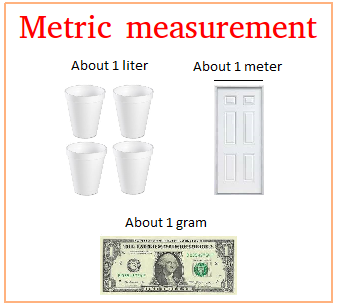
The gram is the basic unit for measuring mass in the metric system. Mass refers to the amount of matter in an object, while weight is the force exerted by gravity on that mass. For example, a single dollar bill has a mass of approximately 1 gram. To put this into perspective, a person weighing 170 pounds in the customary system translates to 77.11 kilograms (kg) in the metric system. This conversion highlights the metric system’s practicality in providing clear and standardized measurements.
The Liter (L) – Measuring Volume and Capacity
The liter is the metric unit for measuring volume or capacity. It is widely used to quantify liquids and gases. For instance, one liter of Coca-Cola is equivalent to about 33.81 fluid ounces in the customary system. Additionally, one liter is about four cups, a familiar unit in everyday measurements. This equivalence makes it easier to understand and convert liquid measurements between the two systems.
The Meter (m) – Measuring Length and Distance
The meter serves as the base unit for measuring length in the metric system. It is commonly used to express the height of objects and distances between points. For example, a person who is 1 meter tall is approximately 3.2808 feet or 39.37 inches tall in the customary system. Moreover, one meter is roughly the average width of a standard door, providing a relatable reference for understanding this unit of measurement.
Which metric unit would you use for the mass of an apple: the gram, the liter or the meter?
Show answer
The gram. Grams measure mass. Liters measure volume, and meters measure length.
Expanding the Metric System with Prefixes
The metric system’s flexibility is enhanced by the use of prefixes that denote multiples or fractions of the base units. These prefixes make it easier to express very large or very small quantities without resorting to cumbersome numbers.
1. Kilo- (k) – Thousandfold
1 kilometer (km) = 1,000 meters
6 kilometers = 6,000 meters
0.5 kilometer = 500 meters
The prefix "kilo" simplifies the expression of large distances or masses, such as measuring the length of a city or the mass of a large object.
2. Hecto- (h) – Hundredfold
1 hectogram (hg) = 100 grams
5 hectograms = 500 grams
10 hectograms = 1,000 grams
"Hecto" is useful for measuring quantities that are larger than the base unit but not as extensive as those denoted by "kilo."
3. Deka- (da) – Tenfold
1 dekameter (dam) = 10 meters
0.5 dekameter = 5 meters
2 dekameters = 20 meters
The "deka" prefix is handy for intermediate measurements, providing a balance between smaller and larger units.
4. Deci- (d) – One-Tenth
1 deciliter (dL) = 0.1 liter
10 deciliters = 1 liter
20 deciliters = 2 liters
"Deci" allows for precise measurements of smaller volumes, essential in scientific and culinary contexts.
5. Centi- (c) – One-Hundredth
1 centimeter (cm) = 0.01 meter
10 centimeters = 0.1 meter
70 centimeters = 0.7 meter
The "centi" prefix is commonly used in everyday measurements, such as height and small distances.
6. Milli- (m) – One-Thousandth
1 millimeter (mm) = 0.001 meter
1 milliliter (mL) = 0.001 liter
1,000 millimeters = 1 meter
3,000 millimeters = 3 meters
"Milli" is essential for highly precise measurements, particularly in fields like medicine and engineering.
From largest to smallest, the order is: kilo-, hecto-, deka-, the base unit (gram, liter or meter), deci-, centi-, milli-. Each unit in this list is 10 times as big as the next one.
- Kilo- means thousandfold, so 1 kilometer = 1,000 meters.
- Multiply the number of kilometers by 1,000: 2.5 × 1,000 = 2,500.
2.5 kilometers = 2,500 meters
Mixing up kilo- and milli-. Kilo- makes a unit 1,000 times as big (1 km = 1,000 m), but milli- makes it 1,000 times as small (1 mm = 0.001 m). Also note that the letter m alone means meter, while m at the start of mm or mL means milli-.
How many centimeters are in 1 meter?
Show answer
100 centimeters. 1 centimeter is 0.01 meter, one-hundredth of a meter, so it takes 100 of them to make 1 meter.
Comparing Metric and Customary Systems
While the metric system is the standard in most countries worldwide due to its simplicity and scalability, the United States primarily uses the customary system, which includes units like pounds, ounces, feet, and gallons. However, both systems coexist in the U.S., with the metric system often used in scientific, medical, and certain industrial contexts.
For example:
- Mass: 1 kilogram ≈ 2.20462 pounds
- Volume: 1 liter ≈ 0.264172 US gallons
- Length: 1 meter ≈ 3.28084 feet
Understanding both systems is beneficial, especially in global contexts where metric measurements are prevalent. For instance, international travel, trade, and scientific research often require familiarity with metric units.
Which is longer: 1 meter or 3 feet?
Show answer
1 meter. 1 meter is about 3.28 feet, which is a little more than 3 feet.
Global Adoption and Usage
The metric system is officially adopted by almost every country in the world, facilitating international communication, trade, and cooperation. The United States, Liberia, and Myanmar are often named as the countries where the customary system remains dominant. Myanmar (in 2013) and Liberia (in 2018) announced that they are switching to the metric system, and the metric system is increasingly used in specific sectors in all three countries.
In the United States, both the metric system and the customary system are used. However, people are more familiar with the customary system in the USA. Check this map to see which countries are not officially using the metric system.
Summary
- The metric system is based on the liter, gram, and meter.
- Prefixes like kilo-, hecto-, deka-, deci-, centi-, and milli- extend the system’s scalability.
- To change units, multiply or divide by 10, 100 or 1,000: for example, 1 km = 1,000 m and 1 m = 100 cm.
- The metric system is globally recognized, while the customary system is primarily used in the USA.
- Understanding both systems is advantageous for comprehensive measurement proficiency.
Test Yourself: Interactive 10-Question Quiz
Now check what you learned. Every answer is explained, and each time you play you get new questions.
Quiz Complete!