Measurement Benchmarks
In this lesson, you will learn
- what a measurement benchmark is and why it helps you estimate
- common benchmarks for customary units such as the foot, the pound and the gallon
- common benchmarks for metric units such as the centimeter, the kilogram and the liter
- how to use a benchmark to make a quick, sensible estimate
What Is a Measurement Benchmark?
Below are some examples of measurement benchmarks often used in elementary schools. These benchmarks can help students estimate measurements.
A measurement benchmark is a familiar object whose length, weight or capacity you already know. You compare other things with it to estimate their measurements.
Each unit measures one kind of thing. Use a benchmark of the same kind as what you want to estimate.
- Length foot, yard, centimeter, meter
- Weight ounce, pound, gram, kilogram
- Capacity (how much a container holds) cup, gallon, milliliter, liter
Is a gallon a unit of length, weight or capacity?
Show answer
Capacity. A gallon tells how much a container holds, like a large fish bowl or a milk jug.
Benchmarks for Customary Units
Examples of estimating with customary units
- The box of cereal weighs about 1 pound
- The length of a book is about 1 foot
- A large fish bowl holds about 1 gallon of water
- A slice of bread weighs about 1 ounce
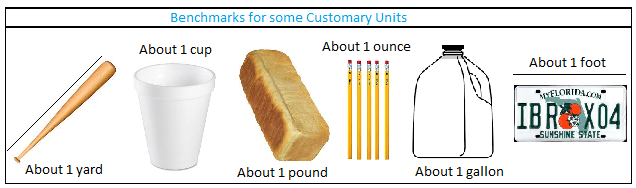
The chart below shows benchmarks for customary units of measurement
Using a unit of the wrong kind. "A large fish bowl holds about 1 pound of water" mixes things up: a pound measures weight, but here we want to know how much the bowl holds. Use a capacity unit: about 1 gallon.
A loaf of bread weighs about 1 pound. About how much do 3 loaves of bread weigh?
Show answer
About 3 pounds. Each loaf is about 1 pound, so 3 loaves are about 3 × 1 = 3 pounds.
Benchmarks for Metric Units
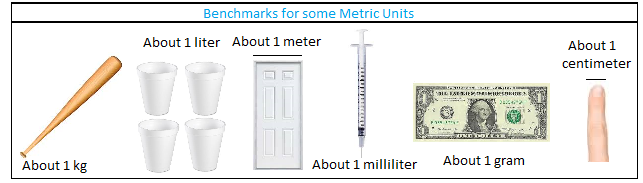
The chart below shows benchmarks for metric units of measurement


Other examples of estimating with metric units
- The length of a bed is about 2 meters
- The length of a smartphone is about 15 centimeters
- A house front door weighs about 35 kg
- A bathtub can hold about 200 liters of water
Would you measure the water in a bathtub in milliliters or in liters?
Show answer
Liters. A milliliter is only a few drops, about what a small syringe holds, so a bathtub would need a huge number of them.
How to Estimate with a Benchmark
To estimate a measurement, compare the object with a benchmark you already know.
- Decide what you are measuring: length, weight or capacity.
- Pick a benchmark of that kind that is not too far from the size of the object.
- Ask yourself how many of those benchmarks it would take.
- Write your estimate with the word "about" and the unit.
- We are measuring a length.
- Benchmark: the length of a book is about 1 foot.
- The table is as long as 4 books, so it is about 4 × 1 foot = 4 feet.
The table is about 4 feet long.
A benchmark gives an estimate, not an exact measurement. That is why we say "about 4 feet" and not "exactly 4 feet".
A shelf is about as wide as 30 finger widths. About how wide is the shelf?
Show answer
About 30 centimeters. A finger is about 1 centimeter wide, so 30 finger widths are about 30 × 1 = 30 centimeters.
Summary
- A measurement benchmark is a familiar object whose measurement you know, such as a book that is about 1 foot long.
- Customary benchmarks: a baseball bat is about 1 yard, a slice of bread is about 1 ounce, a box of cereal is about 1 pound, and a large fish bowl holds about 1 gallon.
- Metric benchmarks: a finger is about 1 centimeter wide, a dollar bill weighs about 1 gram, a baseball bat weighs about 1 kilogram, and a small syringe holds about 1 milliliter.
- Always use a benchmark of the same kind (length, weight or capacity) as what you are estimating.
- To estimate, count how many benchmarks fit, then write "about" with the number and the unit.
Test Yourself: Interactive 10-Question Quiz
Now check what you learned. Every answer is explained, and each time you play you get new questions.
Quiz Complete!