Investing in Savings Bonds
In this lesson, you will learn
- The 4 terms: face value, cost, redemption value and interest earned
- How to use a redemption table to find the redemption value
- How to find the interest earned on a savings bond
- How savings bonds are different from the bonds sold on the market
Savings Bonds: 4 Terms You Need to Know
When investing in savings bonds, you need to understand the following terms and how to find them.
- Face value
- Cost of the savings bonds
- Redemption value
- Interest earned
Keep in mind that savings bonds are sold by the United States government. You just need to pay 50% of the face value.
The 50% rule is how paper Series EE savings bonds were sold: you paid $25 for a $50 bond. Since January 1, 2012, savings bonds are sold electronically at their full face value. This lesson uses the 50% rule to practice the math.
The face value is the original price of the savings bonds. Savings bonds could be purchased with a face value ranging from $50 to $10,000.
The cost of the savings bonds is 50% of the face value.
The redemption value is the value of the bond when it is redeemed.
This is usually based on how long you invest and how much the government is willing to pay. See redemption table below. You will need to find the redemption value before you can compute the interest you will earn. The face value is used when computing the redemption value.
| After | Redemption value |
|---|---|
| 6 months | $50.75 |
| 1 year | $52.50 |
| 2 years | $55.20 |
| 3 years | $57.95 |
| 4 years | $60.21 |
| 5 years | $62.50 |
A savings bond has a face value of $200. What does it cost?
Show answer
$100. The cost is 50% of the face value: 200 × 0.50 = 100.
How to Find the Interest Earned on Savings Bonds
The way we compute the interest earned when investing in savings bonds is different than the way we compute interest in bonds. In order to find out how much interest you will earn, you need to subtract the cost of the savings bonds from the redemption value.
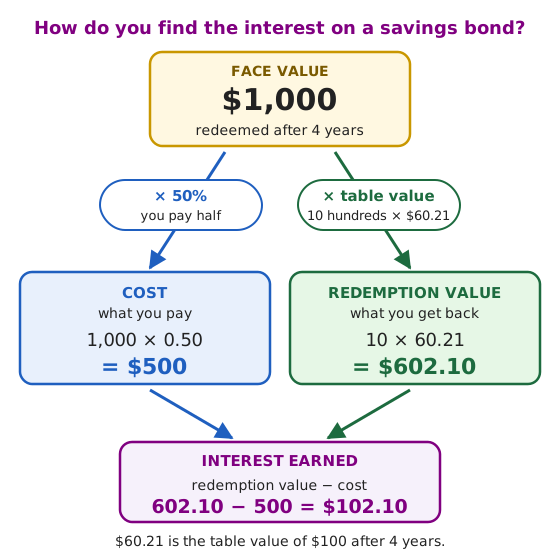
Subtracting the face value instead of the cost. For a $1,000 bond worth $602.10, the interest is 602.10 − 500 = $102.10, not 602.10 − 1,000. You paid $500, not $1,000.
A Couple of Examples Showing How Investing in Savings Bonds Works
A chart similar to the one above could be used when computing the redemption value.
Example #1
Say for instance, you buy a 1000-dollar bond and redeem it 4 years later. Using the redemption table shown above, find the redemption value of the bond and the amount of interest you will earn.
Here is how you can compute the redemption value:
Redemption value = (redemption value of 100 dollars after 4 years) × (number of 100 dollars in face value)
Since 1000 ÷ 100 = 10, the number of 100 dollars in face value is 10.
60.21 × 10 = 602.10
The redemption value is 602.10 dollars.
Cost of savings bonds = face value × 50%
Cost of savings bonds = 1000 × 0.50
Cost of savings bonds = 500
Interest earned = redemption value − cost of savings bonds
Interest earned = 602.10 − 500
Interest earned = 102.10
The interest earned is 102.10 dollars.
Example #2
Say for instance, you buy savings bonds in the amount of 3,000 dollars and redeem them 5 years later. Using the redemption table shown above, find the redemption value of the bonds and the amount of interest you will earn.
Here is how you can compute the redemption value:
Redemption value = (redemption value of 100 dollars after 5 years) × (number of 100 dollars in face value)
Since 3000 ÷ 100 = 30, the number of 100 dollars in face value is 30.
62.50 × 30 = 1875
The redemption value is 1875 dollars.
Cost of savings bonds = face value × 50%
Cost of savings bonds = 3000 × 0.50
Cost of savings bonds = 1500
Interest earned = redemption value − cost of savings bonds
Interest earned = 1875 − 1500
Interest earned = 375
The interest earned is 375 dollars.
You buy a $500 savings bond and redeem it after 2 years. Use the table to find the interest earned.
Show answer
$26. Cost: 500 × 0.50 = 250. Redemption value: 5 hundreds × 55.20 = 276. Interest: 276 − 250 = 26.
Bonds vs Savings Bonds: What Is the Difference?
Both bonds and savings bonds have a face value, and you usually pay less than the face value. The table shows how they are different.
| Bonds | Savings bonds | |
|---|---|---|
| Who sells them | Corporations or the government, on the market | Only the United States government |
| Price you pay | A percent of the face value, for example 80% | 50% of the face value (paper Series EE bonds) |
| How to find the interest | Face value × annual rate | Redemption value − cost |
| When you get the interest | Every year | When you redeem (cash in) the bond |
| What you need | The annual interest rate | A redemption table |
| Can you sell it to another investor? | Yes, on the market | No, you redeem it with the government |
- Bond: cost = 1000 × 0.80 = $800. Interest = 1000 × 0.04 = $40, paid every year.
- Savings bond: cost = 1000 × 0.50 = $500. Redemption value after 4 years = 10 × 60.21 = $602.10.
- Savings bond interest = 602.10 − 500 = $102.10, paid all at once when you redeem it.
Bond: $800 cost and $40 interest each year. Savings bond: $500 cost and $102.10 interest after 4 years.
Which formula do you use to find the interest on a savings bond: face value × annual rate, or redemption value − cost?
Show answer
Redemption value − cost. Face value × annual rate is the formula for bonds sold on the market.
Summary
- Savings bonds are sold by the United States government. In this lesson, the cost is 50% of the face value.
- Redemption value = (table value of $100) × (number of $100s in the face value).
- Interest earned = redemption value − cost of savings bonds.
- For bonds sold on the market, interest = face value × annual rate, paid every year. For savings bonds, you get the interest when you redeem the bond.
Test Yourself: Interactive 10-Question Quiz
Now check what you learned. Every answer is explained, and each time you play you get new questions.
Quiz Complete!