Investing in Bonds
In this lesson, you will learn
- What a bond and its face value are
- How to find the cost of a bond sold at a percent of its face value
- How to find the yearly interest a bond pays
What Is Investing in Bonds?
Investing in bonds is in some ways like investing in stocks. Bonds are sold on the market. They are commonly known as "fixed income" securities.
When corporations or the government are trying to raise money, they often sell bonds at a price lower than the face value.
The face value is just the original price shown on the security certificate.
The price you pay for them is given as a percent of the face value.
Any interest you receive is based on the face value. The following explains how we can use skills such as percents to solve such problems.
A bond with a face value of $1,000 sells for 90%. Do you pay more or less than $1,000?
Show answer
Less: you pay $900. 90% of $1,000 is 0.90 × 1000 = 900.
The 2 Formulas for Bonds: Cost and Interest
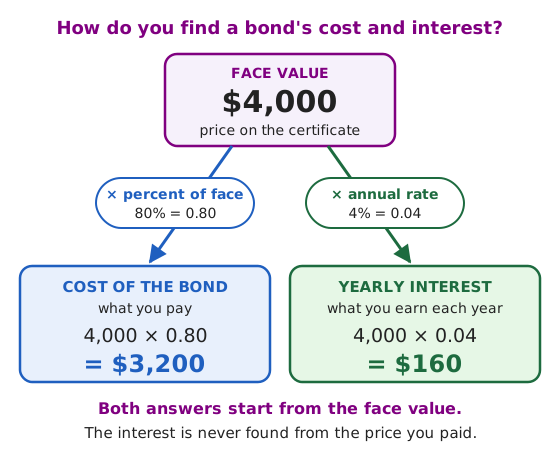
Finding the interest from the cost instead of the face value. For a $4,000 bond that sold for 80% at 4%, the interest is 4000 × 0.04 = 160, not 3200 × 0.04 = 128.
A Few Examples Showing How Investing in Bonds Works
Example #1:
Find the cost of 4,000 worth of fixed income, which sold for 80% and the amount of interest you will earn if the annual interest rate is 4%.
Cost of Bond = Face value × Percent of Face
Cost of Bond = 4000 × 0.80
Cost of Bond = 3200
The cost is then 3200.
Here is how to find the interest they pay you if the annual interest is 4%.
Interest = Face Value × Annual Rate
Interest = 4000 × 0.04
Interest = 160
The interest you will receive is 160.
Example #2:
Find the cost of 10,000 worth of bonds, which sold for 75% and the amount of interest you will earn if the annual interest rate is 3%.
Cost of Bond = Face value × Percent of Face
Cost of Bond = 10,000 × 0.75
Cost of Bond = 7500
The cost is then 7500.
Here is how to find the interest they will pay you if the annual interest is 3%.
Interest = Face Value × Annual Rate
Interest = 10000 × 0.03
Interest = 300
The interest you will receive is 300.
Example #3:
Find the cost of 1 million worth of bonds, which sold for 80% and the amount of interest you will earn if the annual interest rate is 5%.
Cost of Bond = Face value × Percent of Face
Cost of Bond = 1,000,000 × 0.80
Cost of Bond = 800000
The cost is then 800000.
Here is how to find the interest they will pay you if the annual interest is 5%.
Interest = Face Value × Annual Rate
Interest = 1000000 × 0.05
Interest = 50000
The interest you will receive is 50000.
Because you pay less than the face value but earn interest on the full face value, you earn more than the stated rate on the money you paid. In Example #1, 160 ÷ 3200 = 0.05, so you earn 5% on what you paid, not just 4%.
- Change the percents to decimals: 90% = 0.90 and 5% = 0.05.
- Cost of Bond = Face Value × Percent of Face = 6000 × 0.90 = 5400.
- Interest = Face Value × Annual Rate = 6000 × 0.05 = 300.
Cost: $5,400. Interest: $300 per year.
A $2,000 bond sells for 85% and pays 6% interest. Find the cost and the yearly interest.
Show answer
Cost = $1,700 and interest = $120. 2000 × 0.85 = 1700 and 2000 × 0.06 = 120.
Summary
- The face value is the original price shown on the bond certificate.
- The price you pay is a percent of the face value: Cost of Bond = Face Value × Percent of Face.
- The interest is always based on the face value: Interest = Face Value × Annual Rate.
- Change every percent to a decimal before you multiply, for example 80% = 0.80.
Test Yourself: Interactive 10-Question Quiz
Now check what you learned. Every answer is explained, and each time you play you get new questions.
Quiz Complete!