Simple Interest
In this lesson, you will learn
- What simple interest is, and how to use the formula I = Prt
- How to find the interest, the principal, the rate and the time
- How to find the end balance of a loan or an investment
- Which loans use simple interest
When someone pays or receives simple interest (I), he or she pays or receives interest on the principal only, not on the interest that has already been paid.
To find the interest you can use the following formula.
Simple Interest Formula
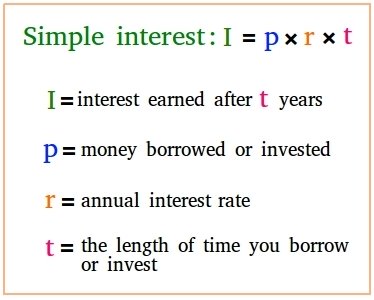
- The principal is the amount of money you borrow or invest.
- The interest rate is the percent charged for the use of money.
- The time is the duration or the time the money is invested or borrowed in years.
To find the simple interest, just multiply the principal amount by the annual interest rate and the time.
Multiplying by the percent as a whole number. Write the rate as a decimal first: 5% = 0.05. Using 5 instead of 0.05 makes the interest 100 times too big. Also make sure the time is in years: 6 months is 0.5 year.
What is the simple interest on $500 at 3% for 2 years?
Show answer
$30. I = 500 × 0.03 × 2 = 15 × 2 = 30.
What Types of Loans Use Simple Interest?
Regarding car loans, personal loans, and student loans, the lender may use simple interest to figure out how much interest they should charge you.
As a borrower, it is always a good idea to ask the lender how you will pay interest. You may save money and pay less interest if simple interest is used. However, as an investor, you will want them to use compound interest in order to earn as much money as possible.
How to Find the Simple Interest
A few exercises showing how to compute or find the simple interest.
Exercise #1: Compute the interest if the principal amount is 2000 dollars at a rate of interest of 5% for 4 years.
I = p × r × t
p = 2000, r = 5%, and t = 4
Interest = 2000 × 5% × 4
Interest = 2000 × 0.05 × 4
Interest = 100 × 4 = 400
After 4 years, the simple interest on a 2000 principal is 400 dollars.
Exercise #2: Suppose you inherited a lump sum of 2 million dollars. Compute the interest if the principal amount is 2,000,000 dollars at a rate of interest of 4% for a year.
I = p × r × t
p = 2,000,000, r = 4%, and t = 1
Interest = 2,000,000 × 4% × 1
Interest = 2,000,000 × 0.04 × 1
Interest = 80,000 × 1 = 80,000
If you have 2 million dollars and your bank pays you 4% interest every year, you will earn 80,000 dollars every year.
Great, you can perhaps quit your daytime job!
Exercise #3: Compute the interest if the principal is 100 dollars at a rate of interest of 2% for 10 years.
I = p × r × t
p = 100, r = 2%, and t = 10
Interest = 100 × 2% × 10
Interest = 100 × 0.02 × 10
Interest = 2 × 10 = 20
With so little money invested and such low interest, 10 years investment gives you a mere 20 dollars. It is hard to imagine that some banks do not even give a rate of 2%. You may for instance get an interest rate of only 0.01% on a standard savings account at Bank of America (2026). This might turn out to be a waste of time!
How to Find the Principal When the End Balance Is Known
End balance = money invested + simple interest
Let P be the money invested.
End balance = P + Prt
- Write the rate as a decimal: r = 4% = 0.04, and t = 5.
- Multiply r and t: 0.04 × 5 = 0.2.
- Add 1: 1 + 0.2 = 1.2.
- Multiply by the principal: 3,000 × 1.2 = 3,600.
Answer: the end balance is $3,600 (the $3,000 invested plus $600 interest).
Exercise #4: The end balance of an auto loan after 5 years is 38150. Find the price of the car if the annual interest rate is 1.8%.
Use r = 1.8% = 1.8/100 = 0.018
Use t = 5
End balance = P + Prt
38150 = P(1 + 0.018 × 5)
38150 = P(1 + 0.09)
38150 = P(1.09)
38150 / 1.09 = P
P = 35000
The price of the car is $35000.
The end balance of an investment after 2 years at 5% is $2,200. What was the principal?
Show answer
$2,000. 1 + 0.05 × 2 = 1.1, and 2,200 ÷ 1.1 = 2,000.
How to Find the Annual Interest Rate
Exercise #5: Find the annual percentage rate (APR) if the amount of money you invested in a company has doubled after 8 years.
Let P be the initial principal or the amount that you invested.
Then, the end balance is 2P.
End balance = P(1 + rt)
2P = P(1 + 8r)
2 = 1 + 8r
2 − 1 = 8r
1 = 8r
18 = r
r = 0.125
r = 12.5%
The APR is 12.5%.
When money doubles, the interest equals the principal: Prt = P, so rt = 1. When it triples, the interest is twice the principal, so rt = 2.
An investment doubles in 10 years with simple interest. What is the annual rate?
Show answer
10%. 2 = 1 + 10r, so 10r = 1 and r = 0.1 = 10%.
How to Find the Time When the Total Interest Is Known
Exercise #6: How long does it take to get a total interest of $5760 if the principal is $16000 and the interest rate is 3%?
Interest = Principal × Interest rate × Time
5760 = 16000 × 3% × Time
5760 = 16000 × 0.03 × Time
5760 = 480 × Time
Time = 5760 / 480
Time = 12 years
How many years does it take for $1,000 at 5% to earn $250 in simple interest?
Show answer
5 years. 1,000 × 0.05 = 50 dollars a year, and 250 ÷ 50 = 5.
Summary
- Simple interest is paid on the principal only: I = Prt.
- Write the rate as a decimal (5% = 0.05) and the time in years before you multiply.
- The end balance is the principal plus the interest: End balance = P(1 + rt).
- To find the principal, divide the end balance by 1 + rt.
- To find the rate or the time, put the numbers you know into the formula and solve for the one you don't know.
Practice: Solve 5 Simple Interest Problems
Now solve some problems yourself. Problems 1 and 2 walk you through every step. Problem 3 has fewer steps. In problems 4 and 5, you follow the key steps and find every answer yourself. You can skip a problem at any time, and each time you play you get new problems.
Practice Complete!