How to Interpret the Remainder
This lesson will show 4 ways to interpret the remainder. Depending on the division problem you are solving, the 4 ways to interpret the remainder are the following.
- Write the remainder as a fraction
- Add 1 to the quotient
- Use only the remainder (or drop the quotient)
- Drop the remainder (or use only the quotient)
In this lesson, you will learn
- how to read a word problem to decide what the remainder means
- when to write the remainder as a fraction
- when to add 1 to the quotient, use only the remainder, or drop the remainder
One Division, Four Different Answers
The same division can give different answers to different questions. The figure below uses 14 ÷ 4 = 3 r2 to show all 4 ways to interpret the remainder.
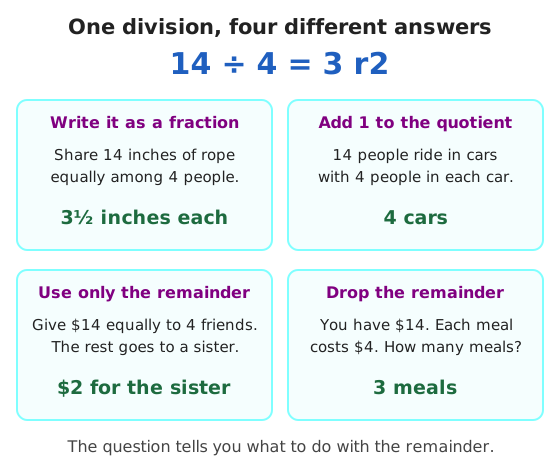
Divide first. Then read the question again to decide what to do with the remainder.
Example #1: Write the Remainder as a Fraction
Sarah has a piece of Twizzlers candy that is 16 inches long. She wants to share the whole candy with four friends so that each person has the same amount.
How long will each piece be?
Solution
Divide 16 by 5. The answer is 3 r1
The remainder, 1 inch, can be divided into 5 equal pieces: 15
The length of each piece of candy will be 315 inches.
Sarah shares the candy with four friends, so 5 people get a piece. That is why you divide by 5, not by 4.
12 inches of ribbon are shared equally by 5 people. How long is each piece?
Show answer
225 inches. 12 ÷ 5 = 2 r2, and the 2 inches left are split into 5 equal parts.
Example #2: Add 1 to the Quotient
Thirty people are going to a wedding. They want to put 4 people in each car so that people can sit comfortably. How many cars will be needed?
Solution
Divide 30 by 4. The answer is 7 r2
The answer shows that 7 cars will be needed, but 2 people still need a car.
Therefore, they will need 8 cars.
Answering 7 cars. With 7 cars, 2 people would have no ride. When everyone or everything must fit, add 1 to the quotient.
45 students go on a trip, and each bus holds 10 students. How many buses are needed?
Show answer
5 buses. 45 ÷ 10 = 4 r5. The 5 students left over need one more bus.
Example #3: Use Only the Remainder
David has 20 dollars in his pocket. He wants to give the same amount of money to 3 friends. The rest of the money, if any, will go to his sister to buy candies. How much money will go to his sister if David wants to give away everything he has?
Solution
Divide 20 by 3. The answer is 6 r2
The remainder is 2, so 2 dollars will go to his sister.
Tom has 17 marbles. He gives the same number to 5 friends, and the rest go to his brother. How many marbles does his brother get?
Show answer
2 marbles. 17 ÷ 5 = 3 r2. The question asks about what is left, so use only the remainder.
Example #4: Drop the Remainder
Darlene has 50 dollars in her pocket. She wants to buy meals for 6 best friends. If each meal costs 9 dollars, will Darlene be able to keep all her friends happy?
Solution
Divide 50 by 9. The answer is 5 r5
Darlene can only buy 5 meals. Therefore, somebody will not be happy.
- Divide first: 29 ÷ 6 = 4 r5.
- How many boxes can she fill completely? Drop the remainder: 4 full boxes.
- How many boxes does she need to pack all the cupcakes? Add 1 to the quotient: 5 boxes.
- How many cupcakes are in the box that is not full? Use only the remainder: 5 cupcakes.
One division, 29 ÷ 6 = 4 r5, gives three different answers: 4, 5 and 5.
You have 40 dollars, and each book costs 7 dollars. How many books can you buy?
Show answer
5 books. 40 ÷ 7 = 5 r5. 5 dollars are not enough for another book, so drop the remainder.
Summary
- Divide first, then read the question again to decide what the remainder means.
- Write the remainder as a fraction when you share something that can be cut, like candy or rope: 16 ÷ 5 = 315.
- Add 1 to the quotient when everyone or everything must fit, like people in cars.
- Use only the remainder when the question asks what is left over.
- Drop the remainder when only complete groups count, like meals you can pay for.
Interactive Practice: Solve 5 Remainder Word Problems
Problems 1 and 2 guide you through every step. Problem 3 has fewer, bigger steps with a hint for each. In problems 4 and 5, you divide and find the answer on your own. You can skip a problem at any time, and each time you play you get new problems.
Practice complete!