Estimate Quotients Using Multiples
When we estimate quotients using multiples, we are not looking for an exact answer. Instead, as it says, we are looking for an estimate, or a number that is close to the real answer.
In this lesson, you will learn
- how to make a table of multiples of the divisor
- how to find the two numbers a quotient is between
- how to estimate a quotient with the closest multiple
- a trick to keep the table small when the quotient is big
Examples Showing How to Estimate Quotients Using Multiples
Example #1
Find two numbers that the quotient of 50 ÷ 7 is between. Then estimate the quotient.
Step 1
Ask yourself, "What number multiplied by 7 is about 50?"
Instead of guessing, you can just make a table showing some possibilities. Keep in mind that the product of any counting number multiplied by 7 is a multiple of 7.
Therefore, the table will show multiples of 7.
Notice that we stopped at 56 since 56 is bigger than 50.
| Counting number | 1 | 2 | 3 | 4 | 5 | 6 | 7 | 8 |
|---|---|---|---|---|---|---|---|---|
| Multiples of 7 | 7 | 14 | 21 | 28 | 35 | 42 | 49 | 56 |
Step 2
Use the table to find multiples of 7 closest to 50.
7 × 7 = 49
7 × 8 = 56
50 is between 49 and 56, so the answer is either 7 or 8.
50 is closest to 49, so 50 ÷ 7 is about 7.
A multiple of 7 is the product of 7 and a counting number: 7, 14, 21, 28 and so forth.
Giving the multiples instead of the counting numbers. 50 ÷ 7 is between 7 and 8, not between 49 and 56. The multiples 49 and 56 only help you find 7 and 8.
Between which two numbers is 40 ÷ 6? Then estimate the quotient.
Show answer
Between 6 and 7, and 40 ÷ 6 is about 7. 6 × 6 = 36 and 6 × 7 = 42. 40 is between 36 and 42, and it is closest to 42.
Trick to Estimate Quotients Using Multiples When the Quotient Is Big
Example #2
Find two numbers that the quotient of 152 ÷ 6 is between. Then estimate the quotient.
Step 1
Ask yourself, "What number multiplied by 6 is about 152?"
Once again, instead of guessing, you can just make a table showing some possibilities. This time though, we need to play strategically and here is the reason why.
Notice that 6 × 10 = 60. This means that if we had made a table with just the first 10 counting numbers, we would still be very far away from 152. If we put counting numbers 1, 2, 3, 4, 5, and so forth, this will make the table way too big!
Therefore, instead of using counting numbers 1, 2, 3, 4, 5, and so forth, we should use 10, 15, 20, 25, 30, and so forth to keep the table small.
| Counting number | 10 | 15 | 20 | 25 | 30 |
|---|---|---|---|---|---|
| Multiples of 6 | 60 | 90 | 120 | 150 | 180 |
Step 2
Use the table to find multiples of 6 closest to 152.
6 × 25 = 150
6 × 30 = 180
152 is between 150 and 180, so the answer is either 25 or 30.
152 is closest to 150, so 152 ÷ 6 is about 25.
- 8 × 10 = 80 is far from 230, so use the counting numbers 10, 15, 20, 25, 30: the multiples of 8 are 80, 120, 160, 200, 240.
- 230 is between 200 and 240, so 230 ÷ 8 is between 25 and 30.
- 230 is 30 more than 200 but only 10 less than 240, so 230 is closest to 240.
230 ÷ 8 is about 30.
Estimate 118 ÷ 4 using the counting numbers 10, 15, 20, 25, 30.
Show answer
About 30. 4 × 25 = 100 and 4 × 30 = 120. 118 is between 100 and 120, and it is closest to 120.
This Figure Summarizes the Process of Estimating Quotients Using Multiples
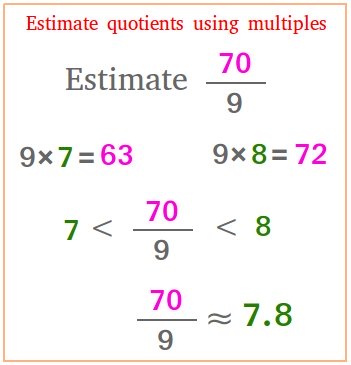
Summary
- To estimate a quotient, ask: what number multiplied by the divisor is about the number you divide?
- Make a table of multiples of the divisor. Stop when a multiple is bigger than the number.
- The two counting numbers whose multiples are just below and just above the number are the two numbers the quotient is between.
- The counting number with the closest multiple is the estimate: 50 ÷ 7 is about 7.
- When the quotient is big, use the counting numbers 10, 15, 20, 25, 30 and so forth to keep the table small.
Test Yourself: Interactive 10-Question Quiz
Now check what you learned. Every answer is explained, and each time you play you get new questions.
Quiz complete!