Divide Using Partial Quotients
Divide using partial quotients is closely related to divide using repeated subtraction.
In this lesson, you will learn
- how partial quotients make repeated subtraction faster
- how to subtract greater multiples of the divisor, such as 100 × 4 and 20 × 4
- how to add the partial quotients to find the quotient
- how to find the remainder
Examples Showing How to Divide Using Partial Quotients
In the lesson about divide using repeated subtraction, we divided 28 by 5 and we came up with the following.
| 5 | 28 | |
| −5 | 1 | |
| 23 | ||
| −5 | 1 | |
| 18 | ||
| −5 | 1 | |
| 13 | ||
| −5 | 1 | |
| 8 | ||
| −5 | 1 | |
| 3 |
Notice that 5 is subtracted five times. Subtracting 5 five times is the same as subtracting 25. Therefore, instead of subtracting 5 five times, you can just subtract 25 once.
When you do it like that, you are just subtracting greater multiples of the divisor. Notice that we call 5 a partial quotient. Although in this problem, there is only one partial quotient, you will in practice get more than 1 partial quotient as example #2 below shows.
| Partial quotients | |||
| 5 | 28 | ||
| −25 | 5 × 5 | 5 | |
| 3 |
Since 3 is less than 5, 3 is the remainder. Thus the answer is 5 r3
A partial quotient is the number of times you subtract the divisor in one step. In 5 × 5 = 25, the partial quotient is 5.
Subtracting 6 four times is the same as subtracting what number once?
Show answer
24. 4 × 6 = 24, so you can subtract 24 once, and the partial quotient is 4.
Example #2: Divide 496 by 4
Use partial quotients to divide 496 by 4
Step 1
Subtract greater multiples of the divisor. Notice that if we were using repeated subtraction, we would have to subtract 4 one hundred times! Now you see why it is good to divide using partial quotients.
Step 2
Subtract lesser multiples of the divisor.
Step 3
Add the partial quotients. All the steps are shown below.
| Partial quotients | |||
| 4 | 496 | ||
| −400 | 100 × 4 | 100 | |
| 96 | |||
| −80 | 20 × 4 | 20 | |
| 16 | |||
| −16 | 4 × 4 | 4 | |
| 0 |
After adding the partial quotients, the answer is 100 + 20 + 4 = 124
496 ÷ 4 = 124
To divide 368 by 4, you subtract 80 × 4 = 320 and then 12 × 4 = 48. What is 368 ÷ 4?
Show answer
92. Add the partial quotients: 80 + 12 = 92. Nothing is left, because 368 − 320 − 48 = 0.
Example #3: Divide 786 by 7
Use partial quotients to divide 786 by 7
| Partial quotients | |||
| 7 | 786 | ||
| −700 | 100 × 7 | 100 | |
| 86 | |||
| −70 | 10 × 7 | 10 | |
| 16 | |||
| −14 | 2 × 7 | 2 | |
| 2 |
After adding the partial quotients, we get 100 + 10 + 2 = 112
We also have a leftover or a remainder of 2.
Therefore, using partial quotients, 786 divided by 7 is 112 r2
The meaning of 112 r2 is a quotient of 112 with a remainder of 2.
Subtracting a multiple that is too big. For 786 ÷ 7, 200 × 7 = 1,400 is more than 786, so you cannot use it. Use 100 × 7 = 700 instead.
- Subtract a greater multiple: 100 × 5 = 500, and 573 − 500 = 73.
- Subtract a lesser multiple: 10 × 5 = 50, and 73 − 50 = 23.
- Subtract again: 4 × 5 = 20, and 23 − 20 = 3. 3 is less than 5, so 3 is the remainder.
- Add the partial quotients: 100 + 10 + 4 = 114.
| Partial quotients | |||
| 5 | 573 | ||
| −500 | 100 × 5 | 100 | |
| 73 | |||
| −50 | 10 × 5 | 10 | |
| 23 | |||
| −20 | 4 × 5 | 4 | |
| 3 |
573 ÷ 5 = 114 r3
Need More Help? Study This Figure
Did you find the examples above tough to understand? Did you not understand them at all? Please take a look at this figure!
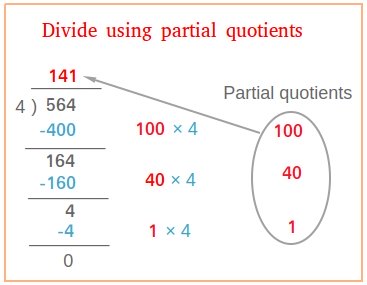
You can check your answer: quotient × divisor + remainder = the number you divided. For the figure, 141 × 4 + 0 = 564.
Summary
- Partial quotients make repeated subtraction faster: instead of subtracting the divisor many times, subtract a multiple of it once.
- Start with greater multiples of the divisor, such as 100 × 4, then use lesser multiples.
- Stop when the number left is less than the divisor. That number is the remainder.
- Add the partial quotients to get the quotient: 100 + 20 + 4 = 124.
Interactive Practice: Solve 3 Partial Quotients Problems
Problem 1 guides you through every step. Problem 2 has fewer, bigger steps with a hint for each. In problem 3, you choose your own partial quotients and find the answer on your own. You can skip a problem at any time, and each time you play you get new problems.
Practice complete!
Interactive Partial Quotients Grid: Try Your Own Problem
Type a number from 10 to 9999 and a divisor from 2 to 99. In each row, choose a partial quotient, multiply it by the divisor and subtract. Stop when the number left is less than the divisor, then type the quotient and the remainder.