Divide Using Repeated Subtraction
Divide using repeated subtraction is what this lesson will teach you. We will show you how to do some divisions with some really good examples.
In this lesson, you will learn
- how to divide by subtracting the divisor again and again
- when to stop subtracting
- how to find the quotient and the remainder
- what an answer such as 5 r3 means
Interesting Examples Showing How to Divide Using Repeated Subtraction
Example #1: Divide 28 by 5
Write
| 5 | 28 |
Step 1
What you need to do here is to subtract the divisor until the remainder is less than the divisor or 5. Record a 1 each time you subtract. In our example, the divisor is 5, so you will subtract 5. Note that the 1 shown in red keeps track of the number of times you need to subtract 5.
| 5 | 28 | |
| −5 | 1 | |
| 23 | ||
| −5 | 1 | |
| 18 | ||
| −5 | 1 | |
| 13 | ||
| −5 | 1 | |
| 8 | ||
| −5 | 1 | |
| 3 |
Since 3 is smaller than 5, we can stop subtracting.
Step 2
Count the number of times you subtracted the divisor or 5. Above you can see that there are 5 ones.
Therefore, 5 is subtracted 5 times and the number that is left is 3.
Therefore, 28 ÷ 5 = 5 r3
The meaning of 5 r3 is a quotient of 5 with remainder of 3.
The quotient is the number of times you subtracted the divisor. The remainder is the number left at the end.
Divide 17 by 4 using repeated subtraction.
Show answer
17 ÷ 4 = 4 r1. 17 − 4 = 13, 13 − 4 = 9, 9 − 4 = 5, 5 − 4 = 1. You subtracted 4 times, and 1 is left.
Example #2: Divide 380 by 62
Write
| 62 | 380 |
Step 1
Subtract the divisor until the remainder is less than the divisor or 62. Record a 1 each time you subtract. In our example, the divisor is 62, so you need to subtract 62. Notice again that the 1 keeps track of the number of times you subtract 62.
| 62 | 380 | |
| −62 | 1 | |
| 318 | ||
| −62 | 1 | |
| 256 | ||
| −62 | 1 | |
| 194 | ||
| −62 | 1 | |
| 132 | ||
| −62 | 1 | |
| 70 | ||
| −62 | 1 | |
| 8 |
8 is smaller than 62, so we stop subtracting.
Step 2
Count the number of times you subtracted the divisor or 62. Above you can see that there are 6 ones.
Therefore, 62 is subtracted 6 times with 8 left.
Therefore, 380 ÷ 62 = 6 r8
Again, the meaning of 6 r8 is a quotient of 6 with remainder of 8.
Stopping too early. In example 2, 70 is still bigger than 62, so you must subtract one more time: 70 − 62 = 8. Stop only when the number left is smaller than the divisor.
- Subtract 12 and record a 1 each time: 50 − 12 = 38, 38 − 12 = 26, 26 − 12 = 14, 14 − 12 = 2.
- 2 is smaller than 12, so stop subtracting.
- Count the 1s: you subtracted 12 four times, and 2 is left.
| 12 | 50 | |
| −12 | 1 | |
| 38 | ||
| −12 | 1 | |
| 26 | ||
| −12 | 1 | |
| 14 | ||
| −12 | 1 | |
| 2 |
50 ÷ 12 = 4 r2
Subtracting 9 from 40 again and again gives 31, 22, 13 and 4. What is 40 ÷ 9?
Show answer
40 ÷ 9 = 4 r4. You subtracted 9 four times, and 4 is left. 4 is smaller than 9, so you stop.
Need More Help? Study This Figure
Did you have a hard time understanding the examples above? Did you not get it at all? Do you need to understand it a little deeper? Then, take a look at this figure below and study it carefully!
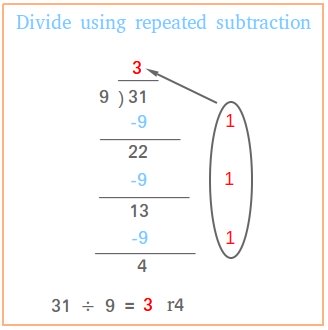
You can check your answer: quotient × divisor + remainder = the number you divided. For the figure, 3 × 9 + 4 = 31.
Summary
- To divide using repeated subtraction, subtract the divisor again and again.
- Record a 1 each time you subtract.
- Stop when the number left is smaller than the divisor.
- The number of 1s is the quotient, and the number left is the remainder: 28 ÷ 5 = 5 r3.
Interactive Practice: Solve 3 Repeated Subtraction Problems
Problem 1 guides you through every step. Problem 2 has fewer, bigger steps with a hint for each. In problem 3, you do the subtractions and find the answer on your own. You can skip a problem at any time, and each time you play you get new problems.
Practice complete!
Interactive Subtraction Grid: Try Your Own Problem
Type a number from 1 to 999 and a divisor from 2 to 99. The divisor must go into the number at most 12 times. Subtract until the number left is smaller than the divisor, then type the quotient and the remainder.