Inertia: Definition and Examples
Inertia is the tendency of an object to keep doing what it is already doing: an object at rest stays at rest, and a moving object keeps moving at the same speed in a straight line, unless a force acts on it.
In this lesson, you will learn
- what Newton's first law of motion, the law of inertia, says
- how Galileo's experiments with a rolling ball changed Aristotle's idea of motion
- how to spot inertia in everyday life, from seat belts to icy roads
Newton's First Law of Motion: The Law of Inertia
Isaac Newton is the one who formulated a great definition of inertia. His first law of motion, also known as the law of inertia, restated Galileo's idea. The spinning top in the video would keep spinning if there were no friction.
Below is what Newton said in simple terms:
If an object is already moving, it will keep moving in a straight line at constant speed unless a force acts on it.
If an object is at rest, it will remain at rest unless a force moves it.
In other words, Newton is saying that an object will keep its uniform motion if no force acts on it, and it will not start moving unless some external force makes it move.
A hockey puck slides across perfectly smooth ice with no friction. What happens to its motion?
Show answer
It keeps sliding in a straight line at the same speed. No force acts on it to slow it down or turn it.
Why Inertia Was an Important Discovery: Aristotle's View
This was an important discovery because Aristotle believed that if an object keeps moving, then some force is being applied to it.
Aristotle did not say that an object can start moving on its own. He believed that force must be applied to get something to move.
However, he also believed that as soon as this force is removed, the object will seek its natural state, which is rest.
This view of motion was accepted for about 2,000 years until Galileo challenged it with an experiment.
Thinking, like Aristotle, that a moving object stops because its "push runs out". A rolling ball stops because a force, friction, slows it down. Without friction, it would keep rolling.
Galileo's Experiments on Inertia
Galileo used the two planes you see below. Then, he rolled a ball down the incline. He noticed that the ball would continue to move until it reached almost the same height on the other side. The less friction there is on the plane, or the smoother the plane is, the closer the ball comes to reaching the same height.
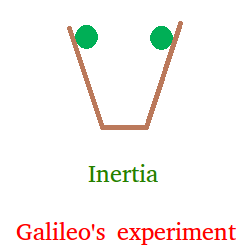
This is interesting because when the ball reaches the bottom of the incline, the slope ends, so gravity no longer pulls the ball forward. Yet the ball keeps moving.
The ball thus kept its natural state of motion.
The second experiment is similar to the first one except that the other plane is longer and the plane is inclined at a smaller angle.
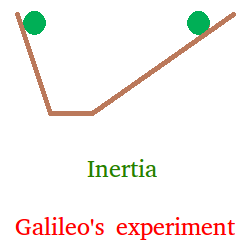
The ball still nearly reached the same height, but this time traveled a longer distance.
What if the other plane was completely horizontal?
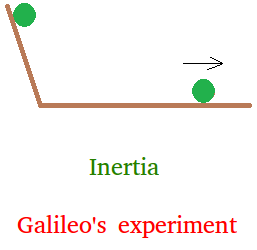
Again, in the absence of external forces such as friction or air resistance, the ball will keep rolling with a constant speed.
The ball will not come to rest as Aristotle said.
Try Galileo's experiment yourself
Press Release the ball. Watch how high it climbs on the other side.
- In both experiments, the ball rolls up the other plane until it gets back to nearly its starting height.
- The gentler the slope, the farther the ball has to travel to get back to that height.
- A horizontal plane never rises, so the ball never reaches its starting height.
- With no friction to slow it down, nothing stops the ball.
The ball keeps rolling forever at a constant speed. That is inertia.
In Galileo's experiment, what makes the ball stop a little below its starting height on a real ramp?
Show answer
Friction. On a smoother plane, the ball gets closer to its starting height.
Examples of Inertia in Real Life
- A great example of inertia is when somebody is not wearing a seat belt while driving. The car collides with a tree and the person flies forward. The body was just trying to keep the same speed it had before impact. Now you know why you should always put on your seat belt. Inertia could kill you!
- A soccer ball keeps moving after it has been kicked.
- A sofa is not moving because no one is pushing it with a force.
- A car continues to move on an icy road even after you applied the brake.
- A shopping cart is not moving because no one is pushing it.
The more mass an object has, the more inertia it has. That is why a loaded truck is much harder to start or stop than a bicycle.
A bus starts moving suddenly. Why do standing passengers lean backward?
Show answer
Inertia. Their bodies were at rest and tend to stay at rest while the bus moves forward under them.
A Solid Definition of Inertia
In the absence of forces or friction, an object already in motion will keep moving indefinitely, in a straight line at constant speed.
An object at rest remains at rest unless a force is applied to the object.
If you are taking a physics class, your teacher may use an air table to demonstrate inertia to you and your classmates. An air table has many tiny holes that blast air out. It does not remove friction completely, but it reduces it tremendously.
Summary
- Inertia is the tendency of an object to keep its state of rest or motion.
- Newton's first law, the law of inertia: an object at rest stays at rest, and a moving object keeps moving in a straight line at constant speed, unless a force acts on it.
- Aristotle believed a force was needed to keep things moving. Galileo's rolling-ball experiments showed that friction is what stops them.
- Seat belts, icy roads and kicked balls are everyday examples of inertia.
- The more mass an object has, the more inertia it has.
Test Yourself: 10-Question Quiz
Now check what you learned. Every answer is explained, and each time you play you get new questions.