Definition of Mass
The definition of mass can be quickly understood with concrete examples. In a nutshell, mass is a measure of inertia.
In this lesson, you will learn
- why mass is a measure of inertia
- why mass is not the same as weight or volume
- a second definition: mass is the amount of matter in an object
- what 1 kilogram is, and how it relates to 1 liter of water
Mass Is a Measure of Inertia
Mass is a measure of inertia: the more mass an object has, the harder it is to start it moving, stop it, or change its motion.
Get a bucket and fill the bucket with Q-tips. Get another bucket the exact same size as the other one and fill it with steel nails.
Kick both buckets with the same force and tell me which bucket moved farther.
The bucket filled with Q-tips moved farther, of course.
We say that the bucket filled with nails has a greater inertia.
In other words, the bucket filled with nails has a greater tendency to remain at rest.
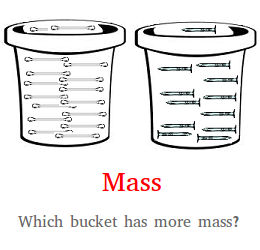
This makes sense since the bucket with steel nails has a bigger mass.
In the same fashion, which one would you prefer to kick?
A soccer ball or a stone sphere the same size as the soccer ball?
Actually, don't try to kick the stone sphere. You may hurt yourself.
It is obvious though, even if you never kick the stone sphere, that you will be able to move the soccer ball more easily with a kick.
Again, the stone sphere has a greater inertia.
Two boxes are the same size. One is full of books, and one is full of pillows. You push both with the same force. Which one has more inertia?
Show answer
The box of books. It has more mass, so it is harder to get moving.
Mass Is Not the Same as Weight or Volume
Notice that I did not say the stone sphere is heavier than the soccer ball. Mass is not the same as weight.
When you think of the mass of an object, don't think of heaviness. Think of how easy it is to move this object.
Weight is the force of gravity pulling on an object, so it changes from place to place. Mass does not. An astronaut on the Moon weighs about one sixth of what she weighs on Earth, but her mass is exactly the same.
Mass is not the same as volume either. An object may have a large mass yet have a small volume.
Fill a small bag with sand. Fill a bigger bag with cotton candy.
The bigger bag will have a greater volume. However, it may be easier to drag the bag filled with cotton candy.
Thinking that a bigger object always has more mass. Size is volume, not mass: a small bag of sand can have more mass than a big bag of cotton candy.
An astronaut has a mass of 70 kg on Earth. What is her mass on the Moon?
Show answer
70 kg. Mass does not depend on gravity. Only her weight changes on the Moon.
Another Definition of Mass: The Amount of Matter
Mass is a measure of the amount of matter inside an object.
An object can be quite small yet have a lot of matter inside of it.
A bar of gold, for instance, may be quite small and yet have a mass of 2 kilograms (kg).
What Is 1 Kilogram?
Talking about kilograms, what is 1 kilogram?
One kilogram is about the mass of 1 liter of water in its densest state. This is how the kilogram was first defined.
Water is in its densest state when the temperature is close to 4 degrees Celsius.
The following cube will be able to hold 1 liter of water.
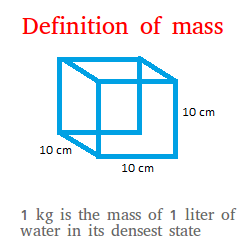
Volume of the cube
Volume = 10 × 10 × 10 = 1,000 cm3
In math, 1 liter = 1,000 cm3
In the English system, 1 kg is about 2.2 pounds. Therefore, if you could reproduce the experiment above, you would find out that the mass of the water in the cube is about 1 kg, or about 2.2 pounds.
- Each liter of water has a mass of about 1 kg, so 3 liters have a mass of about 3 kg.
- Each kilogram is about 2.2 pounds, so 3 kg is about 3 × 2.2 = 6.6 pounds.
The water has a mass of about 3 kg, or about 6.6 pounds.
A fish tank holds 20 liters of water. About how much mass does the water have?
Show answer
About 20 kg. Each liter of water has a mass of about 1 kg.
Summary
- Mass is a measure of inertia: more mass means an object is harder to start, stop or move.
- Mass is also a measure of the amount of matter inside an object.
- Mass is not weight (the pull of gravity) and not volume (how much space an object takes up).
- 1 kilogram is about the mass of 1 liter of water at about 4 °C, and 1 kg is about 2.2 pounds.
- A cube with 10 cm edges has a volume of 1,000 cm3, which is 1 liter.
Test Yourself: 10-Question Quiz
Now check what you learned. Every answer is explained, and each time you play you get new questions.