Domain of a Function
In this lesson, you will learn
- what the domain of a function is
- what a restricted domain is
- which values must be excluded from a domain: zero denominators and square roots of negative numbers
- how to write a domain in interval notation
What Is the Domain of a Function?
Basically, the domain of a function is the set of the first coordinates (x-coordinates) of a set of ordered pairs or relation.
An ordered pair is a pair of numbers inside parentheses such as (5, 6). Generally speaking you can write an ordered pair as (x, y).
x is called x-coordinate, x-value or independent variable and y is called y-coordinate, y-value, or dependent variable. If you have more than one ordered pair, you name this situation set of ordered pairs or relation.
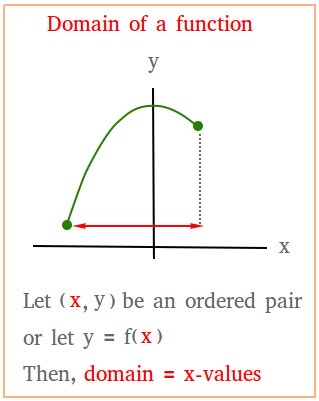
For example, take a look at the following relation or set of ordered pairs: (1, 2), (2, 4), (3, 6), (4, 8), (5, 10), (6, 12), (7, 14)
The domain is 1, 2, 3, 4, 5, 6, 7. We will not focus on the range too much here. This lesson is about the domain of a function. However, the range of a relation is the set of the second coordinates or 2, 4, 6, 8, 10, 12, 14.
What is the domain of the relation (−2, 5), (0, 1), (3, 5)?
Show answer
−2, 0, 3. The domain is the set of first coordinates.
A Concrete Example About the Domain of a Function
Let's say you have a business (selling books) and your business follows the following model:
- You sell 3 books and make 12 dollars. The ordered pair is (3, 12)
- You sell 4 books and make 16 dollars. The ordered pair is (4, 16)
- You sell 5 books and make 20 dollars. The ordered pair is (5, 20)
- You sell 6 books and make 24 dollars. The ordered pair is (6, 24)
The domain is the set of all inputs, x-values or x-coordinates of the ordered pairs.
Thus, the domain of your business is 3, 4, 5, and 6 since these are the inputs or x-coordinates.
Pretend now that you can sell unlimited books (3, 4, 5, 6, 7, …). Your domain in this case will be all whole numbers.
You may then need a more convenient way to represent your business situation.
A close observation at your business model and you will be able to see that the y-coordinate equals x-coordinate × 4.
The formula for your business showing the relationship between the number of books sold and how much money you make is y = 4x or f(x) = 4x.
You can also write this situation as an ordered pair or (x, 4x). In this case, the domain is x and x represents all whole numbers or your entire domain for this situation.
In reality, it makes more sense for you to sell unlimited books.
When the domain is only 3, 4, 5, and 6, we call this type of domain restricted domain, since you restrict yourself only to a portion of your entire domain.
With f(x) = 4x, how much money do you make if you sell 9 books?
Show answer
36 dollars. f(9) = 4 × 9 = 36, so (9, 36) is an ordered pair of your business.
Excluded Values of a Domain
In some cases, some value(s) must be excluded from your domain in order for things to make sense. Consider for instance all integers and their inverses as shown below with ordered pairs.
…, (−4, 1−4), (−3, 1−3), (−2, 1−2), (−1, 1−1), (0, 10), (1, 11), (2, 12), (3, 13), (4, 14), …
One of these domain values will not make sense. Do you know which one?
The domain value that does not make sense is 0! If the domain is 0, then 10 does not make sense since 10 is not defined or has no answer.
Instead of writing all these ordered pairs, you could just write (x, 1x) and say that the domain of definition is x such that x is not equal to 0.
Notice that in function notation, (x, 1x) is f(x) = 1x.
In general, the domain of definition of any rational expression is any number except those that will make the denominator equal to 0.
Setting the numerator equal to 0. A numerator of 0 is fine: 05 = 0. Only a denominator of 0 must be excluded.
Which value must be excluded from the domain of f(x) = 2x + 3?
Show answer
x = −3. The denominator x + 3 equals 0 when x = −3.
How to Write the Domain of a Function
The proper way to write the domain of a function is to use interval notation whenever it is possible to do so. An interval has endpoints, a comma, and either parentheses, brackets, or a combination of parentheses and brackets.
We saw in the previous section that 1x accepts any value except x = 0. This means all real numbers except zero.
In interval notation, the domain of the function f(x) = 1x is (−∞, 0) ∪ (0, +∞).
When the endpoints are not included in the domain, just use parentheses. Since negative infinity, zero, and positive infinity are not included in the domain of f(x) = 1x, we use parentheses.
On the other hand, when numbers are included in the domain, you can use brackets or [ ] to show this.
How do you write "all numbers greater than or equal to 2" in interval notation?
Show answer
[2, +∞). 2 is included, so it gets a bracket; infinity always gets a parenthesis.
More Examples Showing How to Find the Domain of a Function
Example #1: What is the domain of 6x + 7x − 5?
The denominator equals 0 when x − 5 = 0 or x = 5.
The domain for this rational expression is any number except 5 or (−∞, 5) ∪ (5, +∞).
Example #2: What is the domain of −x + 5x2 + 4?
The denominator equals 0 when x2 + 4 = 0.
However, x2 + 4 is never equal to 0. Why? Because x2 is never negative no matter what number you replace x with, so x2 + 4 is at least 4.
42 = 16 and 16 is positive. 16 + 4 is still positive.
(−5)2 = 25 and 25 is positive. 25 + 4 is still positive.
The domain is any real number or (−∞, +∞).
Example #3: What if the denominator of example #2 is x2 − 4?
If you change the denominator of example #2 to x2 − 4, the denominator will be 0 for some numbers.
x2 − 4 = 0 when x = −2 and x = 2.
22 − 4 = 2 × 2 − 4 = 4 − 4 = 0
(−2)2 − 4 = (−2) × (−2) − 4 = 4 − 4 = 0
The domain will be in this case the set of all real numbers except 2 and −2, or (−∞, −2) ∪ (−2, 2) ∪ (2, +∞).
Example #4: Integers and their square roots
Consider now all integers and their square roots as shown below with ordered pairs.
…, (−4, √−4), (−3, √−3), (−2, √−2), (−1, √−1), (0, √0), (1, √1), (2, √2), (3, √3), (4, √4), …
Many of these domain values will not make sense. Do you know which ones?
They are −4, −3, −2, and −1. For any of these domain values, you are taking the square root of a negative number, which does not exist. At least it does not exist for real numbers. It does exist for complex numbers, but this is a completely different story that we will not consider here.
Our assumption here is that we are only working with real numbers to look for the domain of a function and the square root does not exist for real numbers that are negative!
Instead of writing all these ordered pairs, you could just write (x, √x) and say that the domain of definition is x such that x is greater than or equal to 0.
Example #5: What is the domain of √x − 5?
When you deal with square roots, the number under the square root sign is called a radicand.
√x − 5 is defined when the radicand x − 5 is greater than or equal to 0.
x − 5 ≥ 0
x − 5 + 5 ≥ 0 + 5
x ≥ 5
The domain of definition is at least 5 or any number greater than or equal to 5. In interval notation, the domain of √x − 5 is [5, +∞).
The endpoint 5 is included so we use a bracket to show this.
- A rational expression: exclude the numbers that make the denominator 0.
- Solve 2x − 8 = 0: 2x = 8, so x = 4.
- Every other real number works, so write all real numbers except 4.
Domain: (−∞, 4) ∪ (4, +∞)
Using a parenthesis at an endpoint that is included. For √x − 5, x = 5 gives √0 = 0, so 5 is in the domain and the interval starts with a bracket: [5, +∞).
What is the domain of √x + 2?
Show answer
[−2, +∞). The radicand x + 2 must be greater than or equal to 0, so x ≥ −2.
As you can see here, the domain of a function does not always make sense for some value(s). It is your job to find these values when you look for the domain of a function.
Summary
- The domain of a function is the set of first coordinates (x-values, inputs) of its ordered pairs.
- A restricted domain uses only part of the entire domain, such as selling only 3, 4, 5 or 6 books.
- For a rational expression, exclude every number that makes the denominator equal to 0.
- For a square root, the radicand must be greater than or equal to 0 (real numbers only).
- Write the domain in interval notation: parentheses for endpoints that are not included (and for ∞), brackets for endpoints that are included.
Test Yourself: Interactive 10-Question Quiz
Now check what you learned. Every answer is explained, and each time you play you get new questions.
Quiz Complete! 🎉