Range of a Function
In this lesson, you will learn
- what the range of a function is
- how a list of ordered pairs helps you find the range
- how adding or subtracting a number moves the range of x2
- the range of f(x) = x, x3 and 1x
What Is the Range of a Function?
The range of a function is the set of all possible outputs of the function.
When looking for the range, it may help to make a list of some ordered pairs for the function.
The ordered pairs of a function are (1, 5), (2, 7) and (3, 5). What is the range?
Show answer
{ 5, 7 }. The range is the set of outputs (second coordinates); 5 is written once.
The Range of x2, x2 + 3 and x2 − 3
Example #1: What is the range of f(x) = x2?
Pick { −4, −3, −2, −1, 0, 1, 2, 3, 4 } as your domain. The ordered pairs are
(−4, 16), (−3, 9), (−2, 4), (−1, 1), (0, 0), (1, 1), (2, 4), (3, 9), (4, 16)
Range = { 0, 1, 4, 9, 16 }
Notice that whether the number in the domain is positive or negative, the number in the range will never be negative: it is positive, or 0 when x = 0.
The range { 0, 1, 4, 9, 16 } comes from the 9 numbers we picked. If the domain is all real numbers, x2 can be 0 or any positive number, so the range of f(x) = x2 is [0, +∞).
Example #2: Trick when looking for the range of a function. What is the range of f(x) = x2 + 3?
All we are doing here is adding 3 to the function of example #1. The only thing you need to notice is that when x = 0, f(0) = 3. So unlike the first example, the range does not start at 0 but at 3. For any other numbers in the domain, the numbers in the range will be positive and bigger than 3.
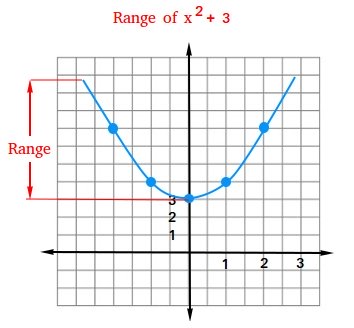
Example #3: Another trick when looking for the range of a function. What is the range of f(x) = x2 − 3?
This is the same as example #2, except that we start at −3 instead of 3.
Saying the range of x2 + 3 starts at 0. The smallest value of x2 is 0, so the smallest value of x2 + 3 is 0 + 3 = 3.
- The smallest value of x2 is 0, when x = 0.
- So the smallest value of f(x) is f(0) = 0 + 5 = 5.
- Every other x gives a positive x2, so f(x) is bigger than 5. For example, f(2) = 9.
The range is all numbers greater than or equal to 5: [5, +∞).
What is the smallest number in the range of f(x) = x2 − 7?
Show answer
−7. f(0) = 0 − 7 = −7, and every other x gives a bigger value.
More Problems About the Range of a Function
Example #4: What is the range of f(x) = x?
The domain can be any real number. Since the numbers in the range are equal to the numbers in the domain, the range can be any real number as well.
Example #5: What is the range of f(x) = x3?
Pick { −4, −3, −2, −1, 0, 1, 2, 3, 4 } as your domain. The ordered pairs are
(−4, −64), (−3, −27), (−2, −8), (−1, −1), (0, 0), (1, 1), (2, 8), (3, 27), (4, 64)
Range = { −64, −27, −8, −1, 0, 1, 8, 27, 64 }
Notice that when the numbers in the domain are positive, the numbers in the range are positive. Moreover, when the numbers in the domain are negative, the numbers in the range are negative as well.
Can f(x) = x3 give an output of −1,000?
Show answer
Yes. f(−10) = (−10)3 = −1,000. Unlike x2, x3 can be negative.
Example #6 Is a Tricky Range of a Function Problem!
Example #6: What is the range of f(x) = 1x?
Notice that we can choose any number in the domain except 0.
However, we can pick any number as close as possible to 0, or the number can be very big.
Suppose the numbers in the domain are positive. What happens when the numbers in the domain are closer and closer to 0 such as when x = 0.00001 or x = 0.0000001?
10.00001 = 100,000
10.0000001 = 10,000,000
The numbers in the range will get bigger and bigger.
What happens when the numbers in the domain are very big such as 100,000 or 100,000,000?
1100,000 = 0.00001
1100,000,000 = 0.00000001
The numbers in the range will get smaller and smaller, but they will never be zero.
So far, when the domain is positive, the range is f(x) > 0.
Similar logic can be used when the numbers in the domain are negative. What happens when x is closer and closer to 0 such as when x = −0.00001 or x = −0.0000001? We get
1−0.00001 = −100,000
1−0.0000001 = −10,000,000
On the other hand, what happens when x is farther and farther away from 0 such as when x = −100,000 or x = −100,000,000?
1−100,000 = −0.00001
1−100,000,000 = −0.00000001
The range will be negative or f(x) < 0.
Putting both parts together, the range of f(x) = 1x is all real numbers except 0: (−∞, 0) ∪ (0, +∞).
Is 0 in the range of f(x) = 1x?
Show answer
No. A fraction with numerator 1 is never 0, however big x is.
Summary
- The range of a function is the set of all possible outputs.
- A list of ordered pairs helps you see which outputs are possible.
- x2 is never negative, so the range of x2 + k starts at k: [k, +∞).
- The range of f(x) = x and of f(x) = x3 is all real numbers.
- The range of f(x) = 1x is all real numbers except 0.
Test Yourself: Interactive 10-Question Quiz
Now check what you learned. Every answer is explained, and each time you play you get new questions.
Quiz Complete! 🎉