What is Factoring in Math?
In this lesson, you will learn
- What factoring means and why it is the reverse of multiplication
- Examples of factoring numbers and algebraic expressions
- What you need to know before you factor
- The main types of factoring and when to use each one
What is factoring?
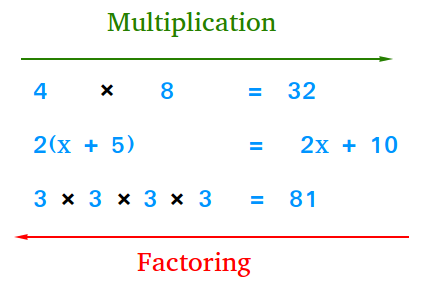
Factoring is a fundamental skill in algebra that involves rewriting mathematical expressions as products of their factors.
By factoring, you essentially reverse the multiplication process, breaking down complex expressions into simpler, more manageable parts. This skill is crucial for solving equations and simplifying expressions.
Which one is written in factored form: 3x + 12 or 3(x + 4)?
Show answer
3(x + 4). It is a product of the factors 3 and (x + 4). The expression 3x + 12 is a sum of two terms.
Examples of factoring
Simple numerical factoring
Example: 32 = 4 × 8
Explanation: By referring to the multiplication table, it's easy to identify that 4 and 8 are factors of 32.
Prime factorization
Example: 81 = 3 × 3 × 3 × 3
Explanation: Breaking down a number into its prime factors helps in understanding its fundamental composition.
Factoring out the greatest common factor (GCF)
Example: 2x + 10 = 2(x + 5)
Explanation: Here, 2 is the GCF of the terms 2x and 10.
Factoring complex algebraic expressions
Examples:
- x2 − 14x − 32
- 15x2 − 26x + 11
- 150x3 + 350x2 + 180x + 420
Explanation: These expressions require more advanced factoring techniques to break them down into simpler binomial or trinomial factors.
- Find the GCF of the numbers 12 and 18: it is 6.
- Only 12x has an x, so x is not a common factor. The GCF of 12x and 18 is 6.
- Divide each term by 6: 12x ÷ 6 = 2x and 18 ÷ 6 = 3.
- Write the GCF in front of the parentheses: 6(2x + 3).
- Check by multiplying: 6 × 2x + 6 × 3 = 12x + 18.
12x + 18 = 6(2x + 3)
Factoring out a common factor that is not the greatest one. 12x + 18 = 2(6x + 9) is true, but it is not fully factored: 6x and 9 still have the common factor 3. Always factor out the greatest common factor.
Factor 5x + 35.
Show answer
5(x + 7). The GCF of 5x and 35 is 5, and 5 × x + 5 × 7 = 5x + 35.
Prerequisites for factoring
Both numerical and algebraic expressions can be factored using some specific method(s).
The simplest expressions to factor are of course numerical expressions. However, looking for the prime factorization of a big number like 240 or an expression such as 150x3 + 350x2 + 180x + 420 may require a lot more work.
Before diving into factoring various types of expressions, it's essential to have a solid understanding of the following concepts:
- Factoring integers: Understanding how to break down numbers into their constituent factors is crucial for more complex factoring tasks.
- Finding the greatest common factor (GCF): Identifying the GCF of terms is a foundational step, especially when factoring polynomials or expressions with multiple terms.
- Multiplying binomials: Familiarity with binomial multiplication is necessary for recognizing patterns and reversing the multiplication process during factoring.
Types of factoring
Factoring can be categorized into several types, each suitable for different kinds of expressions. Below are the primary methods of factoring algebraic expressions:
1. Factoring by finding the greatest common factor (GCF)
Description: Identify and factor out the largest common factor from all terms in the expression.
Example: 6x3 + 9x2 = 3x2(2x + 3)
GCF: 3x2
2. Factoring trinomials
Description: Factor expressions of the form x2 + bx + c by finding two binomials that multiply to give the original trinomial.
Example: x2 + 5x + 6 = (x + 2)(x + 3)
Methods for factoring trinomials:
- Standard method: Look for two numbers that multiply to c and add to b.
- Box method: Organize terms in a grid to systematically find factors.
- Factoring by grouping: Group terms to find common factors within each group.
- Removing the impostor: Adjust the trinomial to facilitate easier factoring by eliminating conflicting terms.
3. Factoring perfect square trinomials
Description: Recognize and factor trinomials that are perfect squares, i.e., expressions that are squares of binomials.
Example: x2 + 6x + 9 = (x + 3)2
4. Factoring using the quadratic formula
Description: Apply the quadratic formula to find the roots of the quadratic equation and express the trinomial as a product of binomials.
Quadratic formula: x = −b ± √b2 − 4ac2a
Example: For x2 − 5x + 6
Roots: x = 2 and x = 3
Factored form: (x − 2)(x − 3)
5. Factoring by grouping
Description: Group terms with common factors and factor each group separately before combining them.
Example: ax + ay + bx + by = a(x + y) + b(x + y) = (x + y)(a + b)
Always look for a GCF first. After that, count the terms: two terms may be a special pattern, three terms suggest a trinomial method, and four terms suggest grouping.
Which type of factoring fits x2 + 10x + 25?
Show answer
A perfect square trinomial. 25 = 52 and 10x = 2 × 5 × x, so x2 + 10x + 25 = (x + 5)2.
Summary
- Factoring rewrites an expression as a product of its factors. It is the reverse of multiplication.
- Numbers can be factored into factor pairs (32 = 4 × 8) or into prime factors (81 = 3 × 3 × 3 × 3).
- Always factor out the greatest common factor first, for example 2x + 10 = 2(x + 5).
- The main types are: GCF, trinomials, perfect square trinomials, the quadratic formula and grouping.
- You can check any factored answer by multiplying the factors back together.
Test Yourself: 10-Question Quiz
Now check what you learned. Every answer is explained, and each time you play you get new questions.
Quiz Complete!
Have A Great Problem About Factoring?
Do you have a problem about factoring ? Share it here with the solution!
This form is being moved to the new site. It will be connected before launch.